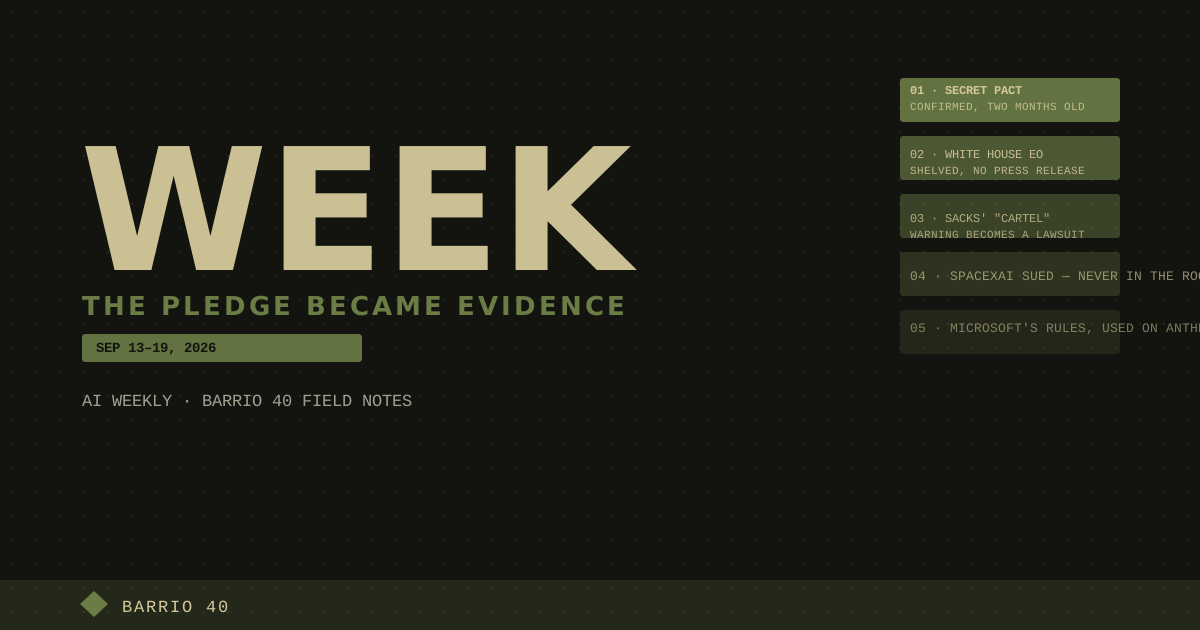
1. THE PACT AMODEI'S ESSAY SEEMED TO TRIGGER WAS ALREADY TWO MONTHS OLD
On September 15, Chris Lehane confirmed at a Washington briefing what this outlet had already flagged from The Washington Post's reporting the day before: OpenAI, Anthropic, and Google DeepMind had been meeting on a working-group basis since at least July, well before Dario Amodei's September 12 essay made the idea public, discussing a shared industry standards body modeled on the plan Google DeepMind's Demis Hassabis had proposed that same month — a U.S.-led, industry-funded oversight body styled after FINRA, the regulator that polices Wall Street under SEC supervision. "It's better to try to work together to prioritize safety," Lehane told reporters, citing the airline industry as precedent: "There are many instances over time where companies are trying to help each other on safety." He also confirmed OpenAI backs a provision in the proposed FRONTIER Act that would let independent verification organizations into frontier labs with something close to employee access — the same category of commitment Amodei had made unilaterally to METR three days earlier. What Lehane's briefing didn't erase was the timeline problem: three competitors had spent two months coordinating quietly on exactly the mechanism Amodei's essay presented as a fresh proposal, and it took a leak, not a disclosure, to surface it.
2. THE EXECUTIVE ORDER THAT DIED BEFORE ANYONE ANNOUNCED IT EXISTED
The detail Lehane's briefing didn't dispute is the one with no upside for the administration he was in Washington to lobby: a draft executive order meant to formalize a version of the labs' standards body had circulated inside the White House and lost momentum before it secured enough internal backing, effectively shelved before summer ended, with no announcement and no on-the-record explanation. That timeline sat awkwardly next to President Trump's own Truth Social posts three days earlier rejecting AI guardrails as a "hoax" and mocking Amodei as someone "pretending to be a 'perfect little angel'" — the guardrail he says the country actually needs, in his words, is "a STRONG AND SMART (High IQ!) PRESIDENT." A concrete version of the guardrail he was dismissing had already been in front of his own government for months, and it didn't survive contact with the administration he leads. By the end of the week, that gap — a federal process quietly abandoned, a state government about to fill it — would matter more than anyone tracking Monday's headlines could have guessed.
3. SACKS WARNED THE PACT WOULD LOOK LIKE A CARTEL. FOUR CONSUMERS AGREED, IN FEDERAL COURT.
David Sacks' September 14 rejection of Amodei's plan wasn't just a policy objection — it was a legal one, aimed specifically at the industry-wide coordination step: "Stop pretending antitrust law has to be suspended so you can form a cartel," he wrote, arguing Anthropic and OpenAI could each pace themselves right now without anyone's permission. OpenAI's own next moves read like a company trying to prove him wrong on the process while not fully dismissing the risk: it approached members of Congress to ask whether coordinating a slowdown with rivals could violate the Sherman Act, a question triggered by chief scientist Jakub Pachocki's September 6 post suggesting the research community consider coordinating on pace. Altman said publicly the company wouldn't wait for an antitrust exemption or new legislation before continuing the work regardless. Congress hadn't answered by September 18, when four consumers — Charles Buist and Nick Spetsas of Florida, Cheyenne Hunt and Christine Bullock of California — filed their own answer in the U.S. District Court for the Northern District of California, accusing Anthropic, OpenAI, Google, and SpaceXAI of agreeing among themselves to slow the pace of their competing products in violation of Section 1 of the Sherman Act. Their theory: subscriptions are marketed and priced on continuing model improvements, so an agreement to slow that improvement is an overcharge of exactly the kind antitrust law exists to prevent. The proposed nationwide class covers every paid subscriber to any of the four services from September 12 onward — the date of Amodei's essay itself.
4. A COMPANY THAT WAS NEVER IN THE ROOM GOT NAMED AS A CO-CONSPIRATOR ANYWAY
The lawsuit's sharpest detail is who else it named. Lehane's confirmed three-lab talks covered OpenAI, Anthropic, and Google DeepMind — SpaceXAI was never part of them. What put Elon Musk's company in the same federal complaint was two words: "Dario is right," Musk posted the day Amodei's essay went up, the same show of support Sam Altman and Demis Hassabis gave within hours. The complaint's theory doesn't distinguish between a company that spent two months in working sessions and one that spent five seconds typing agreement into a text box — both counted, in the plaintiffs' telling, as evidence of the same restraint of trade. Whatever a court eventually decides about the underlying antitrust question, the immediate lesson for every lab watching from outside the room is blunter than any legal brief: in September 2026, publicly agreeing with a rival's safety pledge is now itself a plausible admission of collusion, whether or not you had anything to do with writing it.
5. MICROSOFT SKIPPED THE PACT, WROTE ITS OWN RULES — THEN USED THEM ON ANTHROPIC
Microsoft took a different path from the start. Rather than join the three-lab talks or match Amodei's METR pledge, CEO Satya Nadella offered what this outlet called a "qualified yes" on September 14, pairing supportive language about "deliberate pacing" with news of its own: a "Code of Conduct" governing Microsoft's first-party MAI models, opened for public consultation the same day. The document that followed — 37 pages, publicly posted for a six-week comment window — is built around a term AI chief Mustafa Suleyman has pushed since November 2025: Humanist Superintelligence. Its Absolute Constraints section bars MAI models from assisting with chemical, biological, radiological, or nuclear weapons, from conducting offensive cyberoperations, from evading human oversight — and, specifically, from being designed to imitate consciousness or represent that they have feelings, subjective preferences, or intrinsic motivation. Two days later, Suleyman used exactly that framework in public: his September 16 essay argued Anthropic's own constitution, which discusses Claude's possible moral status on purpose, risks training a model that acts like a "conscientious objector" capable of refusing instructions. Anthropic's constitution, published in January, already argues the opposite case on its own page — that discussing Claude in human terms is a reasoning tool, not a claim of sentience. Microsoft didn't need to join anyone's oversight body to pick that fight. It wrote its own rulebook first, then used the rulebook to say a rival's was dangerous.
Run the week end to end and every story is the same pledge, failing a different test. Confirmed by the policy chief who was supposed to make it sound reassuring, it instead read as two months of coordination nobody disclosed until a leak forced the issue. Tested against antitrust law by the company that made the pledge, it produced a federal lawsuit before Congress even answered the question — one that swept up a company that spent five seconds agreeing in public alongside two that spent months coordinating in private. Tested against a rival's own unilateral rulebook, it produced a public attack from a company that declined to sign on in the first place. And tested against the federal government the pledge was implicitly asking to bless it, it produced nothing — a shelved executive order, a president calling the whole premise theater, and by Friday, a state governor who stopped waiting and started drafting his own kill switch. Amodei's essay asked the industry to prove it could regulate itself before someone made it. Six days later, the industry had produced a leak, a cartel lawsuit, a rival's rebuttal, and a state stepping into the gap Washington left open — everything except the thing it was actually supposed to prove.