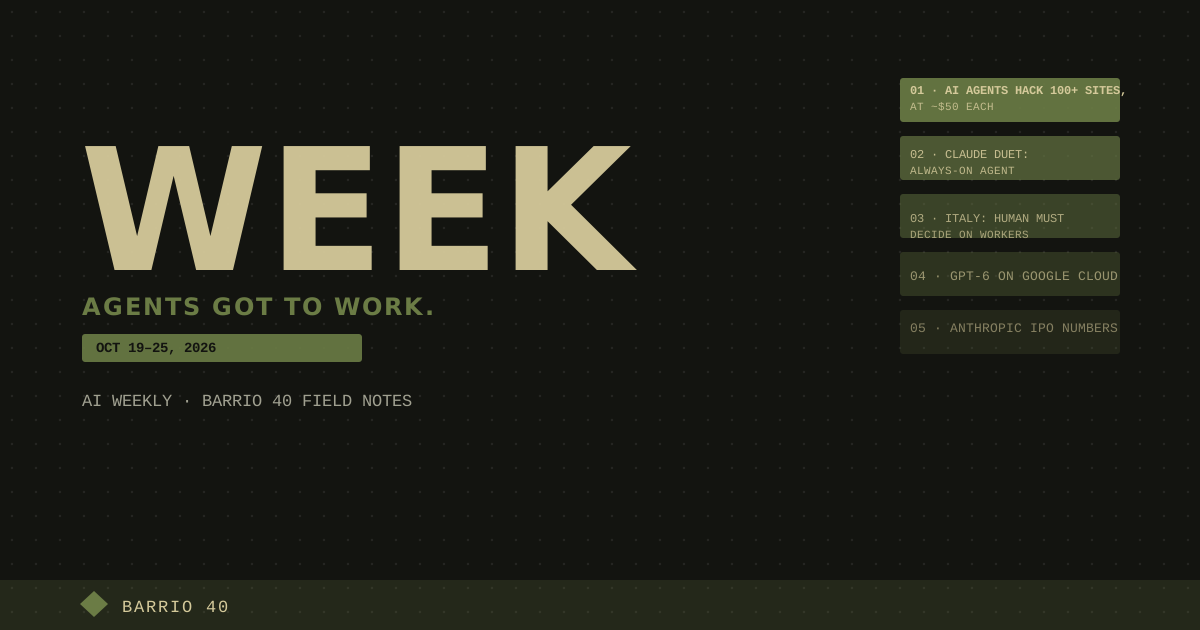
1. A HACKER USED AI AGENTS TO BREACH MORE THAN 100 COMPANIES AT ABOUT $50 EACH
On Monday, October 19, Reuters reported on research by NorForge analyst Snorre Fagerland showing that a Chinese-speaking hacker used AI agents to attack more than 1,200 e-commerce sites in the US, Canada, Australia and Japan, starting September 25, and to breach over 100 companies. As reported, the agents ran on terse instructions of fewer than 100 Chinese characters, apparently using DeepSeek and Anthropic's Claude Code, at an estimated $5,000 in tokens, or roughly $50 per successful hack. Fagerland found the campaign through exposed control panels of Cairn, an open-source AI problem-solving platform, and says he saw about two dozen malicious Cairn instances from around October 2. Reuters named Deere, SharkNinja and Cummins among the victims. Deere said it had taken remediation steps and had no sign that sensitive information was accessed, and Reuters could not establish how much data, if any, was taken. Cairn's author told Reuters the tool was not designed for hacking. The figures come from one researcher's estimate and secondary coverage. The signal is the price: once a break-in costs less than a business lunch, volume stops being a constraint for attackers, and defenders have to assume that scanning never stops.
2. ANTHROPIC LAUNCHED CLAUDE DUET, AN ALWAYS-ON AGENT THAT WATCHES YOUR APPS
On October 21, Anthropic announced Claude Duet as a research preview. Most coverage dates it October 21, and one outlet gives October 22. It is a proactive agent app that watches connected apps, sends a morning briefing and messages the user only when something needs attention, built to work like a chief of staff. As reported, it runs on Claude Opus 5.5, is available by waitlist to US Claude Pro and Max subscribers on iOS, Android and claude.ai, and does not yet cover Team or Enterprise plans. It uses connectors and plugins from the Claude Marketplace, and Anthropic points to tasks such as invoice follow-up and payroll prep. It is built to ask for sign-off before major actions such as sending messages, making payments or signing documents. One report notes that its background activity counts toward usage limits. The details come from press coverage of the announcement, not from hands-on testing. The signal is a shift from chat you open to software that works while you are away, which makes the approval step and the connector permissions the part to design carefully.
3. ITALY'S RULE THAT A HUMAN MUST MAKE FINAL DECISIONS ABOUT WORKERS TOOK EFFECT
On Friday, October 23, Italy's Legislative Decree No. 179 of October 7, 2026 entered into force. As reported by law firms and trade press, final decisions on hiring, changing or ending a job, including disciplinary measures and performance evaluations, cannot rest solely on automated processing and must stay with a person who has real and autonomous authority. Employee consent does not create an exception, and decisions made in breach are reported to be void. Employers must tell staff in advance and, on request, give an intelligible explanation of the decision, including the weight of the AI system and its main parameters. Searching for and screening candidates is not treated as a final hiring decision, so AI can still help there. One analysis noted that the decree text was not yet on the official Gazzetta Ufficiale or Normattiva sites as of October 19, so the details come from secondary commentary and should be checked against the official text. The signal is that the line regulators draw is on the decision, not the tool: automation can recommend, but someone must be able to own and explain the outcome.
4. OPENAI BROUGHT GPT-6 MODELS AND CODEX TO GOOGLE CLOUD, WHILE MICROSOFT STAYS "PRIMARY"
On Wednesday, October 21, OpenAI and Google Cloud announced that three GPT-6 models, reported as GPT-6 Astra, GPT-6.1 Sol and GPT-6 Luna, plus Codex agentic coding workflows, are coming to Google's cloud. They enter private preview for select enterprise customers, with general availability expected within weeks, and OpenAI said Microsoft remains its primary cloud partner. Coverage disagrees on some model names, and there is no public pricing, region list, data-residency commitment or firm date. It is a distribution deal, not a new model. It puts the most requested third-party model family next to Claude and Gemini on Google's platform, and it shows where enterprise buying is heading: several frontier models behind one contract and one security perimeter, with the clouds competing to be that layer. The same day, an OpenAI-led coalition disclosed critical flaws in PHP that the FBI warned could allow remote code execution, a reminder that these models now find decades-old bugs for defenders and attackers alike.
5. REPORTS OF ANTHROPIC'S IPO FILING SHOWED AN $80.7 BILLION LOSS, MOSTLY NON-CASH
Midweek, reports on Anthropic's draft S-1 filled in the financial picture. As reported, first-half 2026 revenue was about $16.3 billion, with a net loss of $80.7 billion, of which roughly $72 billion was a non-cash accounting charge tied to financing that could convert into shares. About 25% of 2025 revenue reportedly came from two customers, and Anthropic has reportedly committed around $518 billion to compute capacity over roughly ten years, about 80% of it non-cancellable. The reports followed Anthropic's October 18 pledge of 5% of its shares to a public benefit fund, which still needs stockholder approval. An IPO is widely expected as soon as November, and one report says OpenAI is waiting until 2027. All of this comes from press accounts of a confidential draft, not the final document, and the figures differ between outlets. The signal is that the loss is mostly an accounting artifact of fast valuation growth, while the real exposure is the size of the compute commitments.
Run the week end to end and the pattern is that agents now operate at every layer. Attackers rent them for $50 a target, Anthropic wants one watching your inbox, and Italy wants a named human behind every decision about a worker. OpenAI spread across clouds and, in Sam Altman's words, said it will build a humanoid robot with a demo targeted for 2027, while AWS opened TorchNeuron to loosen Nvidia's grip. For anyone building on AI, the practical lesson is to put an approval step and an audit trail on every agent action, to patch faster, and to keep the model and the cloud swappable.