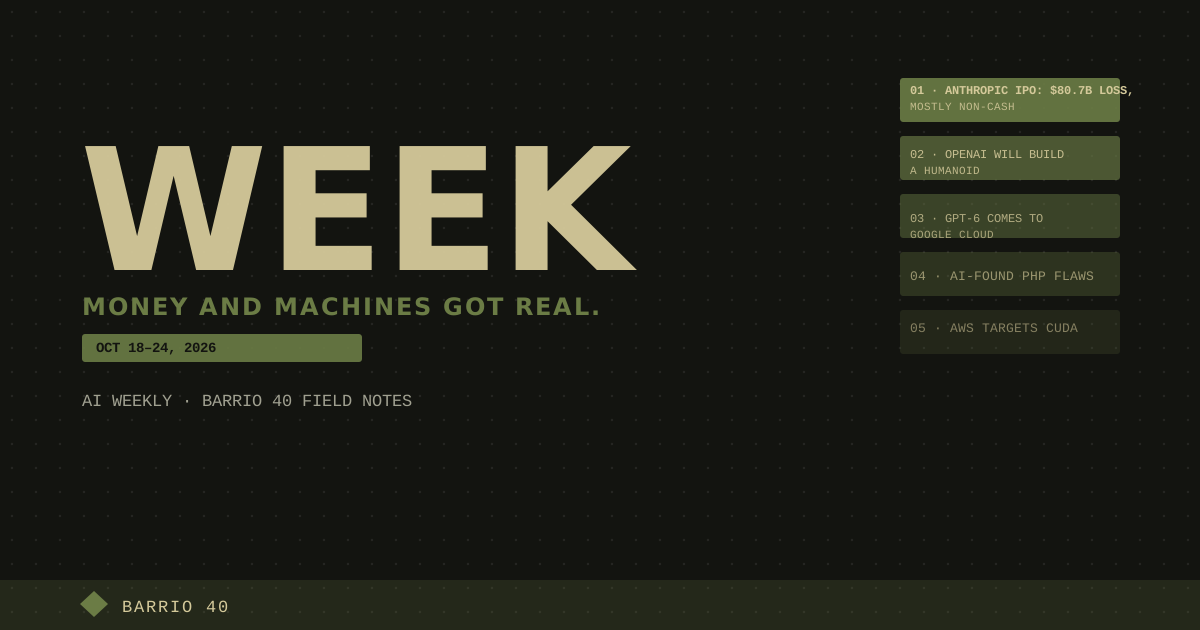
1. ANTHROPIC PLEDGED 5% OF ITS SHARES TO A PUBLIC BENEFIT FUND, AND REPORTS OF ITS IPO FILING SHOWED AN $80.7 BILLION LOSS
On Sunday, October 18, Anthropic said it will commit 5% of its shares to a new Anthropic Public Benefit Fund, with a further 2% at the board's discretion for every 50% rise in company value above an undisclosed baseline. Reporting says the fund would be a wholly owned LLC rather than a charity and could back nonprofits, direct distributions and efforts to address AI's effect on workers. Press estimates put the 5% stake at roughly $48 billion at the May valuation. The pledge still needs stockholder approval, and governance details are promised only for the coming months. Midweek, reports on the company's draft S-1 filled in the financial picture. As reported, first-half 2026 revenue was about $16.3 billion, with a net loss of $80.7 billion, of which roughly $72 billion was a non-cash accounting charge tied to financing that could convert into shares. About 25% of 2025 revenue reportedly came from two customers, and Anthropic has reportedly committed around $518 billion to compute capacity over roughly ten years, about 80% of it non-cancellable. An IPO is widely expected as soon as November, at a valuation variously reported between $1.5 trillion and $2 trillion, and one report says OpenAI is waiting until 2027 and considering a private round instead. All of this comes from press accounts of a confidential draft, not the final document, and the figures differ between outlets. The signal is that the loss is mostly an accounting artifact of fast valuation growth while the real exposure is the size of the compute commitments.
2. OPENAI SAID IT WILL BUILD A HUMANOID ROBOT, AND PROMISED ONLY "A COOL DEMO IN 2027"
On October 20, coverage of Sam Altman's interviews had him answering a direct question about a robot with two words: "We will." He added that OpenAI will "definitely do a humanoid" and other form factors, and told Fortune he expects "a cool demo in 2027," with robots on city streets a few years later. Job listings point to in-house work on custom actuators and motors, and OpenAI's careers page reportedly lists 27 robotics openings. Altman framed the hard part as the software: the body matters less than "the brain that makes the robot work." OpenAI has not disclosed a design, price, manufacturing partner or what the demo will show, and the quotes come mostly from secondary write-ups. Hardware timelines slip for reasons no model improvement fixes, such as batteries, thermals, safety certification and repair. It is a strategic signal, not a product, but it puts OpenAI on a path toward Tesla, Figure and Boston Dynamics.
3. OPENAI BROUGHT THREE GPT-6 MODELS AND CODEX TO GOOGLE CLOUD, WHILE MICROSOFT STAYS "PRIMARY"
On Wednesday, October 21, OpenAI and Google Cloud announced that three GPT-6 models, reported as GPT-6 Astra, GPT-6.1 Sol and GPT-6 Luna, plus Codex agentic coding workflows, are coming to Google's cloud. They enter private preview for select enterprise customers, with general availability expected within weeks. OpenAI said Microsoft remains its primary cloud partner. Coverage disagrees on some model names, and there is no public pricing, region list, data-residency commitment or firm date. For Google Cloud it adds the most requested third-party model family next to Claude and its own Gemini line, and one trade report describes GPT-6, Claude and Gemini on a single enterprise invoice, which was not independently confirmed. It is a distribution deal, not a new model. What it shows is where enterprise buying is heading: several frontier models behind one contract and one security perimeter, with the clouds competing to be that layer.
4. AN OPENAI-LED COALITION DISCLOSED CRITICAL FLAWS IN PHP, AND THE FBI TOLD SITES TO PATCH OR GO OFFLINE
Also on October 21, AP and Axios reported that two easily exploitable flaws had been found in PHP, the open-source language used on nearly 70% of all websites. They were found partly with an OpenAI model, in what Axios describes as bugs humans missed for decades. OpenAI says it led a coalition over the past two months, that PHP's maintainers led the fixes and the release, and that it believes AI found the flaws before attackers did. The FBI's cyber division warned that the vulnerabilities could allow remote code execution and advised taking sites offline if they could not be patched right away, and some websites went dark. The account relies largely on OpenAI's own blog post, so the bug identifiers, the exact age of each flaw and the affected versions are best checked in PHP's security advisories. The point cuts both ways. The same capability that lets defenders find decades-old bugs lets attackers build exploits faster, and the window between a fix and a working attack keeps shrinking.
5. AWS OPENED TORCHNEURON, A PYTORCH BACKEND FOR TRAINIUM, IN A DIRECT CHALLENGE TO CUDA
Announced on the PyTorch blog on October 19 and opened as a public beta on October 20, TorchNeuron is an open-source, Apache 2.0 PyTorch backend for AWS Trainium2 and Trainium3. The pitch is that existing PyTorch code runs on Trainium by changing the device from CUDA to Neuron, with FSDP, DTensor and DDP supported natively. That goes at the software lock-in that has protected Nvidia: years of tuned libraries and kernels mean PyTorch on an Nvidia GPU simply works. AWS has not published benchmarks or price comparisons against Nvidia GPUs, and its documentation still calls the backend a closed beta, so how finished it is remains unclear. Running a model and running it well are different claims, and performance-critical custom kernels are where lock-in actually lives. This is a real cut in switching cost, not a switch. The proof will be case studies of real training runs.
Run the week end to end and the pattern is that the industry is being priced and tested in public. Anthropic's filing turned compute commitments into numbers, and OpenAI is reportedly choosing patience over a 2026 listing. OpenAI also reached outward, to Google's cloud, to robots and to the oldest code on the web, while AWS tried to loosen Nvidia's grip from below. Legal pressure continued in the background: Canadian publishers Postmedia, Torstar, The Globe and Mail and The Canadian Press sued Anthropic over training data, allegations that are unproven. For anyone building on AI, the practical lesson is to keep the model, the cloud and the chip swappable, and to patch faster, because the same models finding the bugs are writing the exploits.