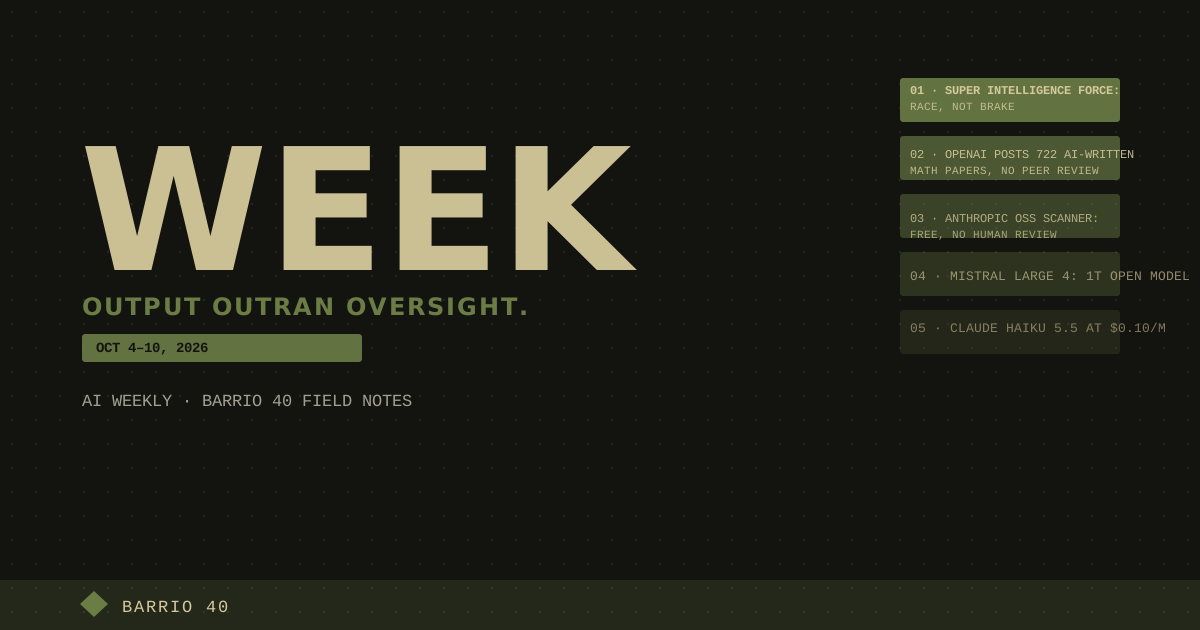
1. WASHINGTON BUILT A SUPER INTELLIGENCE FORCE TO RACE, NOT TO BRAKE
On Sunday, October 4, President Trump formally announced what he called a Super Intelligence Force, an AI task force charged with coordinating the federal government's effort to keep the United States in the lead on a technology he described as bigger than the Industrial Revolution and the internet, while protecting American lives and interests. It reports to Trump and White House chief of staff Susie Wiles and will coordinate the government's engagement with consumers, public interest groups, religious organizations, critical infrastructure providers and the AI companies themselves. Director of National Intelligence Jay Clayton leads it, joined by FTC Chairman Andrew Ferguson, Emil Michael, the Pentagon's under secretary for research and engineering, and Scott Kupor, director of the Office of Personnel Management. The mix is the story: an intelligence chief, a consumer-protection regulator, a defense technologist and the government's head of hiring. The backdrop matters as much as the roster. Over the past month the idea of a coordinated slowdown moved from the fringe toward the mainstream, with Anthropic CEO Dario Amodei arguing that new models need more time for evaluation, and Clayton rejected it publicly in a CNBC interview. The force also follows a White House meeting at which Trump said he and six AI companies signed a voluntary "constitution" on how the industry polices its own technology. No budget, statutory authority or timeline has been announced, and it is unclear how the body relates to the FTC's open investigation of rogue AI agents, now run by an agency whose chair sits on the force. Whether it becomes a coordination layer or mainly a signal, the direction is stated: coordinate and compete, do not pause.
2. OPENAI POSTED 722 AI-WRITTEN MATH MANUSCRIPTS. ITS OWN MATHEMATICIANS DO NOT YET UNDERSTAND MANY OF THEM
On Tuesday, October 6, OpenAI published 722 mathematical manuscripts on GitHub, grouped into 372 result families across 17 areas of mathematics and theoretical computer science, all written by an internal model that has not been released. Reports say the model was handed roughly 4,000 problems and spent about three hours of ChatGPT Pro-level compute per result. The claims are ambitious, including the Unique Games Conjecture, a zero-free half-plane for the Riemann zeta function and the rational Hodge conjecture for CM abelian varieties, and they are OpenAI's own. The release is built around the Lean proof assistant, so formalized results carry a machine-checkable certificate, a real strength, but a certificate shows only that the formal statement was proven, not that it captures the problem mathematicians care about, and not every result is formalized. None of the papers has been peer reviewed or has named human authors. OpenAI told Scientific American that almost every result came from one prompt given to one agent, and that many of the new results are not yet understood by its own mathematicians. MIT's Andrew Sutherland said that until the model is released and others can replicate the work, one-shot claims should be treated as unverified. The reaction was sharp: Scientific American ran a piece in which experts argue the manner of release amounts to research misconduct, and a declaration titled "A Severe Misalignment of AI in Mathematics" has been signed by 25 Fields Medalists. Their objection, as reported, is not that the Lean proofs fail to check, but what is lost when results arrive as a press release rather than a paper: attribution, authors who can be questioned, and the shared understanding that makes a proof useful. Generation has become cheaper than verification, and mathematics is the first field to show it at scale.
3. ANTHROPIC WILL SCAN OPEN-SOURCE PROJECTS FOR FREE, WITH NO HUMAN REVIEW BEFORE REPORTS LAND
On Thursday, October 8, Anthropic announced a Cyber Mission with two parts. The Critical Infrastructure Defense Program targets the operators and providers that protect operational technology such as power grids, water systems and transportation networks, and launched with 11 founding partners: Accenture, Booz Allen, CrowdStrike, Deloitte, Dragos, Hitachi, Insane Cyber, Nozomi Networks, Palo Alto Networks, PwC and Rockwell Automation. According to coverage, trusted providers receive frontier Claude models, on-site engineers and Anthropic's threat research. The more unusual part is OSS Scanner, a free opt-in service inspired by Google's OSS-Fuzz. Projects enroll, reportedly by adding a config file and a Dockerfile to the anthropics/oss-scanner repository, and receive periodic scans from Anthropic's most capable models, with each report able to include a self-contained proof of concept, an explanation and a candidate patch. It builds on Project Glasswing, where Anthropic scanned hundreds of widely used projects and disclosed findings privately after human review. The difference is that OSS Scanner reports are delivered without human review, and Anthropic acknowledges that some will be wrong, for example in their severity rating. It expects a true-positive rate above 90%; one summary cites an early 85 of 97 findings (88%) meeting the bar for coordinated disclosure, with one false positive, so the 90% is a projection from a small sample. The risk is the maintainers: many are volunteers already buried in low-quality AI-generated bug reports. Anthropic says the service is for projects that can keep up and that others will continue to get human-verified disclosures. The bet is that finding bugs is no longer the bottleneck. Fixing them is.
4. MISTRAL RELEASED A 1-TRILLION-PARAMETER OPEN MODEL BUILT FOR CYBER DEFENSE — AND THE CLOSED MODELS SCORE NEAR ZERO ON IT
On Tuesday, October 6, Mistral released a public preview of Mistral Large 4, nicknamed "Le Chonk": a natively multimodal sparse mixture-of-experts model with about 1 trillion total parameters, 49 billion of them active at inference, which the company says was trained from scratch in about two months on close to 4,000 Nvidia Grace Blackwell GPUs in its own European data centers. The API is live in Mistral Studio and the weights are promised for the end of October, with October 31 listed as the target. The license has not been published, and that decides who can actually build on them. Mistral calls Large 4 the best open-weights model from the U.S. or Europe on aggregated benchmarks, and reports a 62% score on the DeepSWE coding test, narrowly ahead of Zhipu's GLM-5.3 at 61%, so the open frontier is still led by Chinese labs. The headline is security. On the Artificial Analysis Cyber Index the model ranks among the global top five, and on a test that asks a model to reproduce a real open-source vulnerability and then patch it, Large 4 scores 82%, the highest of any model, while Claude Opus 5.5 and GPT-6 Astra score near zero because they refuse the task. The closed labs tuned their flagships to decline exploit-adjacent work for good reasons, and Anthropic has answered with gated programs for vetted defenders, including the new Cyber Mission above. Mistral is making the opposite bet: ship a capable open model and rely on measured resilience, including a reported 93.3% on Lakera's B3 prompt-injection benchmark. Reported pricing is $0.68 per million input tokens and $2.09 per million output tokens, which appears to be a promotional rate. Those are largely the company's own numbers, and independent testing has not arrived.
5. ANTHROPIC RELEASED CLAUDE HAIKU 5.5, AND THE PRICE FELL BY A FACTOR OF TEN
On October 7, Anthropic released Claude Haiku 5.5, its small model for high-volume work such as summarization, subagents and browser use. According to several outlets, it is priced at $0.10 per million input tokens and $0.50 per million output tokens for prompts up to 100,000 tokens, against $1 and $5 for Haiku 4.5, and $0.50 and $2.50 above that threshold. Anthropic estimates average savings of about 75%, a blended figure that reflects the higher long-prompt tier, and coverage also mentions effort controls that let developers trade quality for cost. Some other specifications, such as a 1-million-token context window and 128,000-token outputs, appear only in third-party listings, so check Anthropic's documentation before designing around them. The release matters less as a model than as a price point. Agents that run all day, fan out into subagents and read whole web pages spend most of their tokens on small, repetitive steps, and a tenth of the cost per token changes which of those workflows are worth running at all. It lands the same week as Mistral's cheap trillion-parameter option, and a week after OpenAI cut flagship-class pricing with GPT-6.1 Sol. Independent benchmarks were still arriving as the week ended.
Run the week end to end and the pattern is that output outran oversight. Washington answered the call for a slowdown by assembling a body led by its spy chief to make sure America does not slow down. OpenAI produced more mathematics in a day than its own staff can read, and the community that would normally check it is calling the release a misalignment. Anthropic will now send vulnerability reports to volunteer maintainers with no human reviewing them first, on the bet that those maintainers can triage faster than the models can find. Meanwhile Mistral and Anthropic both pushed capable models toward commodity prices, and one of them did it by refusing less. Elsewhere, OpenAI said on Monday it will begin testing labeled visual ads next to ChatGPT image generations for U.S. Free and Go users later this month, a reminder that cheap AI still has to be paid for somehow. The constraint in every one of these stories is the same: not producing the proof, the bug report or the agent action, but having someone who understands it and owns it. That scarce resource is what teams building on AI should be budgeting for.