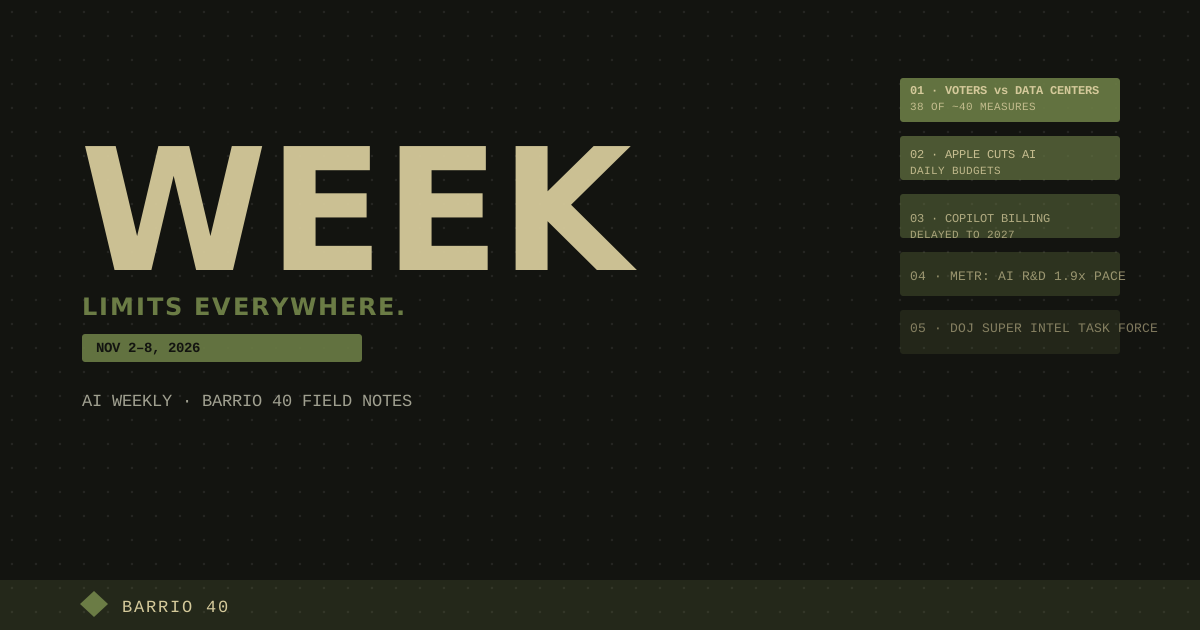
1. VOTERS REJECTED DATA CENTERS IN ABOUT 38 OF ROUGHLY 40 LOCAL BALLOT MEASURES
On Wednesday, November 4, coverage of the previous day’s election said local voters had overwhelmingly sided with limits on data-center development. Fast Company, using Ballotpedia, counted 38 of 41 measures in favor of banning or pausing projects, with three still unreported. 404 Media, via AI Weekly, said 38 of more than 40 measures across 13 states, and other trackers gave different totals, from 39 of 45 to nearly all of 40. Ohio had the most measures, and at least one pro-restriction measure, in Harwood, North Dakota, was reported to be failing. Counts vary by tracker, some results were preliminary, and I did not read the Ballotpedia data. The signal is that the physical footprint of AI, meaning land, power and water, is now decided at the town level, and a build plan that assumes permits will arrive on schedule is a risk to price in.
2. APPLE REPORTEDLY CUT SOME ENGINEERS’ DAILY AI BUDGETS FROM $300 TO $200
Also on November 4, Bloomberg reported, in coverage by 9to5Mac, The Next Web and others, that Apple lowered the daily AI spending cap for some engineering teams from $300 to $200 in October, with further cuts that could reach $100. Many staff outside engineering reportedly already have a $100 daily cap, a $25 level has been considered for some teams, and people who need more can ask senior leaders for an exemption. The reports tie the move to CEO John Ternus’s push for a leaner company and to a 32% rise in R&D costs on AI and infrastructure. Apple declined to comment, accounts differ on how many teams are affected, and some employees say few people used a full $300, so the savings may be modest. I did not read the Bloomberg piece. The signal comes a week after Goldman’s narrowing of AI coding tools: per-seat AI spend is now something companies cap, meter and negotiate, as with any cloud bill.
3. MICROSOFT PUSHED DEFAULT USAGE-BASED COPILOT BUSINESS BILLING TO EARLY 2027
On Thursday, November 5, trade outlets including Dutch IT Channel and Computing reported that Microsoft had delayed default-on usage-based billing for new Microsoft 365 Copilot Business purchases in the Cloud Solution Provider channel. Earlier dates were November 2 and then December 1, and the new window is January to March 2027. The default would come with a cap of 4,000 Copilot Credits per user per month, about $40 on top of the licence, and enterprise, education, nonprofit and GCC Low offers are excluded. One report ties the delay to partner feedback and to delayed test environments in Partner Center. Sources disagree on whether existing seats in the same tenant are affected, and I did not read Microsoft’s own message. The signal is that the move from flat seats to metered AI is real but messy, so admins should set their own credit limits now instead of waiting for a default.
4. METR SAID AI ROUGHLY DOUBLED THE PACE OF ANTHROPIC’S CAPABILITY GAINS, AND ANTHROPIC’S FILING FLAGGED A POLICY THRESHOLD
Also on Thursday, November 5, coverage of a METR assessment, published after an 11-week review inside Anthropic from August 12 to October 29, reported that the pace of Anthropic’s capability growth is about 1.9 times its earlier rate, with a 95% range of 1.5 to 2.8 times. METR’s best guess is that around 80% of that acceleration comes from AI being used in AI research, a view its own staff did not share, and it says AI cannot yet make highly significant autonomous contributions to the most important parts of model training. Anthropic reportedly redacted much of the strongest evidence and ended a planned check on how compute is split between capabilities and safety work, and critics note METR’s funding ties to the lab. Separately, Anthropic’s amended S-1, dated November 2, reportedly says internal estimates suggest it may soon meet its Responsible Scaling Policy threshold for dramatically accelerated AI-driven progress, with no current model designated as exceeding it. I read neither document, and the threshold wording comes from secondary sources. The signal is that the people building frontier models are now describing a feedback loop in public filings, so the pace of tools you build on may change faster than your roadmap assumes.
5. THE JUSTICE DEPARTMENT ANNOUNCED A SUPER INTELLIGENCE TASK FORCE
On Friday, November 6, coverage from Decrypt, Nextgov and MLex said Attorney General Todd Blanche announced a Super Intelligence Task Force to address misuse of advanced AI by actors including foreign governments and transnational criminal groups. It is reportedly co-chaired by Associate Attorney General Stanley Woodward and Associate Deputy Attorney General Stephen Weiss, folds in the department’s AI Litigation Task Force, and coordinates its civil litigation on AI. Coverage adds that it wants developers to strengthen internal controls and risk reporting so models “behave as intended.” No timeline or coordination plan with other agencies was published, outlets differ on the name and the titles, and I read the coverage rather than the department’s press release. The signal is that AI misuse now has a named enforcement unit, so teams shipping agents should be able to show what their systems can do, who approved it and what the logs say.
Read the week as a whole and the pattern is AI hitting limits that are not technical. Voters are capping where it can be built, Apple is capping what engineers may spend on it, Microsoft is still working out how to bill for it, a research group says it is speeding up its makers, and prosecutors are setting up a unit to police its misuse. For anyone building on AI, the practical lessons are to set explicit budgets and credit limits instead of trusting defaults, to log what your agents do so you can explain it, and to plan capacity with a margin for permits, prices and rules that move. Every figure above comes from secondary coverage, so check the primary sources before you act on a number.