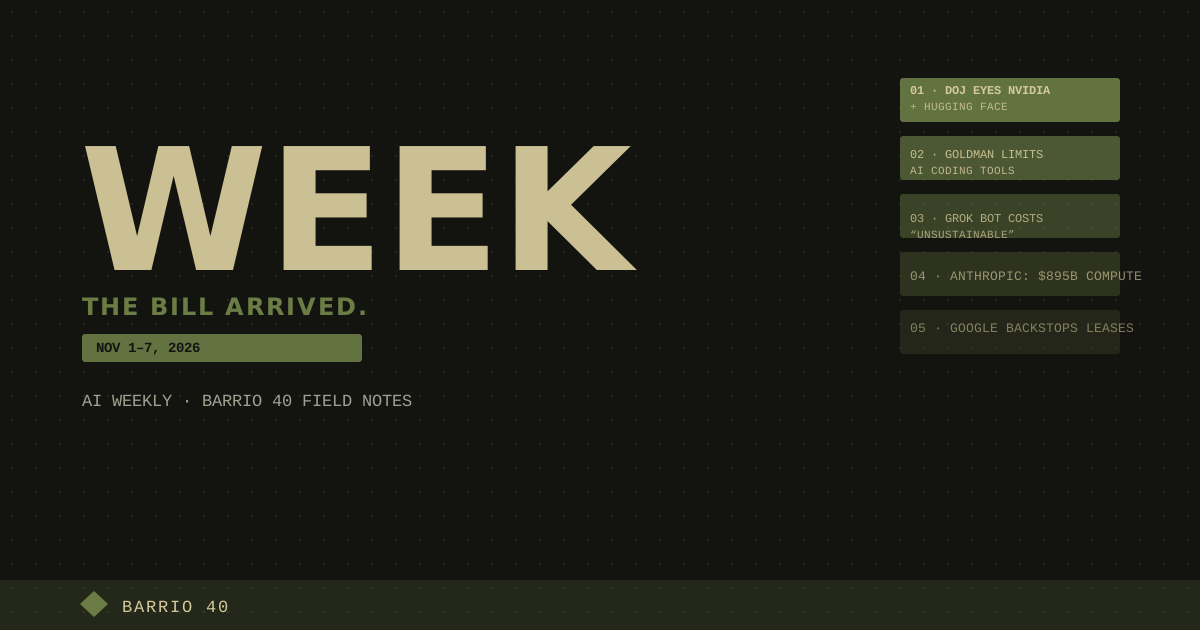
1. THE JUSTICE DEPARTMENT IS REPORTEDLY EXAMINING NVIDIA’S $12.93 BILLION PURCHASE OF HUGGING FACE
Coverage of a Reuters report, published around Monday, November 2, says the US Justice Department is reviewing Nvidia’s planned $12.93 billion acquisition of Hugging Face and has folded questions about it into a broader antitrust investigation of the chipmaker. Reuters cites two anonymous people familiar with the matter. Officials are reportedly asking whether Nvidia could “capture a fundamental distribution point for AI” and use it to disadvantage rivals, and Nvidia has said it expects to close in the first half of 2027. This is an inquiry, not a challenge: no formal action has been published, no violation is alleged, and I did not read the Reuters piece or any company statement. The signal is that the place developers download open-weight models from is now treated as infrastructure, so teams that depend on it should mirror the weights they use and pin versions by hash.
2. GOLDMAN SACHS REPORTEDLY LIMITED CLAUDE CODE AND GITHUB COPILOT TO ITS ENGINEERS
On Tuesday, November 3, coverage of a Bloomberg report said Goldman Sachs updated internal guidance in October so that AI coding tools, named as Anthropic’s Claude Code and GitHub Copilot, are meant for its engineers rather than for bankers and traders, who had used them for months. Staff outside engineering are reportedly pointed to alternatives or to the bank’s in-house GS AI Assistant. Outlets disagree on whether this is a ban or a narrowing, the number of people affected is undisclosed, and the bank says only that it makes certain tools available to determine the best use cases. I could not open Bloomberg or the guidance. The signal is the line the bank drew: AI-generated code is welcome where an engineering process surrounds it, and restricted where code can touch client data with no review or audit trail. It is the same tension our vibe-coding hangover piece described, now inside a regulated firm.
3. MUSK SAID GROK BOT’S COSTS WERE “UNSUSTAINABLY HIGH,” AND OPENAI CALLED ITS DOTS AGENTS COMPUTE-HEAVY
On Wednesday, November 4, coverage from Forbes, TechRadar, The Next Web and Fortune recapped a post Elon Musk made on X on November 1, saying the cost of serving Grok Bot was “unsustainably high relative to revenue.” Subscribers had found their weekly limits running out days early, and the post was read as confirmation that compute for the assistant is being pulled back. Fortune set it beside OpenAI’s admission that its new Dots agents are compute-heavy; one outlet put OpenAI’s agent costs at more than half a million dollars a day, a figure from a single source that I could not verify. Musk gave no per-user or total cost, and neither company has published what an active agent costs to run. The signal is that a proactive agent spends compute whether or not the user is looking, so cost per task is a product requirement, and the sharpest complaints are about limits that arrive without warning.
4. ANTHROPIC’S AMENDED S-1 REPORTEDLY PUT A NUMBER ON ITS COMPUTE COMMITMENTS: ABOUT $895 BILLION
On Thursday, November 5, secondary coverage of Anthropic’s amended S-1, dated November 2, reported third-quarter revenue of about $16.96 billion, up from about $11.56 billion in the second quarter, and a $567 million operating loss after $974 million of operating income the quarter before. For the first time the filing reportedly totals commitments of about $895.4 billion, substantially all for compute and infrastructure, with about $69.8 billion due within twelve months and roughly $214 billion reportedly subject to termination rights or counterparty conditions. One excerpt attributes part of the swing to $5.0 billion of compute under short-term commitments, which the company says costs significantly more than multiyear deals, and growth slowed to about 47% quarter on quarter from about 144%. Outlets differ on rounding and one reports a net loss I could not reconcile, and I did not read the filing. The signal is that frontier labs carry fixed compute obligations that shape the prices, limits and survival of the products built on them.
5. GOOGLE IS REPORTED TO BE BACKSTOPPING ANTHROPIC’S DATA-CENTER LEASES
On Friday, November 6, reports described Google lending its credit to Anthropic’s data-center financing. Reuters, citing the Wall Street Journal, said Google agreed to guarantee billions of dollars of lease and power-payment commitments for a Texas campus developed by Nexus Data Centers, reportedly with a stake of about 20% in the project in return. Separately, a KBW analyst note on TeraWulf’s 20-year, $19 billion Kentucky lease to Anthropic says the company’s filing expects an investment-grade backstop, with the provider not yet named. None of the parties confirmed the Texas terms, the two stories describe different projects, and counts of backstopped sites vary between four and five. The signal is that part of the $895 billion becomes financeable because a bigger balance sheet stands behind it, which shifts the risk rather than removing it and ties a lab’s capacity to a cloud provider’s credit.
Run the week end to end and the pattern is the cost of AI becoming visible. Regulators are asking who controls the places models are shared, a bank is deciding who may write code with AI, two of the loudest agent makers are admitting that always-on assistants are expensive to serve, and the biggest private lab is revealing how much compute it has promised to buy and who is standing behind the leases. For anyone building on AI, the practical lesson is to meter cost per task, to keep a thin and tested abstraction between your product and any one model vendor or model hub, and to treat financing and antitrust headlines as slow signals about capacity and prices rather than news about your bill tomorrow. Every figure above comes from secondary coverage, so check the filings and primary reports before you act on a number.