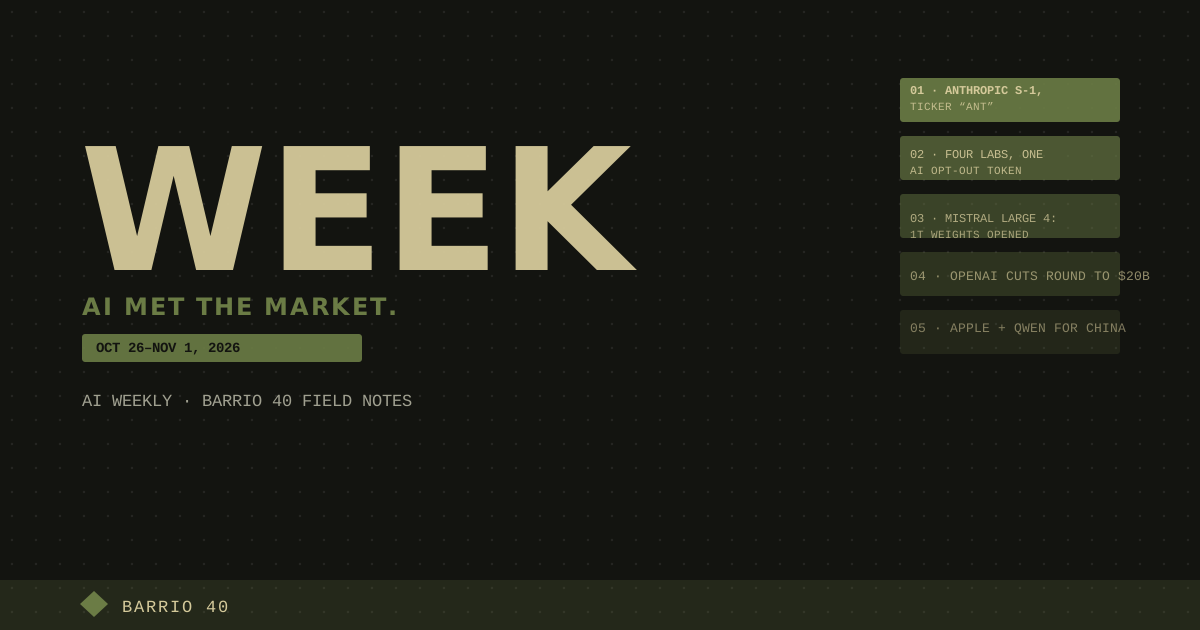
1. ANTHROPIC FILED ITS PUBLIC S-1 TO LIST ON NASDAQ UNDER THE SYMBOL “ANT”
On Monday, October 26, Anthropic filed a registration statement on Form S-1 for a proposed IPO of its Class A shares on the Nasdaq Global Select Market under the symbol “ANT.” As reported, first-half 2026 revenue was about $16.3 billion, up from $1.16 billion a year earlier, against a net loss of $80.7 billion, of which roughly $72.4 billion came from fair-value changes on convertible notes, derivatives and SAFEs. Press accounts say about 80% of revenue was consumption-based and that sales through Google, Amazon and Microsoft marketplaces made up 48%. The share count, price range and valuation were blank, and the filing had not become effective. By the end of the week the Financial Times was reporting that Anthropic is preparing to go public next month at a valuation of no less than $1.5 trillion, and a preview piece put a possible listing in the week of November 16. Neither the timing nor the valuation is confirmed by the company, and the filing on EDGAR was not checked here. The signal is that the loss is mostly accounting, while the compute commitments and the listing date are what investors will price.
2. GOOGLE, MICROSOFT, ANTHROPIC AND OPENAI SAID THEY WILL SUPPORT ONE ROBOTS.TXT TOKEN FOR OPTING OUT OF AI TRAINING
On Friday, October 30, Google, Microsoft, Anthropic and OpenAI said they will support a single robots.txt setting that lets website owners opt content out of AI training across their crawlers. As reported, the proposal is drafted as an IETF Internet-Draft authored by Anthropic's Kevin Kelley. Anthropic has already begun implementing it, OpenAI says it will follow in the coming months, Microsoft is targeting February 1, 2027, and Google is targeting 2027. The announcement is a commitment to support an upcoming standard, not a finished one, and it covers training opt-outs rather than every kind of AI crawling. The details come from secondary coverage, and I could not open the Internet-Draft itself. The signal is that publishers may soon need to maintain one rule instead of one per crawler, but until all four ship, the old per-bot rules still matter.
3. MISTRAL RELEASED THE WEIGHTS OF LARGE 4, A MODEL OF ABOUT 1 TRILLION PARAMETERS
On Thursday, October 29, Mistral released the open weights of Mistral Large 4, nicknamed “Le Chonk,” about three weeks after a public preview on October 6. As reported, the model has about 1 trillion total parameters in a mixture-of-experts design, and the weights are on Hugging Face with FP8 and NVFP4 variants that run on vLLM or SGLang. Sources agree on the total but differ on active parameters, with most saying 52B and two saying 49B. Mistral says it is the best open-weight model for coding and reports a Terminal-Bench 4.0 score of about 41%, up from 28.3% in the preview build, and TechCrunch frames the release as aimed at cybersecurity teams. Independent replication was still pending when this was reported. The license is Mistral's own open-weight license, which one outlet calls a modified MIT license, so it is not open source in the strict sense. The signal is that a trillion-parameter model you can host yourself now exists, which changes the hosting decision more than the hardware bill.
4. OPENAI REPORTEDLY CUT ITS FUNDING TARGET TO UP TO $20 BILLION AS AI STOCKS SOLD OFF
On Friday, October 30, tech stocks tied to AI spending fell, and on Saturday, October 31, CNBC and the Financial Times reported that OpenAI is now seeking up to $20 billion, down from about $30 billion, at a post-money valuation of $1.25 trillion, down from $1.4 trillion. As reported, Intel fell 25% on weak revenue guidance, Micron fell 5.5% and Nvidia fell 4%, and Fortune linked the mood to a credit warning at Meta over cash flow and spending. The first close is expected to come in below $20 billion because some investors have reduced their commitments, one report puts commitments near $11 billion, a UAE-led group is expected to be the largest participant, and a retail offering at the same valuation is planned afterward. For scale, OpenAI's March round raised $122 billion at an $852 billion valuation. These figures come from people familiar with the talks, OpenAI has not published the terms, and the round is still open. The signal is that investors are asking whether AI spending pays off, a question every lab with an IPO or a raise coming will have to answer.
5. APPLE SAID ALIBABA'S QWEN WILL POWER PART OF APPLE INTELLIGENCE IN CHINA
On Saturday, October 31, Apple said Apple Intelligence will reach China with iOS 27.3, with testing in the developer beta from November 4 and a public release in December. As reported, Alibaba's Qwen will support text and image understanding and content generation through Siri, Writing Tools and Visual Intelligence, users can choose whether to turn it on and what to share, and Alibaba says it will not use requests or responses for model training. Coverage lists the iPhone 16 and later, the iPhone 15 Pro models and the iPhone Air as eligible, requires Siri and the phone to be set to English or Simplified Chinese, and says the next-generation features shown at WWDC 2026 are not part of this first release. China's cyberspace regulator completed filings for seven on-device generative AI services in July, including Apple Intelligence. One report dates the Apple–Alibaba partnership to February 2025, while others date the announcement to this week, and one analysis piece raises privacy concerns that are not reporting from either company. The signal is that in China the model behind a global assistant is chosen locally, which makes the model layer something product teams should be able to swap.
Run the week end to end and the pattern is AI meeting the real constraints of markets, rules and borders. Anthropic is preparing to be priced by public investors, OpenAI is finding that private investors are more cautious than a month ago, four rivals found a rare point of agreement on how the web says no, and Mistral and Apple showed that the model layer is increasingly open or local. For anyone building on AI, the practical lesson is to keep your model and your crawler rules configurable, to treat valuations and launch dates as reported rather than settled, and to plan for the case where the money gets tighter before the products get cheaper.