1. THE GATE WIDENS: WASHINGTON TELLS OPENAI TO HOLD BACK GPT-5.6, TOO
For two weeks, the Fable 5 shutdown looked like a story about one company's relationship with one government directive. That framing stopped holding on June 25, when Howard Lutnick called Sam Altman directly to caution against releasing GPT-5.6 without cross-agency sign-off, a request that arrived alongside parallel pressure from Sean Cairncross's Office of the National Cyber Director and Michael Kratsios's Office of Science and Technology Policy. None of the three offices framed it as a formal export-control order in the style of the June 12 directive against Anthropic, and OpenAI is not currently barred from releasing GPT-5.6 the way Fable 5 remains barred — but the mechanism is unmistakably the same one: an administration deciding, model by model, that a frontier release needs government eyes on it before the public gets access, with the lab agreeing to stagger rollout rather than contest the request. Altman's internal framing to employees, that broader availability might land "in a couple of weeks" once relevant agencies have tested and approved the model, is close kin to the language Commerce used when it described Mythos 5's narrow critical-infrastructure carve-out three days earlier.
The capability set driving the caution is also telling: GPT-5.6's rumored feature list includes a 1.5-million-token context window, materially faster Codex response times, and meaningfully improved long-horizon agentic coding — the same category of autonomous, code-touching capability that justified the original directive against Fable 5 and Mythos 5. Read against this site's coverage of the Alibaba letter and the distillation threat it documents, the through-line is that Washington's underlying worry was never really about Anthropic specifically; it was about a class of model capability that any frontier lab might now ship, and this week is the first clear evidence that the government intends to apply the same instinct industry-wide rather than treat the June 12 order as a one-off response to one company's problem. For any team planning a roadmap around GPT-5.6, the practical read is the same one this site has offered about Fable 5 for three weeks running: a government-approved enterprise preview is evidence the underlying model works well enough to be useful, not evidence that broad public access is close.
2. DAY 16, AND THE IRONY THAT LANDED RIGHT ON SCHEDULE: ZHIPU'S GLM-5.2 CLAIMS PARITY WITH MYTHOS
Sixteen days into the blackout, the practical status hasn't moved much since this site's June 27 coverage: Mythos 5 remains available only to the roughly 100 named US critical-infrastructure organizations Commerce cleared on June 26, Fable 5 remains dark worldwide, and Axios's June 27 report that the model is "on track to return soon" reads, on inspection, like the same kind of rounded-up optimism this site flagged in Commerce's "more than 95% restored" framing two weeks ago — a scoop with no confirmed date attached to it. What changed this week is the strength of the counter-argument to the shutdown's own stated purpose. Zhipu, the Chinese lab operating under the Z.ai brand, released its open-weight GLM-5.2 model on June 13 — the day after the original shutdown order — under a tagline, "frontier intelligence belongs to everyone," that read at the time like rhetoric. By this week, independent security researchers had turned it into a benchmark: GLM-5.2 scored 39% F1 on IDOR vulnerability detection, beating Claude Code's 32%, a result multiple outlets are now describing as rough parity with Mythos 5 on the exact autonomous-cybersecurity capability class the export-control directive cited as its national-security rationale.
The policy problem this creates is not subtle: the US government suspended Fable 5 and Mythos 5 specifically to keep that capability class out of reach of foreign nationals, and sixteen days later, a lab with no exposure to US export-control jurisdiction has published, as open weights, a model claiming parity on the same benchmarks — available globally, for free, to anyone who wants to download it. That does not necessarily mean the original directive was wrong on its own terms; classifier-gated access and model weights sitting on a foreign server are different threat models, and Commerce's restoration of Mythos 5 to vetted US institutions this week suggests the government still sees daylight between the two. But it does mean the central trade-off — domestic restriction in exchange for reduced foreign capability access — is harder to defend in week three than it was in week one, and this site expects the GLM-5.2 comparison to keep surfacing in exactly the congressional hearings where the Alibaba letter and the NDAA's distillation language are already being discussed.
3. THE ALIBABA LETTER'S LONG SHADOW: WHY 28.8 MILLION CONVERSATIONS STILL EXPLAIN WASHINGTON'S NERVES
Anthropic's June 10 letter to Alibaba — disclosing roughly 25,000 fraudulent accounts and 28.8 million conversational exchanges between April 22 and June 5, assessed as a systematic attempt to distill Claude's outputs into Alibaba's Qwen model family — broke as news on June 26 and kept shaping coverage all the way through this week's close. The figure dwarfs Anthropic's previous public disclosure on distillation, a February estimate of 16 million exchanges spread across three labs, and the two-day gap between when Anthropic sent the letter and when the original shutdown order landed continues to look less like coincidence the longer this month runs. This week's new context is what it does to the GPT-5.6 story above: if Washington's underlying anxiety is about how fast frontier-model capability leaks into the hands of strategic competitors — through distillation, through export, through any channel — then gating GPT-5.6 behind the same kind of review that produced the Fable 5 order is not a separate policy decision so much as the same risk calculus applied to a second data point.
Alibaba's stock, already at a 16-month low after the letter surfaced, did not recover meaningfully this week, and the draft NDAA language two senators are circulating would impose new disclosure obligations on any lab that detects distillation-scale extraction at anything close to the 28.8-million-exchange volume Anthropic documented. The open question this site flagged last week — whether the letter's timing helped trigger the original shutdown order, rather than merely preceding it by coincidence — remains unresolved, but this week's OpenAI news makes the answer matter less than it did seven days ago: whatever triggered the first gate, a second one just opened on a different company, for reasons that track the same underlying capability-leakage anxiety the Alibaba letter put numbers to.
4. GOOGLE'S BLEEDING CONTINUES: ALPHABET CLOSES THE WEEK DOWN AN ESTIMATED $269 BILLION
The pattern this site has now tracked for three consecutive weeks held again: Google DeepMind continued losing senior researchers to Anthropic, the rival in which Alphabet holds an estimated 14% equity stake, and the market kept pricing the structural awkwardness of that arrangement as a genuine liability rather than a one-week curiosity. Alphabet's market capitalization closed the week down an estimated $269 billion — essentially unchanged from last week's $270 billion estimate, which on its own is the more uncomfortable data point, since it means the market has stopped treating the talent exodus and the Gemini delay as a one-time shock and started pricing them as a persistent discount. Gemini 3.5 Pro's general-availability date, already pushed from June to July in last week's reporting, has not firmed back up; enterprise testers in Vertex AI preview continue flagging the same token-efficiency and long-horizon-task issues that caused the original slip.
Nothing in Google's public posture this week argued against the read this site has offered since the pattern first emerged: a company funding a chief rival's research staff, continuing to lose senior people to that rival, and falling further behind that same rival's public shipping cadence is not three independent problems so much as one compounding one, and a market that has now priced the same roughly $270 billion discount two weeks running appears to agree.
5. OPENAI'S MONEY MOVES: A PRICE WAR IN PREP, AN IPO PUSHED TO 2027, AND A CHIP SHIPPED ANYWAY
OpenAI closed out the week managing three separate financial and strategic threads at once. The Wall Street Journal reported the company is preparing notably more aggressive API pricing for GPT-5.6, specifically positioned to undercut Anthropic at a moment when Fable 5 and Mythos 5 already carry list prices — $10 per million input tokens, $50 per million output tokens — roughly double current Opus pricing and meaningfully above GPT-5.5's $5/$30, itself already priced well below Anthropic's frontier tier. Triggering a price war against a competitor mid-crisis, while that competitor's flagship models sit under a government access gate, is an unusually pointed piece of timing, and it lands in the same week OpenAI itself accepted a government-requested staggered rollout for the model the price war is built around — a reminder that being gated by Washington and being aggressive in the market are not, this week at least, mutually exclusive postures.
The second thread is continuity from last week: Bloomberg's report that OpenAI is leaning toward delaying its IPO into 2027 rather than list in 2026 below its roughly $1 trillion target valuation kept shaping investor conversations through the week, with SpaceX's volatile post-listing trading still cited as the cautionary comparable. The third thread is operational rather than financial: OpenAI retired GPT-4.5 from ChatGPT on June 27, on schedule, thirty days after announcing the sunset, with existing conversations migrating automatically to GPT-5.5 — an unremarkable lifecycle move on its own, but one that, set against everything else this week, underlines how much of OpenAI's actual day-to-day operation keeps running on a normal product cadence even as the company's biggest model navigates a government approval gate, prepares for a pricing fight, and feeds workloads to a custom Broadcom-built chip, Jalapeño, that was still running production GPT-5.3-Codex-Spark inference in the lab as of this week's close.
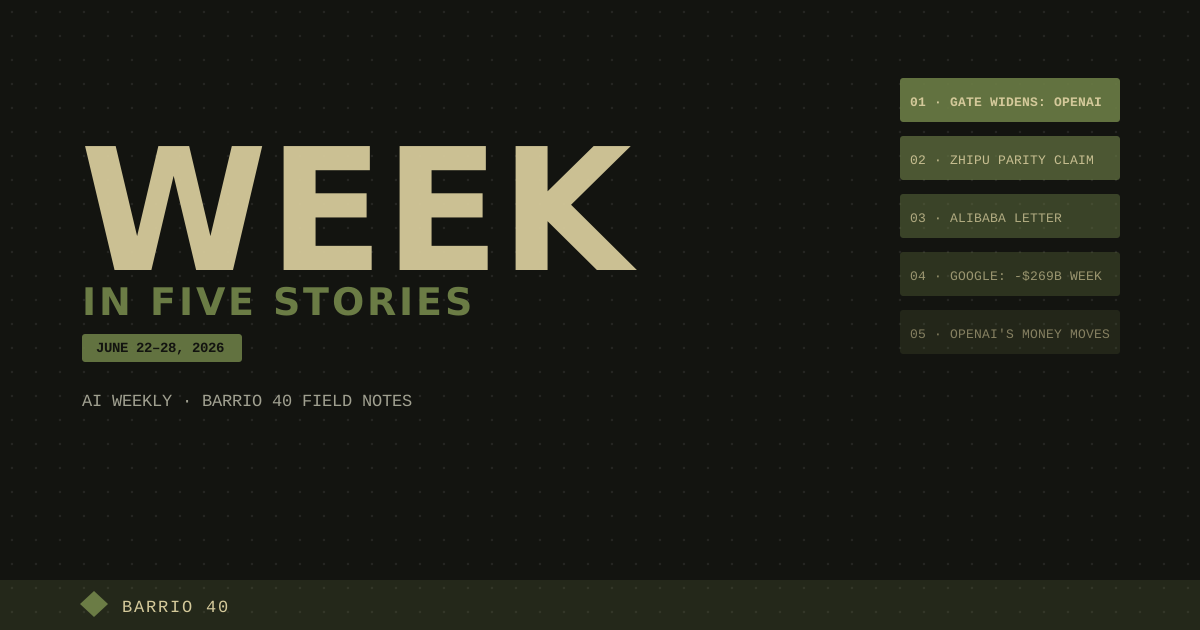
Taken as a whole, the week's five stories converge on a single claim worth stating plainly: the export-control logic Washington built for one company's models stopped being a single-company story this week, the security rationale behind it took its first credible public hit from a lab outside US jurisdiction, and none of that slowed down the commercial fight happening underneath it. A government approval gate, a benchmark-parity claim from an open-weight rival, a 28.8-million-exchange distillation disclosure, a $269 billion week for the company funding its own talent drain, and a price war prepped in the middle of all of it — that is not five unrelated developments. It is one industry being regulated, benchmarked, and undercut simultaneously, in the same seven days, by different actors who are not coordinating with each other and don't need to be for the pressure to compound.