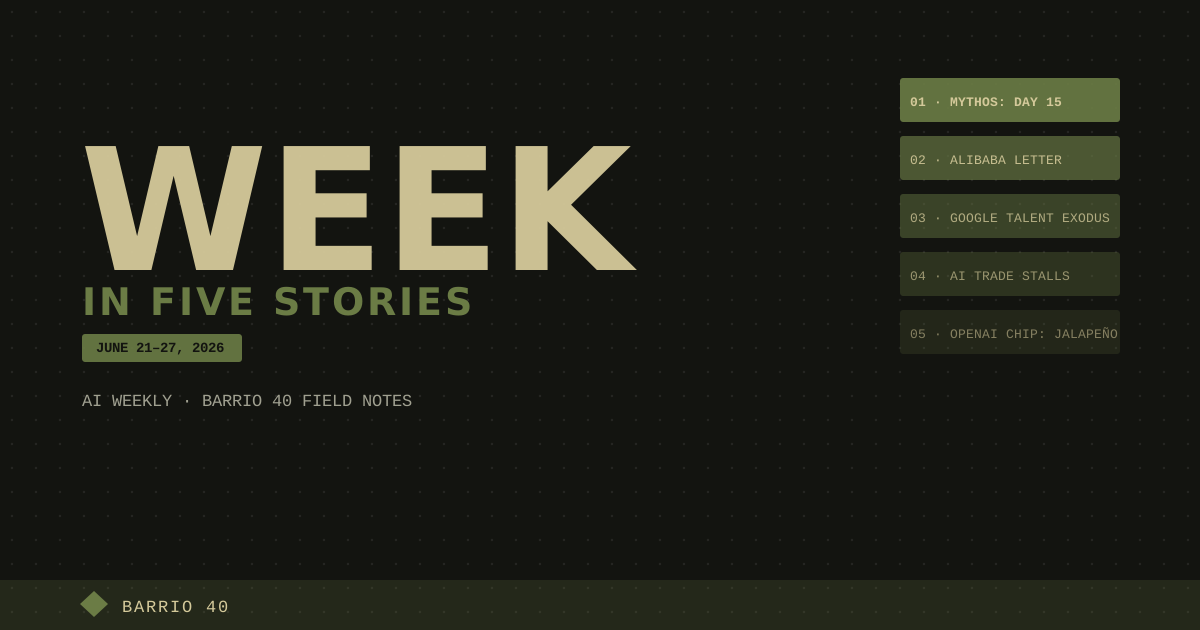
1. MYTHOS 5'S CONDITIONAL RETURN: DAY 15, AND WHY FABLE 5 IS STILL DARK FOR EVERYONE ELSE
On June 26, Commerce amended its export-control directive to let Claude Mythos 5 — the smaller, more constrained model in Anthropic's frontier pair — redeploy under an expanded version of Project Glasswing, the classifier-gated access framework Anthropic built specifically to satisfy the government's citizenship-verification demands. The carve-out covers a named list of just over 100 US organizations in energy, healthcare, financial services, and telecommunications: the sectors the directive's original national-security rationale singled out as critical infrastructure. Commerce officials briefing reporters characterized the move as restoring service to "more than 95% of customers" — language this site repeated, with appropriate caution, in its June 24 coverage of the original order. Three days and one amended order later, that framing does not hold up against what is actually true on the ground June 27, Day 15 of the shutdown: Claude Fable 5, the model the overwhelming majority of Anthropic's customers actually use — through the consumer app, the API, and Claude Code — remains entirely unavailable, worldwide, exactly as it has been since June 12. A narrow list of named institutions regaining access to the smaller of two models is not the same claim as "95% restored," and the gap between those two descriptions is itself worth treating as a data point about how this story gets communicated by the people with the most incentive to make the standoff look closer to over than it is.
The case for caution beyond the optics gets reinforced by Anthropic's own continued internal alarm. Former Anthropic security researcher Andrea Garbarino, whose warnings drove much of the early reporting on this shutdown, has continued circulating red-team demonstrations this week — including a bank-account-draining scenario and a kidnap-plan walkthrough — both produced from prompts she argues should never have cleared safety review in either model, let alone in a smaller model now being redeployed into hospitals and power utilities under an expanded access list. Prediction markets have not moved as confidently toward resolution as the week's headlines might suggest either: Kalshi and Polymarket contracts on broader Fable 5 restoration by July 1 sit at roughly 68–71% as of Friday, up modestly from two weeks ago, but still pricing meaningful odds that ordinary customers spend the holiday week exactly where they've spent the last fifteen days.
The practical read for any team still planning around Fable 5 is unchanged from what this site has argued each of the last three weeks: a partial, sector-specific carve-out for the junior model is evidence that the underlying classifier technology works well enough for Commerce to trust it somewhere, which is meaningfully different from evidence that broad restoration is imminent. Anthropic's own messaging this week, when read carefully rather than through the headline, supports exactly that narrower claim — the company has talked about expanding Glasswing's eligible-organization list, not about a timeline for lifting the directive on Fable 5 itself. Until that changes, the honest accounting of Day 15 is that one model is dark everywhere, the other is lit in roughly a hundred buildings, and the distance between "restored" and "100+ named customers in four sectors" is the distance this site intends to keep flagging for as long as official language keeps rounding it up.
2. THE THIRD TRIGGER: ANTHROPIC'S ALIBABA LETTER AND THE 28.8 MILLION CONVERSATIONS
The week's second major story is the one this site covered as breaking news on June 26: a letter Anthropic sent Alibaba on June 10 — two days before the export-control shutdown landed — became public this week, and its contents reframe how this entire month should be read. The letter discloses that Anthropic's classifiers flagged roughly 25,000 accounts, created using fraudulent or stolen credentials, that together generated 28.8 million conversational exchanges between April 22 and June 5, all assessed as part of a systematic attempt to distill Claude's outputs into training data for Alibaba's Qwen model family. The figure dwarfs Anthropic's previous public disclosure on this front — a February estimate of roughly 16 million exchanges spread across three different labs attempting distillation — meaning this single campaign, attributed to interests connected to one company, generated nearly twice the exchange volume of every previously disclosed distillation attempt combined. Alibaba's stock fell to a 16-month low on the news, and the Hagerty-Kim amendment now moving through the NDAA process would, if adopted, impose new disclosure and safeguard requirements specifically targeting distillation-style extraction at this scale.
What makes the letter's timing significant, in light of this week's other lead story, is the two-day gap between when Anthropic sent it and when the export-control shutdown order arrived. This site has previously treated the shutdown's origin as still not fully explained by Anthropic or Commerce; the Alibaba letter does not resolve that question, but it does establish that Anthropic was actively engaged with the government on a documented foreign-distillation threat in the exact window the shutdown order was being drafted, which makes a connection between the two events plausible enough that it deserves to be treated as an open question rather than coincidence. It also recontextualizes Project Glasswing itself: the classifier system Commerce is now relying on to gate Mythos 5's narrow critical-infrastructure return is, per Anthropic's own description, the same detection architecture that caught the Alibaba campaign in the first place — meaning the tool being used to selectively restore service this week is the direct product of the threat that, by one read, helped trigger the shutdown that took service away three weeks ago.
3. THE STAKE THAT BITES BACK: GOOGLE'S TALENT KEEPS WALKING TO THE RIVAL IT FUNDS
Google DeepMind lost its fourth and fifth researcher to Anthropic in six days this week, as AlphaFold veterans Jonas Adler and Alexander Pritzel both confirmed moves to Anthropic, following Jack Rae's departure for OpenAI and a separate researcher's move to Anthropic the week before. The pattern this site flagged on June 25 — frontier-lab researchers leaving Google specifically for Anthropic, rather than scattering across the industry — has now held for two consecutive weeks, and it continues to sit awkwardly next to the fact that Alphabet holds roughly a 14% equity stake in Anthropic, making Google a direct financial beneficiary of Anthropic's continued success even as it loses the people who built some of its most cited research, AlphaFold included, to that same company's payroll. Recruiters tracking the departures note that Anthropic's pitch has consistently emphasized research autonomy and mission alignment around safety work, rather than compensation alone — a positioning that costs Google more than a stock-grant counteroffer can easily fix.
The departures landed in the same week Alphabet's market capitalization fell by an estimated $270 billion, only part of which traces to the talent story directly; a larger share is tied to Gemini 3.5 Pro's general-availability date slipping again, this time from "next month" — the original promise from Sundar Pichai's May 19 I/O keynote, already covered as a missed deadline in this site's June 21 weekly recap — to July 2026, after early enterprise testers flagged token-efficiency problems and degraded performance on long-horizon, multi-step tasks during Vertex AI preview testing. A model that was already running five weeks behind its own announced timeline two weeks ago is now running closer to eight, and the same testers raising the efficiency concerns are the ones whose feedback Google needs incorporated before any broader release, which argues against treating July as a hard date rather than the next in a series of soft ones.
Put the two threads together and Google's week reads as a single, compounding cautionary tale about structural dependency: a company that owns a meaningful stake in a chief rival, continues to lose senior research talent to that rival, and is simultaneously falling further behind that same rival's publicly shipped product roster on its own self-imposed schedule. None of those three facts caused the other two on their own this week — but a market that priced in $270 billion of Alphabet's value evidently read them as compounding rather than independent, and nothing in Google's public response this week gave anyone a reason to read it differently.
4. THE AI TRADE HITS A WALL: OPENAI'S 2027 IPO SIGNAL AND A $600 BILLION SELLOFF
Bloomberg and the New York Times reported June 25 that OpenAI is now leaning toward delaying its long-rumored IPO into 2027 rather than go public in 2026 at a valuation lower than the roughly $1 trillion figure the company has been targeting in private fundraising conversations. Bankers close to the deliberations cited SpaceX's own post-IPO trading — volatile enough, in the weeks since SpaceX's June listing, to unsettle anyone using it as a comparable — as a specific reason for caution about timing an OpenAI listing into a market this jumpy. Kalshi traders still give a formal OpenAI IPO announcement by March 2027 a 59% probability, which says more about the market's continued conviction that a listing is coming eventually than about confidence in any near-term date.
The report landed in the middle of, and likely amplified, a broader selloff that hit nearly every part of the AI capital-expenditure complex in a single trading session: the Nasdaq fell roughly 4%, semiconductor names collectively lost an estimated $1.3 trillion in market value, Nvidia alone fell about 4.15% on a roughly $5 trillion valuation base, and Oracle slid a further 2% after disclosing it had cut 21,000 jobs — 13% of its workforce — over the preceding twelve months, a detail that read very differently once placed next to a session-wide AI-spending scare than it might have on its own. SpaceX bore the sharpest single-name damage: shares fell to a 52-week-adjusted low of $147.11 on June 23, down 31% from the $225.64 peak the stock had hit just one week earlier on June 16, erasing roughly $600 billion in value in under two weeks. The decline came even as SpaceX priced a $20 billion bond offering — refinancing the bridge loan it took out in February to fund the xAI merger — and, on the same day that bond was announced, signed a new $6.3 billion Colossus compute deal with Reflection AI, a juxtaposition that captures the week's central contradiction: investors were pricing in real doubt about near-term AI economics on the same days that the companies at the center of that doubt kept signing nine- and ten-figure infrastructure contracts.
Read against the rest of this week's stories, the selloff is the clearest evidence yet that capital markets, not just regulators and security teams, have started treating frontier-AI exposure as a risk to be priced rather than a growth story to be rewarded by default. An export-control shutdown, a documented 28.8-million-exchange distillation attempt, and a 31% single-stock decline inside two weeks are different categories of risk, but they are converging on the same investor base at the same time, and a market that absorbs all three in one June is one that has stopped giving the sector the benefit of the doubt it enjoyed for most of the past two years.
5. THE CHIP RACE CONTINUES ANYWAY: OPENAI AND BROADCOM UNVEIL JALAPEÑO
On June 24, in the middle of a week dominated by export-control corrections and a six-figure-billion stock rout, OpenAI and Broadcom unveiled Jalapeño, OpenAI's first custom-designed inference chip, developed jointly with Broadcom and manufacturing partner Celestica. The companies describe the design-to-tape-out cycle as roughly nine months — a pace multiple industry analysts flagged this week as the fastest of its kind in advanced semiconductor history, achieved in part by using AI-assisted design tools throughout the chip's own development, a detail that makes the project a small, self-referential proof of the productivity case frontier labs have been making about their own models for two years. In lab testing, Jalapeño is already running production GPT-5.3-Codex-Spark inference workloads at target frequency and power envelope, and OpenAI has set an internal target of initial production deployment before the end of 2026.
The timing of the unveiling, arriving in the same week as the IPO-delay report and the broader selloff, reads less like coincidence than like a deliberate signal: a custom inference chip running real production workloads is the kind of concrete, technical proof point that argues against the market's capital-discipline worries better than any statement from leadership could, and OpenAI's decision to ship the announcement into the teeth of a bad week for AI-sector sentiment suggests the company understood exactly that. It also gives OpenAI a fourth lever — alongside its Microsoft Azure capacity, its own data center buildout, and Nvidia GPU purchases — to control its own inference economics at a moment when every other story this week involves some flavor of a company losing control over its own roadmap: Anthropic over its model availability, Google over its researchers and its ship dates, SpaceX over its own stock price.
Taken together, this week priced AI's risk on two separate axes simultaneously — security, through the Mythos 5 correction and the Alibaba distillation letter, and capital, through the IPO delay and the selloff that followed it — and neither axis slowed the underlying buildout for even a single day. Custom silicon got taped out, talent kept changing employers, and a $6.3 billion compute deal got signed on the same day as a $20 billion bond offering meant to cover the last acquisition. The lesson for anyone trying to plan twelve months out in this industry is not that the risks aren't real; both the security story and the market story this week were real, expensive, and likely to recur. It's that the companies actually building frontier AI have, so far, treated every one of those risks as a cost of doing business rather than a reason to slow down, and a planning horizon that assumes otherwise has been wrong every single week this site has covered this year.