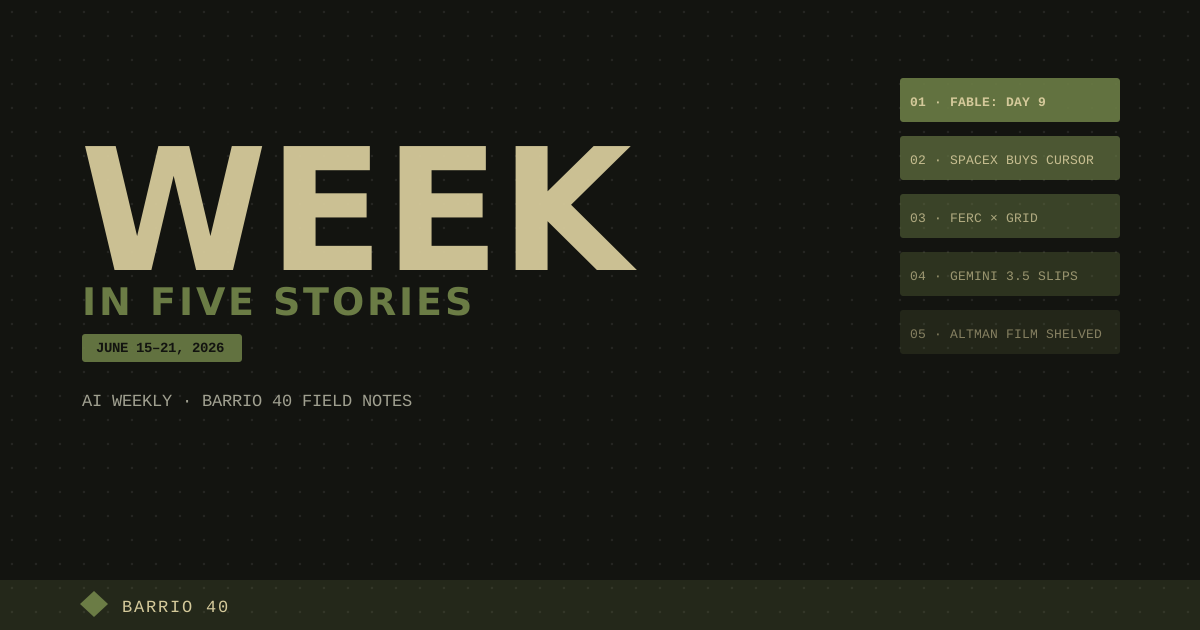
1. DAY NINE: TRUMP SOFTENS ON ANTHROPIC AT THE G7, BUT THE DIRECTIVE — AND THE BLACKOUT — STILL STAND
On June 17, on the sidelines of the G7 summit in Évian-les-Bains, Dario Amodei and Google DeepMind CEO Demis Hassabis sat down with world leaders for a working lunch on AI policy, where the two executives jointly proposed a US-led democratic AI coalition designed to coordinate advanced-AI standards among allied nations while excluding China. Three days later, in an interview with Axios, President Trump described his takeaway from meeting Amodei in noticeably personal terms — calling him "nice" and "smart" — and was asked directly whether he still viewed Anthropic as a national security threat. His answer: "Well, not now, but a week ago, maybe." It was the most direct walk-back any administration official has offered since Commerce Secretary Howard Lutnick's directive landed on Amodei's desk at 5:21 PM Eastern on June 12, and after a week in which the public framing from Trump adviser David Sacks had been that "the ball is in Anthropic's court," a softer line from the president himself read, to most coverage, as a genuine shift in tone rather than a scripted talking point.
What a shift in tone does not do, as of Saturday, is change the facts on the ground. The Commerce Department's export-control directive remains the operative legal instrument, and rescinding it is a bureaucratic process — involving the same agency that issued it, under the same national-security authority it cited — that a presidential interview cannot shortcut on its own. Claude Fable 5 and Claude Mythos 5 enter Day 9 of the suspension exactly as they entered Day 8: unavailable to any customer worldwide, because Anthropic still has no mechanism to filter access by citizenship at the API layer in real time, and a refund deadline for affected enterprise customers that several trackers flagged as closing on June 20 has now passed with no parallel announcement that access itself is returning. Anthropic's own public language has not moved past "confident... in the coming days" — the same phrase Managing Director of International Chris Ciauri used in Seoul on June 18, a day before Trump's softened remarks, which suggests the optimism inside Anthropic was not actually triggered by the G7 meeting but has been running in parallel with it since at least the middle of the week.
The practical lesson for anyone watching this as a vendor-risk question, rather than a political story, is that a president's change of heart and a federal directive's legal status are two different clocks, and only one of them has moved this week. Enterprise teams that built contingency plans around Fable 5 and Mythos 5 going dark for "a few more days" now have nine days of actual downtime behind them and a friendlier political mood ahead of them, which is a meaningfully better position than seven days ago — but it is still not a restoration date, an SLA credit, or a technical explanation of what "patched" will mean when the directive is finally lifted. The single most informative detail to come out of the G7 episode may not be Trump's quote at all, but the fact that Amodei used his seat at the table not to lobby privately for Fable 5's return, but to pitch a multilateral AI coalition — a reminder that for Anthropic, the blackout is now one item on a much longer geopolitical agenda, not the only thing the company is negotiating in Washington this month.
2. SPACEX CLOSES ITS $60 BILLION CURSOR ACQUISITION, BUILDING A VERTICALLY INTEGRATED CODING STACK AROUND XAI
SpaceX completed its all-stock acquisition of Cursor for $60 billion on June 16, exercising an option it had held since April 2026 to either buy the AI coding company outright for that figure or settle for a $10 billion partnership instead. The timing is notable on its own: the deal closed just four days after SpaceX's own record-breaking IPO, meaning the company used freshly listed stock, rather than cash, to absorb a startup generating roughly $4 billion in annualized revenue, including $2.6 billion from enterprise accounts — a business large enough that, stood alone, it would already rank among the most valuable pure-play AI coding companies on the market. The strategic rationale, confirmed by people close to the deal, is that Cursor's developer ecosystem and proprietary coding data will be folded into the broader SpaceXAI organization (formed when xAI merged with SpaceX in February 2026), running on xAI's Colossus supercomputing infrastructure, with a jointly trained model — reported under the working name Grok Build — expected to ship inside both Cursor and a forthcoming standalone product in the near term.
The significance of the deal goes beyond its size. Cursor's entire commercial pitch since launch has rested on being model-agnostic — a polished interface layered over whichever frontier model (Anthropic's Claude, OpenAI's GPT family, Google's Gemini) a given customer or task performed best with. A vertically integrated owner with its own frontier model and its own compute changes that calculus in a direction every AI coding tool has so far tried to avoid: Cursor under SpaceXAI has both the incentive and the infrastructure to start routing more of its workload toward Grok Build rather than the third-party models that built its reputation, the same tension that has shaped GitHub Copilot's relationship with OpenAI and Claude Code's relationship with Anthropic's own model line, except now playing out at a company that spent three years marketing model-agnosticism as its core differentiator. It also gives Musk a third pillar — alongside Grok itself and Tesla's robotics ambitions — in a coding-tools market that, until this week, was effectively a two-horse race between Microsoft/OpenAI's Copilot stack and Anthropic's Claude Code, now reshaped into a genuine three-way contest with a deep-pocketed, vertically integrated new entrant.
For engineering organizations that adopted Cursor specifically because it let them choose their underlying model on a task-by-task basis, the acquisition is the second vendor-dependency story of the month — after Fable 5's export-control exposure — that argues for treating "which company owns my coding tool" as a question worth re-asking on a recurring basis rather than answering once at procurement time and filing away. Nothing about Cursor's existing integrations breaks on day one; SpaceXAI has every commercial incentive to keep multi-model support working well enough that customers don't churn during the transition. But a tool's incentives shift the moment its owner also owns a frontier model competing for the same workload, and teams with meaningful Cursor footprints should expect that shift to show up gradually, in default settings and pricing tiers, well before any formal announcement says so explicitly.
3. FERC TELLS THE GRID TO MAKE ROOM: SIX OPERATORS, 200 MILLION AMERICANS, 60 DAYS TO ANSWER
On June 18, the Federal Energy Regulatory Commission voted unanimously to issue tailored "show cause" orders, under Section 206 of the Federal Power Act, to the six largest US regional grid operators: PJM Interconnection, the Midcontinent Independent System Operator, the Southwest Power Pool, the California Independent System Operator, ISO New England, and the New York Independent System Operator — a footprint covering roughly 200 million Americans across more than 30 states and the District of Columbia. Texas, which runs its own grid outside federal jurisdiction through ERCOT, is explicitly excluded. Each operator now has 60 days to either defend its existing interconnection rules or propose reforms across five categories the agency identified, and a separate 30-day deadline to report exactly how much spare generating capacity it has, if any — a level of mandated transparency about grid headroom that utilities have historically been reluctant to disclose in this much granular detail.
The order is the most direct federal intervention yet specifically aimed at AI's power demand, and it traces back to an October 2025 directive from Energy Secretary Chris Wright asking FERC to consider reforms that would let "large loads" — the agency's term of art, covering AI data centers alongside heavy manufacturing — connect to the grid faster without compromising reliability or shifting costs onto existing residential and commercial ratepayers. That last clause is doing real political work: every grid operator FERC named has spent the past two years fielding interconnection requests from data center developers whose timelines now routinely outpace the years-long queues that traditional generation and transmission planning processes were built around, and the tension FERC is trying to resolve is exactly the one utilities have been quietly warning about — fast-tracking a hyperscaler's data center is only acceptable to regulators and the public if it doesn't mean a manufacturing plant or a household pays more for the privilege.
For any company planning AI infrastructure buildout in the regions FERC named, the order is worth reading less as a one-time mandate and more as the opening move in a 60-to-90-day window where the actual rules of interconnection — queue priority, cost allocation, capacity disclosure — are about to be renegotiated in public, with regulators explicitly weighing speed against reliability and cost-shifting in real time. Companies with data center projects already in a given operator's interconnection queue have a direct interest in how each of the six responses reshapes that queue; companies still scouting sites have a rare, short window to see exactly how much spare capacity each region claims to have before committing to one over another. It is also a reminder, arriving in the same week as a Cursor acquisition and a presidential about-face on Anthropic, that the AI industry's most durable constraint this year may turn out to be neither model capability nor regulatory goodwill, but the literal availability of electrons on a grid that nobody designed for this load.
4. GEMINI 3.5 PRO MISSES PICHAI'S OWN DEADLINE, STILL STUCK IN ENTERPRISE PREVIEW
When Sundar Pichai unveiled Gemini 3.5 Pro at Google I/O on May 19, he closed the announcement with a line that drew an audible groan from the developer audience in the room: "Give us until next month to get it to you." Five weeks later, with only days left in that "next month," Gemini 3.5 Pro remains in limited preview for a handful of Vertex AI enterprise customers — it has not reached the public Gemini app, Google AI Studio, or the consumer Gemini subscription tier, and Google has not issued a revised public timeline. The model's headline specifications, a 2-million-token context window and a "Deep Think" reasoning mode aimed at frontier multimodal tasks, remain unverified at any meaningful public scale, which is itself notable given how aggressively Google marketed both figures at the original announcement.
The delay is a small story next to export-control directives and ten-figure acquisitions, but it lands at an instructive moment. Polymarket now runs a market on exactly when the "next Google Gemini Pro model" will release — a smaller, quieter echo of the Kalshi and Polymarket contracts pricing Fable 5's restoration that this site covered last week, and a sign that prediction markets have normalized as a way for developers to express uncertainty about any major lab's shipping commitments, not just Anthropic's. The comparison that matters most for teams evaluating frontier model vendors is the contrast in pace: in the same five-week window that Gemini 3.5 Pro has sat in enterprise preview, Anthropic shipped Fable 5 and Mythos 5 publicly, had them pulled by federal order, and is now negotiating their return, while SpaceXAI closed a $60 billion acquisition to build an entirely new model from scratch. Google's caution may well be the more defensible engineering choice — shipping a 2-million-token context window and a new reasoning mode broadly is a harder problem than most public roadmaps acknowledge — but in a market currently rewarded for speed even when that speed produces export-control headaches, a missed self-imposed deadline reads as a competitive liability regardless of the underlying technical justification.
For product teams that built a 2026 roadmap assuming Gemini 3.5 Pro's headline capabilities would be generally available by June, the practical move is the same one this site has recommended for Fable 5 dependencies all month: treat any unshipped frontier-model capability as a planning assumption, not a commitment, and keep a fallback path live until the model is in your hands under your own account, not a vendor's preview waitlist. The gap between "announced" and "generally available" has widened across every major lab this year, not narrowed, and Gemini 3.5 Pro's slipping deadline is simply the cleanest current example of a pattern that should already be priced into any roadmap leaning on a model that hasn't shipped yet.
5. AMAZON SHELVES ITS OWN SAM ALTMAN MOVIE, FOUR MONTHS AFTER WRITING OPENAI A $50 BILLION CHECK
Amazon MGM Studios has dropped Artificial, Luca Guadagnino's nearly finished film about Sam Altman and the founding of OpenAI, starring Andrew Garfield as Altman. The film had reportedly tested well with early audiences, and insiders who have seen it told Variety that its portrayal of both Altman and Elon Musk is unflinching — the two characters described as the least sympathetic in the film and the ones audiences liked least — with a tone considerably darker than Amazon had anticipated when it greenlit the project. The decision to shelve it comes four months after Amazon committed $50 billion to OpenAI as part of a $110 billion funding round that also made AWS the exclusive third-party cloud distribution provider for OpenAI's enterprise platform, and Amazon has offered no public explanation beyond a statement that it is "working to find the film a new home" at another studio. Altman's personal ties to Amazon leadership — he attended the wedding of Amazon executive chairman Jeff Bezos and Lauren Sánchez in Venice last June — add a layer reporters have not been shy about noting, even without any confirmation that it factored into the decision.
What makes this story worth including alongside four much larger ones is how cleanly it rhymes with the throughline running underneath every other item in this week's roundup. Amazon is simultaneously Anthropic's largest investor and a cloud host whose security team's findings helped trigger the Fable 5 shutdown this site covered in detail last week; this week, the same company is both OpenAI's largest new investor and the studio that controls whether a commercially finished, unflattering film about OpenAI's CEO ever reaches an audience. SpaceX's Cursor acquisition collapses the line between "tool vendor" and "model owner" in coding software the same way Amazon's overlapping roles collapse the line between "investor" and "media gatekeeper" in how the AI industry's own story gets told. None of these companies set out, this particular week, to demonstrate the same structural point five different ways — but taken together, the Fable 5 G7 reversal, the Cursor acquisition, the FERC grid order, Gemini's slipped deadline, and now a shelved biopic all describe an industry where the handful of companies with the capital to fund, host, and build frontier AI are increasingly the same companies positioned to shape how the public hears about it, regulates it, and gets to use it at all.
For anyone trying to read AI industry coverage clearly this year — whether to make a procurement decision, a regulatory comment, or just to understand what actually happened in a given week — the practical takeaway is to ask, for any story involving Amazon, Microsoft, Google, or SpaceX, what other role that same company is playing in the story being told. It does not mean a given report is wrong. It means the entanglement is now thick enough, across enough simultaneous storylines, that treating any single company's account of an AI-adjacent event as disinterested requires checking, every time, whether that company also has money, infrastructure, or now apparently a finished film riding on how the story lands.