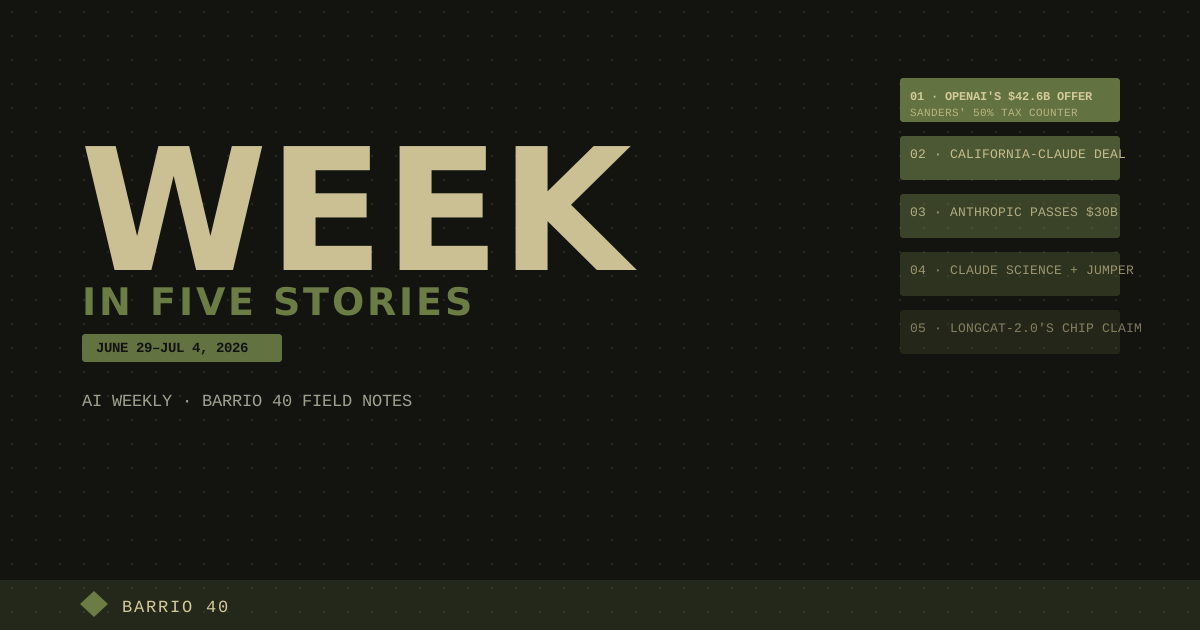
1. WASHINGTON'S GATE REACHES ITS NEXT STAGE: A $42.6 BILLION OFFER, A 50% TAX COUNTER, AND A RACE TO WRITE THE RULES DOWN
This site has now tracked a full month of the same underlying story arriving through a different mechanism each time it resurfaces. It started June 12 with Commerce ordering Claude Fable 5 and Mythos 5 off the market entirely; it continued June 26 with Mythos 5's narrow return to roughly 100 vetted critical-infrastructure organizations; it picked up a second lab on June 30 when Commerce Secretary Howard Lutnick personally asked Sam Altman to stagger GPT-5.6's release behind a pre-approval gate, limiting Sol, Terra, and Luna to roughly 20 partner organizations at launch; and it reached, on July 1, the moment Fable 5 came back online worldwide after nineteen days dark. What this week added is the clearest sign yet that the labs themselves have stopped waiting for the next directive and started proposing terms first. Altman's July 2 offer — a 5% OpenAI stake worth $42.6 billion, structured through what he's calling a government-seeded "Public Wealth Fund" modeled loosely on the Alaska Permanent Fund — is, on its own, a negotiating opener rather than a signed deal. But it is a negotiating opener that only makes sense against everything this site covered in June: a company conceding, in effect, that its relationship with Washington is now closer to a capital-table conversation than a compliance checkbox.
Sanders' response sharpened the contrast rather than resolving it. Where Altman's offer is negotiated, voluntary, and structured to let OpenAI control governance terms, Sanders' 50% tax on OpenAI, Anthropic, and xAI shares is a legislated transfer no CEO gets to shape after the fact — and his public dismissal of the equity stake as "not enough" makes clear the two are not converging toward the same policy, just competing for the same political space. That space got more crowded still this week when the Financial Times and Reuters both reported that the White House is in advanced talks with OpenAI, Google, and Anthropic on voluntary standards governing how new frontier models get tested and released before launch, following the executive order Trump signed in June directing agencies to work with labs on exactly that. An announcement is reportedly possible within days. If it lands, it would formalize — as an actual, named policy — the ad hoc gating this site has documented lab by lab since June 12: GPT-5.6's staggered rollout, Fable 5 and Mythos 5's shutdown and partial restoration, and now a codified pre-release review that every major US lab would operate under going forward, not just the two Washington has already intervened on directly.
The practical takeaway for any team planning twelve months out on a frontier-model dependency hasn't changed shape this week so much as it's gained a third data point supporting it: an equity stake, a competing tax proposal, and a forthcoming standards framework are three different mechanisms pointing at the same underlying fact, which is that the relationship between the US government and the handful of companies building frontier AI has moved from background regulatory risk to an active, week-to-week variable in the product roadmap. None of the three is finalized. All three are worth tracking as if they will be.
2. CALIFORNIA BETS ON CLAUDE WHERE THE PENTAGON WOULDN'T
On June 29, Governor Gavin Newsom announced what his office is billing as a first-of-its-kind partnership: every California state agency, city, and county gains access to Claude at a 50% discount, along with free workforce training and technical support from Anthropic, routed through a new California Department of Technology portal — the Statewide IT Shared Services, or SITeS, platform — designed to centralize AI procurement and make pricing transparent across departments. The deal isn't starting from zero: the Department of Technology and the Office of Emergency Services are already running Claude Security and Claude Code for cyber-defense work, while the DMV and the Department of Health Care Services have been piloting Claude for customer service and internal workflow tasks. Newsom framed the initiative carefully around labor, not replacement: "AI should not replace the human work of government; it should help our workers move faster, solve problems more effectively, and deliver better results for Californians."
What makes the timing notable is the contrast it draws with Anthropic's own year. Earlier in 2026, Anthropic and the Department of Defense clashed over contract language that would have permitted Claude's use for mass domestic surveillance and fully autonomous lethal weapons systems; Anthropic pushed for explicit carve-outs against both, Defense Secretary Pete Hegseth refused to accept them, and the Pentagon signed its agentic-AI contract with OpenAI instead. Read next to that outcome, the largest state government in the country choosing Claude — at a discount, with the state's own governor publicly framing the deal around augmenting rather than replacing government workers — reads less like a coincidence than like Anthropic finding, at the state level, the kind of government customer it couldn't secure at the federal one. It is also, mechanically, the largest state-level AI deployment either lab has landed to date, and a template other states now have a concrete example to negotiate against.
For product and public-sector teams, the SITeS portal detail is worth more attention than the headline discount. A government adopting a single AI vendor at scale, with transparent per-use-case pricing published in one place, gives every other state and municipal buyer a live pricing benchmark to negotiate from — the kind of leverage individual enterprise customers rarely get. Expect this deal's actual terms, once departments start reporting usage, to shape how other states structure their own AI procurement conversations for the rest of the year.
3. THE REVENUE CROSSOVER: $30 BILLION TO $25 BILLION, AND WHY BOTH SIDES ARE ARGUING ABOUT THE NUMBER
Reporting that gained fresh attention this week confirms a crossover that first happened back on April 7: Anthropic's annualized revenue hit $30 billion, ahead of OpenAI's roughly $25 billion, marking the first time since ChatGPT's late-2022 launch that Anthropic has out-earned its larger rival. The growth curve behind that number is the more striking detail — Anthropic went from roughly $1 billion in annualized revenue in January 2025 to $30 billion fifteen months later, a 30x increase that outpaces almost any other software business at this scale in recent memory. OpenAI's chief revenue officer has pushed back on the figure, arguing Anthropic's number is overstated by roughly $8 billion due to how the company recognizes revenue passed through cloud-partnership channels; Anthropic's position is that it is the principal in those transactions under standard ASC 606 accounting rules, and therefore entitled to book the revenue directly rather than as a smaller commission. Whichever accounting standard proves more persuasive, the dispute itself is a tell: neither company would be arguing this hard over an $8 billion gap if the underlying number weren't material to how each is positioned in the market right now.
The more durable story sits beneath the accounting fight. Roughly 85% of Anthropic's revenue comes from enterprise and developer customers, while OpenAI's mix runs close to the opposite — around 85% tied to ChatGPT consumer subscriptions. Enterprise usage tends to generate three to five times more revenue per token than consumer traffic, follows more predictable query patterns that are cheaper to serve, and sits inside contracts that are stickier than a monthly consumer subscription. That structural difference is why this week's crossover reads as more than a one-quarter fluke: it reflects two labs that made a fundamentally different bet on who their primary customer would be, and the enterprise bet is, for now, paying out faster. Set against Section 1 of this recap, the juxtaposition is hard to miss — the same week OpenAI is negotiating equity terms with the government it depends on for release approval, it's also the week independent reporting says it fell behind Anthropic on the metric that matters most to investors deciding what any of this is actually worth.
4. CLAUDE GOES TO THE LAB: SCIENCE, A NOBEL LAUREATE, AND A $400 MILLION TELL
Anthropic used the same week it was fighting a political and financial battle on two fronts to formalize a third, entirely different one: on June 30, the company launched Claude Science, a dedicated AI workbench pre-configured for genomics, single-cell biology, proteomics, and cheminformatics, backed by more than 60 scientific databases and available immediately to every paid Claude subscriber. The product didn't arrive as a standalone bet. It capped roughly eight months of deliberate assembly — life-sciences partnerships with the Allen Institute and the Howard Hughes Medical Institute, a pre-training hire in Andrej Karpathy, and a roughly $400 million stock acquisition in April of Coefficient Bio, a stealth biotech startup with fewer than 10 employees, most of them former Genentech computational biology researchers, who brought protein-design and biomolecule-modeling expertise into Anthropic's life sciences division under Eric Kauderer-Abrams. This week's capstone hire made the ambition explicit: John Jumper, the Google DeepMind vice president who won the 2024 Nobel Prize in Chemistry for AlphaFold, is leaving DeepMind after nearly nine years to join Anthropic, though neither side has disclosed what role he'll take.
Dario Amodei's stated goal for the push is to compress life-sciences R&D cycles by a factor of ten — a target worth measuring against where the field actually stands today, which is that no AI-discovered drug has yet won FDA approval. That gap between ambition and outcome doesn't make the buildout less real; Jumper's own AlphaFold work took years to move from a landmark structure-prediction result to anything resembling a therapeutic pipeline, and Anthropic is explicitly betting that assembling in-house computational-biology talent, acquired domain expertise, and a purpose-built product surface compresses that timeline rather than just adding another well-funded entrant to a crowded field. The more immediate signal for anyone watching the broader AI-lab landscape is competitive: Anthropic is now visibly building a second product category, backed by a Nobel laureate and a dedicated acquisition, at the same moment its core model business is fighting export-control fights and equity-stake negotiations — a company with enough organizational bandwidth to run three different high-stakes plays in the same month.
5. THE CHIP WALL CRACKS AGAIN: WHAT LONGCAT-2.0 STILL MEANS, ONE WEEK LATER
This site's July 1 briefing covered Meituan's LongCat-2.0 in detail — a 1.6-trillion-parameter mixture-of-experts model, roughly 48 billion parameters active per token, trained on more than 35 trillion tokens end-to-end on a cluster of over 50,000 domestic Chinese ASIC accelerators, with no Nvidia hardware anywhere in the pipeline, and self-reported benchmarks ahead of Gemini 3.1 Pro and GPT-5.5 on SWE-bench Pro and SWE-bench Multilingual, though still behind Claude Opus 4.7 and 4.8. A week on, the two facts worth holding onto are the ones this site flagged at the time and that neither Meituan nor any independent evaluator has updated since: the model was, within hours, the most-used release on OpenRouter, and the actual weights still haven't shipped — both GitHub and Hugging Face still read "coming soon." That gap between headline and artifact matters, and it hasn't closed.
What the week added is context rather than new facts: LongCat-2.0's release landed in the same stretch as Nvidia CEO Jensen Huang's own account of the Chinese market, where he's said the company has "largely conceded" advanced AI chip sales to Huawei and called that outcome a strategic miscalculation on Washington's part. Set beside this week's other four stories, LongCat-2.0 is the one that complicates all of them from underneath: while Washington negotiates equity stakes and voluntary release standards with the labs it can actually reach, and while those same labs build revenue and scientific credibility on the models sitting behind that gate, the premise that chip export controls keep frontier-scale training out of reach for a determined foreign competitor took another hit this week — not a fatal one, and not yet a verified one, but a data point that keeps arriving faster than the policy built to prevent it.
Taken as a set, this week's five stories describe an industry where every actor — labs, government, capital markets, and now foreign competitors building around the chip controls entirely — is negotiating for more control at the exact same moment none of them has enough of it to dictate terms unilaterally. OpenAI is offering equity to buy political goodwill it can't otherwise guarantee. Anthropic is landing government wins at the state level it couldn't land at the federal one, while its Nobel-laureate hire and enterprise revenue lead say more about long-term positioning than either shutdown or equity story does on its own. And a Chinese food-delivery company just demonstrated that the hardware moat the whole US strategy assumed would hold is thinner than the policy apparatus built around it. None of that resolves by next week. The planning lesson for teams building on any of these vendors is the same one this site has repeated through June and into July: treat the current terms of access, pricing, and vendor stability as provisional, because every one of this week's five stories is evidence that they are.