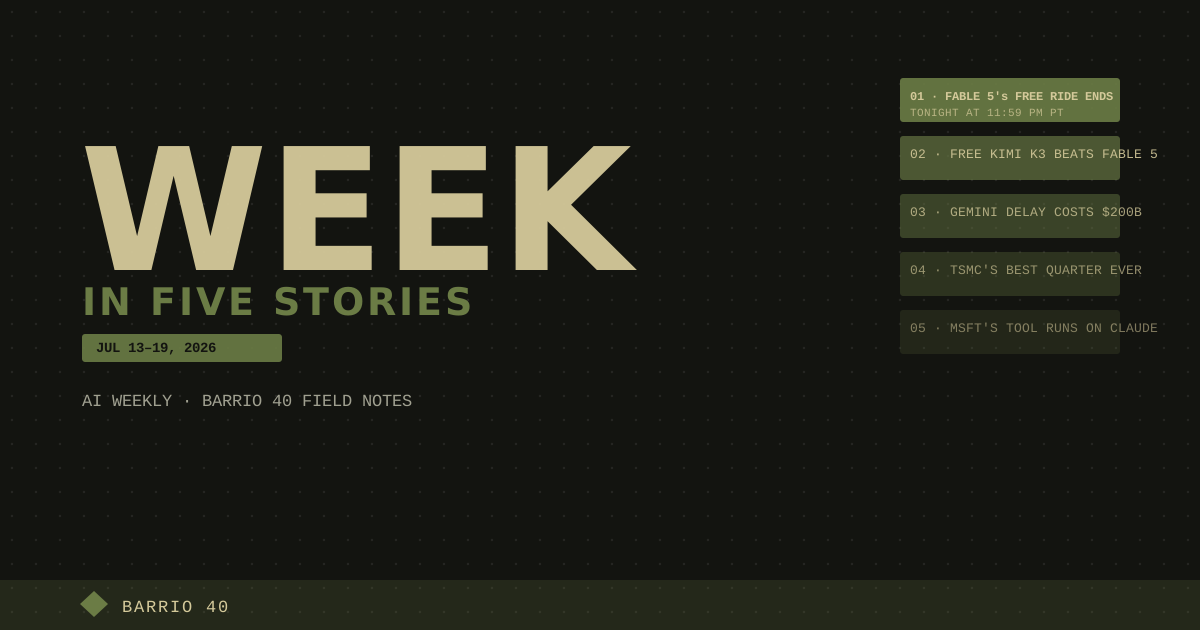
1. FABLE 5's FREE RIDE ENDS TONIGHT — AND THE OPUS 5 RUMORS AREN'T FILLING THE GAP
Anthropic has extended free Claude Fable 5 access for Pro, Max, Team, and premium Enterprise subscribers three times in five weeks, most recently pushing the deadline to July 19 at 11:59:59 PM PT, letting paid users burn up to 50% of their weekly usage limits on the flagship model at no extra charge. Tonight that window closes for good, according to Anthropic's own guidance, and what replaces it is a pay-per-use model priced at $10 per million input tokens and $50 per million output tokens — prepaid credits, billed beyond whatever a subscription already covers. Set against SpaceXAI's Grok 4.5, which completes a full agentic coding task for roughly $2.49 versus Fable 5's own $11.80, the new pricing isn't a technicality; it's Anthropic asking the market to pay a premium it hasn't had to justify in five weeks of free access.
The timing has an unresolved subplot attached to it. A mysterious, unreleased model called "Claude Honeycomb EAP" briefly surfaced inside Cursor earlier this month, and the leak hardened into a working theory across developer forums that Opus 5 could ship before the month is out. Anthropic's own documentation and official channels contain no reference to Honeycomb or an Opus 5 launch date as of this writing, which means subscribers facing tonight's price cliff are choosing between paying full freight for Fable 5, downgrading, or waiting on a model nobody at Anthropic has confirmed exists yet.
2. A FREE, OPEN-WEIGHT CHINESE MODEL BEAT FABLE 5 ON A CODING BENCHMARK
Moonshot AI released Kimi K3 on July 16: 2.8 trillion parameters, a mixture-of-experts design running 896 experts with 16 active per token, a 1-million-token context window, and the first open model to reach the 3-trillion-parameter class. On the Frontend Code Arena leaderboard, Kimi K3 took the top spot outright with 1,679 points, ahead of Claude Fable 5's 1,631, GPT-5.6 Sol's 1,618, and Zhipu's GLM-5.2 at 1,587. The result isn't a clean sweep — on GDPval-AA v2, a broader benchmark spanning real-world tasks across 44 occupations and nine industries, Kimi K3's 1,687 placed third, behind Claude Fable 5 Max (1,815) and GPT-5.6 Sol Max (1,747.8) — but a single-benchmark win against a frontier US model was enough to travel fast this week regardless of the caveat.
What makes the win sting is the price tag: zero. Moonshot has committed to releasing Kimi K3's full weights by July 27, meaning any developer willing to self-host inherits a model that beat Fable 5 on at least one serious coding benchmark without a per-token bill of any kind. That release lands eleven days after Fable 5's free window closes, on the same trajectory this site has been tracking since Chinese models' share of US enterprise AI traffic climbed past 40% earlier this month — proof that the pressure on US labs' pricing power isn't theoretical anymore, it has a benchmark number attached to it.
3. GOOGLE'S GEMINI 3.5 PRO DELAY COST ALPHABET $200 BILLION IN A DAY
Bloomberg reported July 16 that Google scrapped Gemini 3.5 Pro's original base model and restarted pretraining from scratch after engineers found structural failures in recursive tool-calling and SVG generation — the second missed target after the model slipped from its original June debut, and the second time this site has had to report Gemini 3.5 Pro still hadn't shipped on a date Google itself had set. The market's reaction was immediate: Alphabet shares fell 4.4% that Thursday, erasing roughly $200 billion in market capitalization in a single session, with some reports putting the figure as high as $225 billion depending on the intraday mark used. Google is reportedly weighing a stopgap Gemini 3.6 Flash release to bridge the gap while the rebuilt Pro model finishes training.
The selloff didn't happen in isolation. This site reported on June 25 that four senior Google DeepMind researchers left within a single week — Transformer co-inventor Noam Shazeer to OpenAI, AlphaFold Nobel laureate John Jumper to Anthropic, and researchers Jonas Adler and Alexander Pritzel also to Anthropic — a departure wave that already had investors questioning whether DeepMind could hold its research edge. A model delay by itself is a schedule problem. A model delay arriving three weeks after the team's most senior researchers walked out the door reads, to a market pricing Alphabet in real time, like the same problem twice.
4. TSMC POSTED ITS BEST QUARTER EVER — REGARDLESS OF WHICH LAB IS WINNING
Also on July 16, TSMC reported record Q2 2026 revenue of $40.2 billion, up 36% year-over-year, with net profit surging 77.4% to NT$706.56 billion and gross margin climbing to 67.7% — the best quarter in the company's history. High-performance computing, the category covering AI accelerators, made up 66% of quarterly revenue and grew 20% quarter-over-quarter on its own, prompting TSMC to raise its full-year AI-chip growth outlook to above 40% and lift capital-expenditure guidance to $60–64 billion, up from $52–56 billion, alongside a fresh $100 billion commitment to its Arizona fabs. Its newest 2-nanometer node made its first meaningful commercial contribution this quarter, at 3% of wafer revenue, while chips at 7-nanometer or smaller still account for 77% of the total.
Read against the rest of this week's stories, TSMC's number is the tell. Anthropic can raise prices, Moonshot can give a frontier-class model away for free, and Google can lose a quarter-trillion dollars in market cap over a delay — all in the same seven days — but every one of those companies' products still has to be manufactured somewhere, and that somewhere is still TSMC. The model layer is where the public argument happens; the foundry layer is where the money settles, and this week it settled at a record for the fifth time in six quarters.
5. MICROSOFT'S NEW SECURITY TOOL RUNS ON THE LABS IT TRAINED REPS TO TALK DOWN
This site reported on July 16 that Microsoft trained its sales force to call Claude "slower and less accurate" while quietly routing Copilot traffic toward its own in-house MAI models. This week, reporting on Microsoft's forthcoming Project Perception adds an awkward footnote to that story: the AI-driven vulnerability-detection platform, expected to launch this month, is built on a routing system that matches each security task to whichever model handles it best — drawing specifically on models from Anthropic, OpenAI, and Microsoft itself. Its stated selling point against Anthropic's own Claude Mythos is cost, since Mythos's API pricing runs roughly double Claude Opus's and 82% above GPT's on a like-for-like basis. As of this week, Microsoft hadn't published Project Perception's pricing, availability, or customer eligibility.
The contradiction isn't new — Microsoft has been both OpenAI's largest shareholder and a company quietly reducing its reliance on OpenAI's and Anthropic's APIs for months — but Project Perception sharpens it into a single product decision. A company whose sales reps spent this month arguing Claude is the weaker choice is, in the same month, shipping a flagship security tool that leans on Claude specifically because it's good enough to route real vulnerability work to, so long as the price undercuts what Anthropic charges for the equivalent Anthropic-built product.
Taken together, this week's five stories are what happens when an industry that has spent a year competing on announcements gets a week of competing on numbers instead. Anthropic's pricing decision isn't happening in a vacuum — it's landing the same week a free alternative beat its own model on a benchmark, which is exactly the kind of timing a pricing team doesn't get to choose. Google's delay wasn't just a schedule slip; it was a schedule slip priced by a market that had already watched the team responsible walk out the door in June. TSMC's earnings are the reminder that sits underneath every one of the other four stories: the AI race is also, still, a semiconductor business, and that business had its best quarter yet regardless of who's winning the argument above it. And Microsoft's new security tool shows that even the company most invested in talking down its rivals' models can't quite stop building products on top of them. None of that resolves which lab, which model, or which pricing strategy wins from here. It does confirm what this week added up to: five separate numbers — a token price, a benchmark score, a stock chart, an earnings report, and an unpublished price tag — that did more to describe the state of the AI race than any single announcement this week could have.