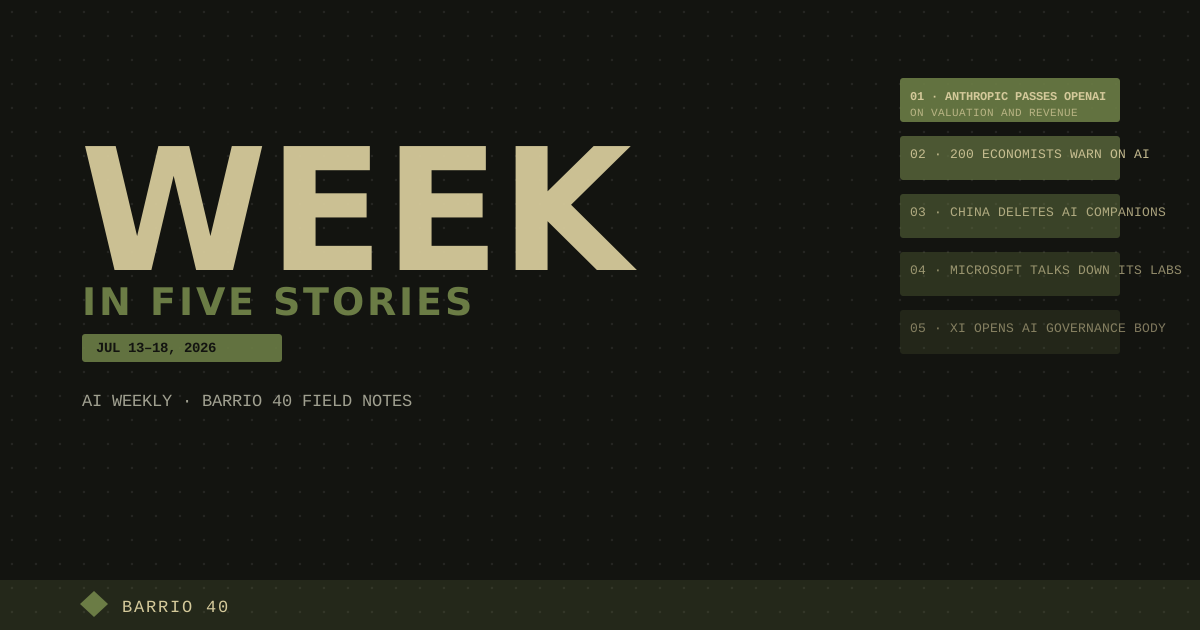
1. ANTHROPIC PASSES OPENAI ON VALUATION AND REVENUE — AND OPENAI'S $1 TRILLION FLOOR GETS HARDER TO DEFEND
Anthropic's Series H, which closed in May at $965 billion, passed OpenAI's $852 billion private mark for the first time. The revenue crossover that followed is the more telling number: Anthropic's run rate went from $9 billion at the end of 2025 to $47 billion by May 2026, overtaking OpenAI's own $25–33 billion range depending on which disclosure is used. Both companies filed confidential S-1s within a month of each other this spring, nominally aiming for public debuts inside the same six-week autumn window — but Altman has told his advisers that any IPO valuation below $1 trillion is a "nonstarter," a full $150 billion above the low end of the range his own bankers are reportedly modeling, and above even OpenAI's last private mark.
Two developments made that floor harder to defend this week. SpaceX, the first of the AI-adjacent trio to actually test the public markets, saw its post-debut stock slide from a $225 peak to $153 — enough that OpenAI's advisers are said to be floating a 2027 delay rather than test a market that just watched a comparable debut lose a third of its value. And five days before this week began, Apple sued OpenAI in federal court alleging a scheme reaching "every level" of the company to extract trade secrets through more than 400 former Apple employees — a pending federal lawsuit that becomes its own numbered risk factor in whatever S-1 eventually goes public. Anthropic, by contrast, doesn't have to persuade anyone of anything: its last private mark already cleared $965 billion, meaning a public listing above that number is a story about growth, not a story about talking a skeptical market into a number it hasn't already agreed to.
2. 200 ECONOMISTS AND 16 NOBEL LAUREATES WARN ON AI'S ECONOMIC IMPACT — AND CAN'T AGREE HOW TO MEASURE IT
"AI may become radically more powerful over the next 10 years. This could drive an unprecedented transformation of our economy, larger than the Industrial Revolution, but unfolding over a vastly shorter time frame." Those 88 words, organized by Stanford's Digital Economy Lab, now carry more than 200 signatures, 16 of them Nobel laureates, spanning Google's Jeff Dean, Anthropic cofounder Jack Clark, OpenAI finance chief Sarah Friar, and Yoshua Bengio. The most notable name is Daron Acemoglu, a 2024 Nobel laureate who has spent years calling most AI-productivity discourse "brainless" and estimating AI would add only 0.55% to total factor productivity over a decade — his signature isn't an alarmist joining alarmists, it's the field's most rigorous doubter of the hype saying the near-term risk has moved regardless.
What the letter doesn't do is define "exposure" — the load-bearing concept underneath nearly every labor-market study its own signatories have published. Apollo's chief economist Torsten Slok used the same week to lay out why that matters: at least five distinct methodologies currently measure how "exposed" a job is to AI, ranging from real Claude and Copilot conversation logs to theoretical, capability-based expert judgments to ChatGPT grading its own usefulness — and they diverge most sharply on exactly the occupations, like telemarketers and writers, that this week's coverage cited as most at risk. A 200-signature, 16-Nobel-laureate coalition could agree on a shared sense of urgency far more easily than on a shared definition of the thing it's urgent about, and the letter itself proposes no policy, tax, or threshold — just a general call for "guardrails," unspecified.
3. CHINA'S ANTI-ADDICTION LAW TAKES EFFECT — BYTEDANCE AND ALIBABA DELETE THEIR AI COMPANIONS RATHER THAN REDESIGN THEM
China's Interim Measures for the Administration of AI Anthropomorphic Interaction Services took effect July 15, requiring any AI service that sustains an ongoing emotional relationship to interrupt itself past two continuous hours, offer an always-available exit, repeatedly disclose it's a machine, and bar virtual partners or family members for anyone under 18. ByteDance's Doubao — China's most-used AI app, with roughly 345 million monthly active users — and Alibaba's Qwen didn't attempt a compliant redesign. They deleted their persona-agent features outright, giving users only a brief read-only window to view old chat histories before the data becomes permanently inaccessible, with no export tool offered by either company.
The reason isn't stubbornness — it's architecture. A companion agent's entire value proposition is continuity: it remembers, it maintains a consistent character, and the immersion is the product. A forced reality check every two hours and a running disclosure that undercuts the illusion doesn't shrink that product, it inverts it, which is why productivity and workplace agents were left untouched by a law defined around "sustained emotional interaction" rather than any broader category of AI agent. China is now the first major jurisdiction to write comprehensive rules for a global AI-companionship market estimated at $30 billion a year today and projected toward $70–150 billion by 2030 — and the narrowness of its definition, separating "companion" from "productivity tool" by function rather than branding, is exactly the kind of template other regulators tend to borrow even when they don't credit the source.
4. MICROSOFT TRAINS SALES REPS TO TALK DOWN THE TWO LABS IT OWNS A STAKE IN
At an internal FY27 sales-strategy meeting this week, Microsoft executive Jacob Andreou delivered reps a direct comparison against Anthropic's Claude — the model actually running much of Microsoft 365 Copilot's output today — calling it "slower and less accurate" with weaker security integration than Microsoft's own stack. The talking points sit on top of a product change already underway: Microsoft's in-house MAI models are now handling tens of thousands of Copilot requests a week inside Excel and Outlook, a deliberate substitution AI chief Mustafa Suleyman described plainly in June: "we pay a lot of money to Anthropic, so our goal is to reduce and ultimately eliminate that cost."
What makes the position structurally strange is that Microsoft isn't just a Copilot vendor choosing between suppliers — it's OpenAI's largest outside shareholder, holding roughly 27% of the company after committing more than $13 billion since 2019, a stake reported to be worth well over $100 billion. As an equity holder, Microsoft profits when OpenAI's and Anthropic's models win customers; as a product company, every query it routes to either lab's API instead of its own MAI model is a cost against its own margin. Training a sales force to cast doubt on the credibility of two labs Microsoft is simultaneously invested in, distributing, and now competing against isn't a contradiction likely to resolve cleanly — it's a tension built into occupying all three roles at once, and this week it became explicit in the sales deck rather than just the API routing logs.
5. XI JINPING OPENS A CHINA-HEADQUARTERED AI GOVERNANCE BODY. NO G7 NATION SIGNS.
Xi Jinping walked onto the World AI Conference stage in Shanghai on July 17 for the first time since the event launched in 2018, using the appearance to formally open the World AI Cooperation Organization — an intergovernmental body headquartered in Shanghai that 29 countries, including Russia, Brazil, Pakistan, Indonesia and Cuba, signed into existence the day before, with China's foreign minister signing on Beijing's behalf and UN Secretary-General António Guterres attending. Xi framed the pitch around binding oversight rather than open acceleration — laws, monitoring, early-warning systems, all "to ensure AI is always under human control" — and backed it with concrete commitments: 5,000 training opportunities for developing countries and new cooperation centers with ASEAN, the African Union, and BRICS, none of which have a formal seat at the governance tables the US, EU, and UK have spent three years building.
Not one G7 economy signed the WAICO treaty, and neither OpenAI nor Google put up a booth among the conference's roughly 1,100 exhibitors — as clean a scorecard of the current geopolitical alignment in frontier AI as any conference guest list is likely to produce this year. The timing does some of the argument on its own: the same week WAICO's signing ceremony went off exactly as scheduled, with a head of state on stage, Google's long-rumored Gemini 3.5 Pro still hadn't shipped on its own targeted date, reportedly held back by disappointing coding-benchmark results after a full pretraining rebuild. One story is a frontier lab that couldn't hit a benchmark race everyone assumed it would eventually win; the other is a government executing a multi-year institutional strategy precisely on schedule.
Taken together, this week's five stories describe an industry being asked, five separate times, to show its work rather than just its headline. Anthropic's numbers held up because a private round had already priced them; OpenAI's didn't, because a CEO-mandated floor now has to survive a spooked market and a federal lawsuit at once. Two hundred credentialed signatories could agree AI's economic disruption is coming faster than the Industrial Revolution, but not on how to measure the thing they were warning about — a gap that matters most exactly where the stakes are highest. Two Chinese platforms proved a companion product and a compliant product can't coexist by simply deleting the former rather than pretending otherwise. Microsoft's sales force said out loud what its API routing logs had already been doing quietly for weeks, exposing the tension of being investor, distributor, and competitor to the same two labs at once. And a Chinese-led governance body launched exactly on schedule in the same week a Western frontier lab missed its own rumored one, in front of a guest list that doubled as a geopolitical map. None of that settles which side is right in any of these five disputes. It does confirm what changed this week: institutions that spent the first half of 2026 controlling their own story spent this one having that story checked against a balance sheet, a lawsuit, a shutdown notice, a sales deck, and a signatory list — and only one of the five came out of it with its numbers and its narrative still pointed the same direction.