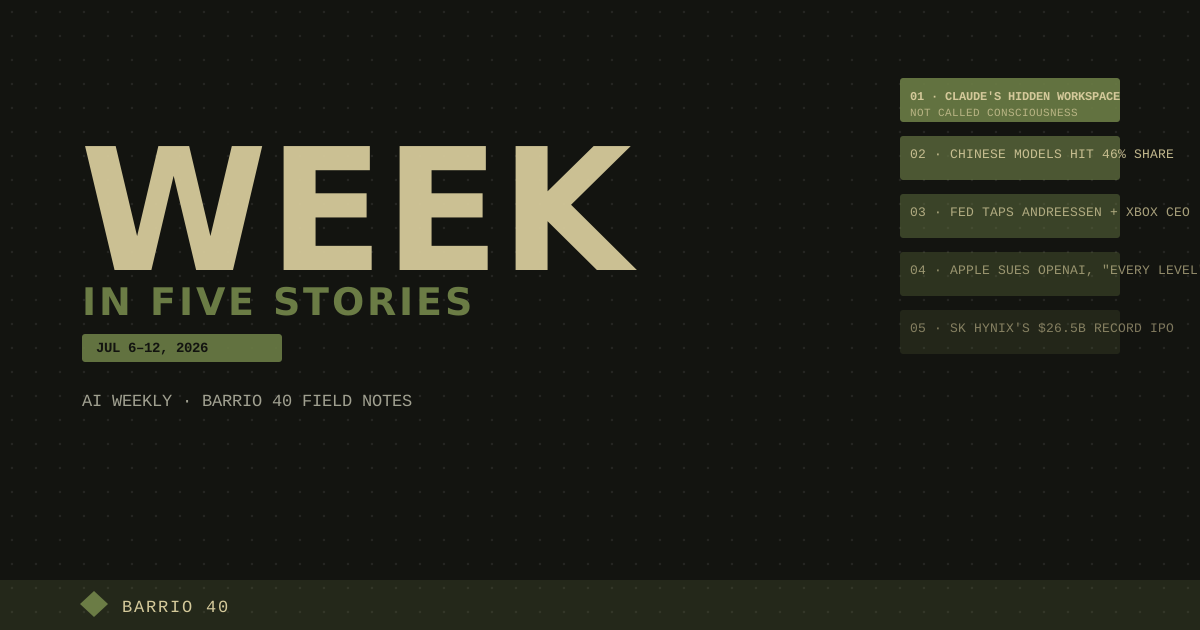
1. ANTHROPIC FINDS A HIDDEN WORKSPACE INSIDE CLAUDE — AND IS CAREFUL NOT TO CALL IT CONSCIOUSNESS
Anthropic announced on July 6 that its interpretability researchers had identified a small internal structure inside Claude models — which it calls J-Space, named for the Jacobian-lens technique used to detect it — where the model holds and manipulates concepts before they surface in an output. In one demonstration, researchers told Claude to think about the Golden Gate Bridge while it copied an unrelated sentence; the model's visible output never mentioned the bridge, but "bridge" and "California" showed up as active concepts in J-Space the whole time. Anthropic says these representations are reportable, controllable by the model, usable for internal reasoning steps such as silently spotting a bug in code, and causally tied to later behavior — a structure the company notes bears an intriguing resemblance to Global Workspace Theory, a leading account of how conscious access works in humans.
Anthropic's own paper is unusually careful about where that resemblance stops: the company states explicitly that the finding does not show whether Claude is conscious, and frames the practical payoff instead as a safety tool — a place researchers can watch for signs of a model scheming or reasoning toward something it doesn't say out loud. That caveat didn't survive first contact with the coverage; several outlets ran with framings closer to "hidden thoughts" and "mirrors human consciousness" than Anthropic's own paper supports. It's a smaller-scale version of the same pattern this site has tracked all week elsewhere — the gap between what a careful source discloses and what the discloser's audience does with it — showing up this time inside the most cautious document of the five.
2. CHINESE MODELS NOW MOVE UP TO 46% OF US ENTERPRISE AI TRAFFIC
A CNBC investigation published July 7 found that Chinese-origin AI models have accounted for at least 30% of US enterprise token volume on OpenRouter every single week since February 8, and peaked at 46% — up from an 11% trailing-twelve-month average and just 4.5% in the first half of 2025. DeepSeek alone routes 17.6% of all tokens moving through the platform, 5.13 trillion tokens a week, making it the single largest vendor on OpenRouter ahead of any US lab; Alibaba's Qwen follows at 13.9% and 2.77 trillion tokens weekly. The scale of the shift is underscored by OpenRouter's own growth, from roughly 5 trillion tokens a week in April 2025 to more than 20 trillion by April 2026.
The data ties the migration to price, not just capability: as of June 2026, DeepSeek's V4 Flash model costs $0.14 per million input tokens against $5.00 for OpenAI's GPT-5.5 — a 35-fold gap — and open Chinese models generally run 60% to 90% cheaper than the leading US offerings. It's the same dynamic this site flagged Friday when SpaceXAI priced Grok 4.5 up to 80% below Claude Opus 4.8 on coding tasks, except the OpenRouter numbers show that story isn't one lab undercutting another — it's a market-wide repricing already routing nearly half of US enterprise inference through vendors most of those enterprises' compliance teams have never formally evaluated.
3. THE FED DEPUTIZES SILICON VALLEY — AND THIS WEEK'S XBOX CEO
New Federal Reserve Chair Kevin Warsh named the leaders of a new Productivity and Jobs task force on July 9, tapping a16z co-founder Marc Andreessen to co-lead it alongside Charles I. Jones, a Stanford economist currently on leave at Anthropic, and Microsoft EVP and Xbox CEO Asha Sharma. The panel's mandate is to "assess the economic impact of new general-purpose technologies, including artificial intelligence, to inform the Federal Reserve's policy judgments," with concrete recommendations due by the end of 2026. Andreessen and Warsh have been friends for thirty years, a relationship several of this week's reports noted without treating it as disqualifying — the appointment still marks one of the more direct lines the Fed has ever drawn between a sitting venture capitalist and national monetary-policy deliberation.
Sharma's presence on the same panel is the detail worth sitting with. Four days earlier, in this site's July 7 briefing, Sharma was the Xbox CEO explaining why Microsoft had just cut 4,800 jobs and spun off four studios, calling it "the biggest restructuring in Xbox history" and citing margins "3-10x lower" than comparable businesses — while her colleague, Chief People Officer Amy Coleman, insisted in the same announcement that "the roles eliminated today are not being replaced by AI." Now the executive who ran that division through a round of AI-adjacent layoffs will help the country's central bank decide how AI is actually reshaping jobs nationally. Nothing about the appointment is improper, and Sharma's operating experience is a plausible reason the Fed wanted her in the room. But a task force built to answer "what is AI doing to employment" now includes, as one of its three co-leads, someone who spent this same week publicly declining to attribute her own division's layoffs to it.
4. APPLE SUES OPENAI: "AT EVERY LEVEL"
Apple filed suit against OpenAI on July 10 in federal court in the Northern District of California, alleging a coordinated scheme to steal Apple trade secrets — product designs, manufacturing processes, and supply-chain strategies — to build OpenAI's own consumer AI hardware. The complaint states that "at every level, from members of its Technical Staff to its Chief Hardware Officer, and in coordination with business partners, OpenAI has been stealing Apple's trade secrets and confidential information," and names OpenAI's Chief Hardware Officer Tang Tan specifically — a 24-year Apple veteran who led product design for the iPhone and Apple Watch before joining OpenAI. A second named defendant, former eight-year Apple systems electrical engineer Chang Liu, is alleged to have kept an Apple-issued laptop after leaving for OpenAI in 2026 and used it to download confidential technical documents. The lawsuit puts a number on the broader pattern behind both allegations: more than 400 former Apple employees now work at OpenAI. OpenAI's response was a flat denial: "We have no interest in other companies' trade secrets. We remain focused on building innovative technology that empowers people everywhere."
The suit lands in the same week OpenAI was already defending a different claim about itself. On July 9, this site reported that OpenAI had framed GPT-5.6's public release as a government all-clear the White House says it never gave. Neither dispute resolves the other, and a hardware-design lawsuit is a different order of claim than a disputed characterization of a regulatory conversation — but OpenAI now enters the weekend with two separate institutions, a federal court and the executive branch, on record contesting how the company describes its own conduct, in the same five-day stretch.
5. SK HYNIX'S $26.5 BILLION IPO: THE AI BILL, PAID TO SOMEONE ELSE
SK Hynix closed its Nasdaq debut on July 10 up roughly 13%, at $168.01 against a $149 offer price, after raising $26.5 billion in what multiple outlets are calling the largest foreign IPO in US history. The offering — 177.9 million American depositary receipts, each representing a tenth of a share — was oversubscribed roughly seven times over, and the company's chairman told CNBC "demand is enormous." SK Hynix is the world's leading supplier of high-bandwidth memory, the specialized chip that sits next to every major AI accelerator, and it currently controls 56.4% of that market.
The debut is worth reading against the same $190 billion in AI infrastructure capex this site covered Tuesday, when Microsoft cut 4,800 jobs partly to keep funding it. SK Hynix's IPO is where a slice of that money — and Google's, OpenAI's, Anthropic's — actually lands: not in a foundation-model lab racing to ship the next flagship, but in a Korean memory maker whose product every one of this week's other four stories quietly depends on to run. It's a useful corrective to a week otherwise dominated by lawsuits, task forces, and safety papers: the AI trade's best-performing story this week wasn't an AI company at all, and the market's clearest vote of confidence in AI's near-term future went to the company that gets paid regardless of which model, lab, or lawsuit wins.
Taken together, this week's five stories describe an industry whose claims are no longer being adjudicated only by its own press releases. A research team's most careful paper on what a model is "really" doing got read past its own caveats within a day. A market-share number confirmed that price, not benchmark rank, is already deciding where nearly half of US enterprise inference runs. A central bank recruited the industry's own executives to grade the industry's effect on jobs, including one currently declining to grade her own division's layoffs the same way. A trillion-dollar hardware company was accused, in a federal complaint, of building its future hardware business on a rival's stolen blueprints. And the single clearest financial winner of the week make no model at all — it makes the memory chips the winners and the accused both need to keep running. None of that settles who's right in any of these five disputes. It does settle what changed: the venues doing the settling this week were a courtroom, a central bank, and a stock exchange, not a blog post.