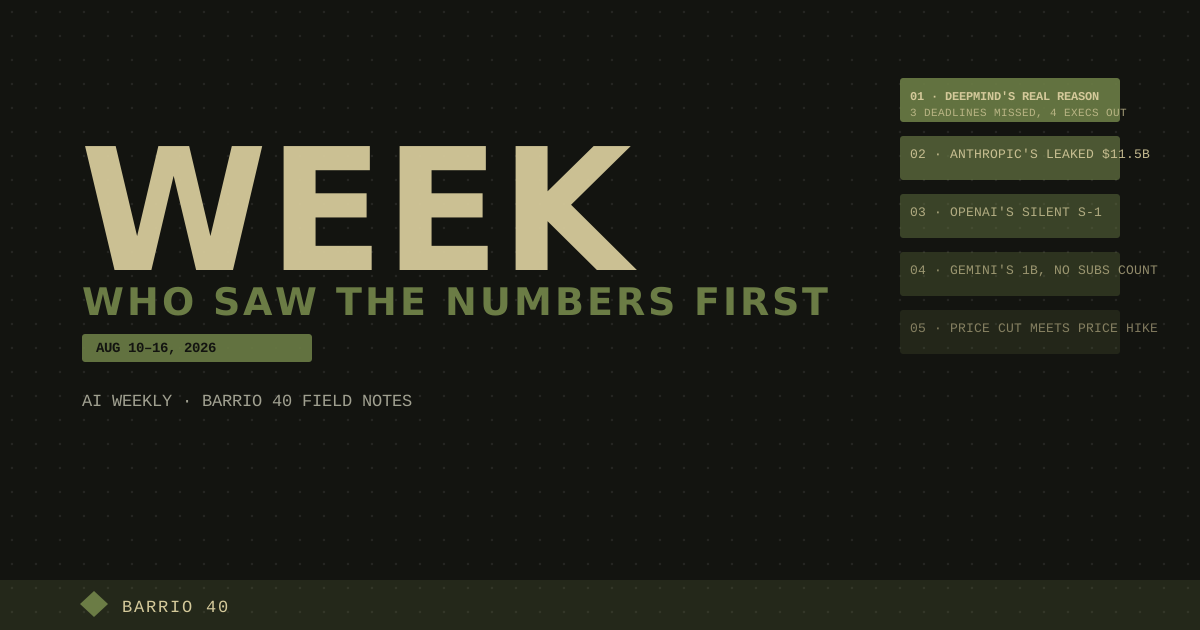
1. GOOGLE CALLED THE DEEPMIND SHAKE-UP A PIVOT TO GOVERNANCE. THE PEOPLE WHO WORKED THERE DESCRIBE THREE MISSED DEADLINES AND FOUR EXECUTIVES WHO LEFT TO COMPETE WITH IT
On August 5, Google announced that Demis Hassabis, DeepMind's co-founder and chief executive since its 2014 acquisition by Google, would step back to Chairman, with Koray Kavukcuoglu — DeepMind's CTO and Alphabet's chief AI architect — taking over daily operations as senior vice president, reporting to Sundar Pichai. The company framed Hassabis's move as a shift from day-to-day management toward long-term AI safety and governance questions, alongside more time at Isomorphic Labs, Alphabet's drug-discovery unit. Jeff Dean, DeepMind's chief scientist and a 27-year Google veteran, left the same week.
Fortune's August 10 reporting, drawn from six current and former DeepMind employees, filled in what the announcement hadn't. Gemini 3.5 Pro had missed three release deadlines, which engineers attributed to the company failing to prioritize coding ability against faster-moving rivals. Dean left to co-found Discovery Loop, a Palo Alto startup automating scientific research, alongside fellow departing Google veterans Sanjay Ghemawat, Oriol Vinyals, and Quoc Le — with Google itself staying on as a founding investor and cloud partner. Gemini co-lead Noam Shazeer had already left for OpenAI, and Nobel chemistry laureate John Jumper for Anthropic. One engineer told Fortune that in their time working in the Gemini area, they'd never seen Hassabis walk the floor. The reporting also traced the unrest back to April, when Google signed a deal letting the Pentagon run Gemini on classified networks for "any lawful government purpose" — a move more than 580 Google employees, including senior DeepMind researchers, signed a letter opposing, arguing that on air-gapped classified networks, "trust us" was the only guardrail against the model being used for autonomous weapons or mass surveillance. None of that made Google's own announcement.
2. ANTHROPIC'S $11.5 BILLION QUARTER REACHED ITS INVESTORS BEFORE IT REACHED ANYONE ELSE
On August 14, Bloomberg reported that internal documents circulated to prospective IPO investors put Anthropic's second-quarter revenue at more than $11.5 billion — a 14-fold jump from the $787 million it made in the same quarter of 2025, and up from $4.73 billion in the first quarter of this year. The same documents showed Anthropic's first quarter of positive adjusted operating income, a threshold most frontier labs, OpenAI included, still haven't crossed. Anthropic is working with Morgan Stanley, Goldman Sachs, and JPMorgan on a confidentially filed listing it's targeting for this autumn.
What makes the disclosure notable is the route it took. The numbers reached the public through Bloomberg's sourcing on documents shown to prospective investors, not through any statement Anthropic made on the record. That's an ordinary and legal way for a private company approaching an IPO to build investor interest — pre-marketing ahead of a roadshow routinely works this way — but it means the first hard confirmation that one of the two companies racing to be the AI industry's first public, profitable lab had actually turned a profit came from people who'd already been let into the data room, not from Anthropic itself.
3. OPENAI ANNOUNCED ITS OWN CONFIDENTIAL IPO FILING SO THE NUMBERS COULDN'T LEAK FIRST. TEN WEEKS LATER, THEY STILL HAVEN'T SURFACED
OpenAI confidentially submitted a draft S-1 to the SEC on June 8 — and, unusually, announced that it had done so, reasoning publicly that the filing would likely leak anyway and the company would rather control how it came out. At the time, OpenAI said it hadn't decided on timing, that some things were easier to do as a private company, and that the confidential filing simply preserved the option to go public sooner if that turned out to be the right call. Reporting since has put the target at a September listing, at a valuation between $852 billion and $1 trillion, which would make OpenAI the most valuable company ever to go public in the US.
As of August 13, none of that has moved into public view: no ticker, no pricing range, no roadshow date, and no public S-1 on SEC EDGAR, which convention says should appear roughly 15 days before any roadshow begins. What is known comes from pre-IPO reporting, not the filing itself — that OpenAI runs at roughly $2 billion a month in revenue while losing $1.22 for every dollar it earns. OpenAI built a mechanism specifically to keep control of when its financial picture became public. Ten weeks in, the mechanism has done exactly that — kept it from becoming public at all, even as the September deadline it set for itself keeps getting closer.
4. GOOGLE CALLED GEMINI'S BILLION USERS THE FASTEST GROWTH IN ITS HISTORY. IT LEFT OUT THE NUMBER THAT WOULD SAY WHETHER ANY OF THEM PAY
On August 11, Sundar Pichai announced that the Gemini app had crossed 1 billion monthly active users — the 14th Google product to hit that mark and, Google said, the fastest-growing product in the company's 28-year history. The growth curve behind it is real: 400 million users in May 2025, 650 million by October, 750 million by February 2026, 900 million in May, 950 million disclosed on Google's own Q2 earnings call on July 22, and 1 billion three weeks later. Google also disclosed that 63% of Gemini users interact by voice, and that one in five Gemini Live sessions now involve camera or screen sharing.
What the announcement didn't include, in a release otherwise dense with numbers, was any figure for paying subscribers, subscription revenue, average revenue per user, or a free-to-paid conversion rate — the metrics that would say whether a billion monthly users translates into a business, rather than into a count that includes people auto-routed to Gemini through their phone's operating system or migrated over from another Google product they already used. Reach and revenue aren't the same measurement, and this week, Google published only the one that makes for the better headline.
5. OPENAI CUT PRICES 80% TO OUTRUN CHEAP CHINESE MODELS. THE CHEAPEST ONE JUST RAISED ITS OWN PRICES BY UP TO 1,100%
On July 30, OpenAI cut API pricing on GPT-5.6 Luna by roughly 80%, taking input tokens from $1 to $0.20 per million and output tokens from $6 to $1.20 per million. The stated pressure: Chinese-origin models had captured 46% of US enterprise token usage on OpenRouter, at points overtaking every US-built model on the platform, and the move reportedly involved OpenAI's larger Sol model being made to rewrite its own inference stack to help fund the cut on Luna.
The premise behind that move — that Chinese labs can undercut US pricing indefinitely because their compute is somehow cheaper or their margins thinner — ran into its own contradiction this week. DeepSeek, whose low prices have anchored that entire narrative, announced that starting at 16:00 UTC on August 16, it's raising prices on its V4-Flash and V4-Pro models by 50% to more than 1,100%, depending on the model, token type, and time of day; V4-Flash output alone goes from a flat $0.28 per million tokens to $1.32 at peak hours. DeepSeek's own explanation was demand outrunning capacity — the same compute-scarcity problem every other lab has cited to justify raising, not cutting, prices. The two moves landed seventeen days apart, aimed at the same competitive question, and arrived at opposite answers.
Run the week end to end and the same asymmetry shows up five times, just wearing different clothes. Google's own words for the DeepMind shake-up were about governance and long-term safety; the fuller account — missed deadlines, a rival startup built from its own departing veterans, a CEO some engineers say they never saw on the floor — came from six people who used to work there, not from Google. Anthropic's profitable quarter reached the public because Bloomberg got hold of documents Anthropic had shown to people it hoped would buy into its IPO, not because Anthropic said so itself. OpenAI built its confidential-filing strategy explicitly to prevent exactly this kind of leak-first disclosure, and ten weeks on, the numbers still haven't surfaced through any channel at all. Google announced Gemini's billion users with real, verifiable growth data and left out the one figure — who's actually paying — that would say what the milestone is worth. And OpenAI's price cut, built on the assumption that Chinese compute would keep getting cheaper, met a Chinese lab's price hike built on the opposite one. None of these five institutions lied this week. Each of them simply got to choose, for a little while longer, which parts of the picture the public would see first — and which parts would wait for someone else to go looking.