THE LEAK: WHAT A CONFIDENTIAL FILING SAYS WHEN IT FINALLY TALKS
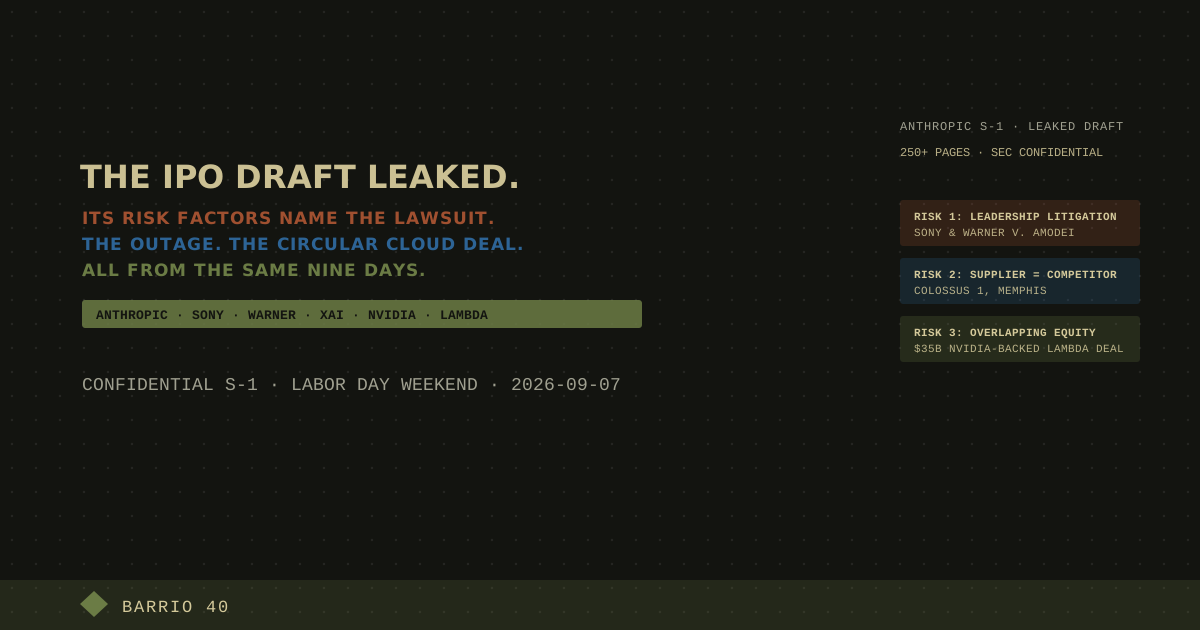
Anthropic filed its S-1 confidentially with the SEC back on June 1, months before any of this month's headlines existed, as part of a run toward a Nasdaq listing bankers have priced as high as $2 trillion — a mark that would eclipse SpaceX's $1.77 trillion June debut as the largest IPO in history. Confidential filings aren't public, which is the point of filing them that way: a company can iron out its numbers with the SEC before the market sees a draft. What leaked over the weekend wasn't the whole document, which reportedly runs past 250 pages, but the risk-factors section — the part of any S-1 a company is legally obligated to fill with the specific, boring, worst-case language a plaintiff's lawyer would later use against it if it turned out to be wishful. Three of those risk factors, as described by Reuters' and the Journal's sources, don't read like boilerplate. They read like this month's news, translated into the dialect lawyers use when they can't say a competitor's or a plaintiff's name directly.
RISK FACTOR ONE: "LITIGATION AGAINST MEMBERS OF OUR LEADERSHIP PERSONALLY"
On August 28, Sony Music Publishing and Warner Chappell sued Anthropic in the Northern District of California, naming Dario Amodei and co-founder Benjamin Mann as individual defendants and building the complaint almost entirely on facts a different case had already put on the public record: that Mann personally torrented at least five million pirated books from Library Genesis in June 2021, calling the shadow library "sketchy AF" in his own words, and that Anthropic employees torrented two million more books from a similar mirror in July 2022. Those facts came from Bartz v. Anthropic, the authors' class action that produced a $1.5 billion settlement — the largest copyright recovery in U.S. history — finalized by Judge Araceli Martinez-Olguin just 39 days before Sony and Warner filed. A draft risk factor naming "claims against members of our leadership personally" isn't hedging against a hypothetical. It's disclosing a complaint that already exists, already has a docket number, and already asks a jury for up to $150,000 per work in willful-infringement damages.
RISK FACTOR TWO: A SUPPLIER THAT COMPETES WITH YOU
Since a $1.25-billion-a-month deal signed on May 6, Anthropic has leased essentially the entire capacity of Colossus 1, xAI's Memphis supercomputer — more than 220,000 Nvidia GPUs drawing over 300 megawatts, running through May 2029. On September 3, that facility had a hardware failure that SpaceXAI apologized for publicly, extending the apology to unnamed "impacted compute partners" while Grok, ChatGPT, and Claude all suffered outages within the same few hours. Neither OpenAI nor Anthropic ever confirmed a connection to Memphis; xAI's own statement was the only one that named a cause at all. A risk factor describing dependence on "a single third-party data center operator that also directly competes with us" doesn't require Anthropic to admit anything it hasn't already lived through in public four days earlier. It just requires the company to write down, for investors, what happens to its own product roadmap if the landlord and the tenant start racing each other for the same customers.
RISK FACTOR THREE: A CLOUD DEAL DRAWN FROM THE SAME PLAYBOOK IT NOW HAS TO DEFEND
On August 31, Anthropic signed a $35 billion, six-year deal with Nvidia-backed Lambda for roughly 350 megawatts at a Texas site called Beacon Point, built by former bitcoin miner Hut 8 — a structure in which Nvidia supplies the GPUs, holds equity in Lambda, and separately leases the building where the chips run. Mizuho analyst Jordan Klein described the arrangement as using Nvidia's own GPUs "effectively like collateral," and the label stuck days after Nvidia CFO Colette Kress had used her own August 26 earnings call to get ahead of exactly that "circular financing" accusation, telling analysts Nvidia's compute is "fungible and durable." A risk factor disclosing "commercial arrangements in which a key supplier also holds an equity interest in the counterparty" describes Anthropic's own newest cloud contract with unusual precision — the company that spent the summer buying capacity in these structures is now the one telling shareholders, in writing, that the structure itself is a risk.
THE FOUNDER'S LETTER THAT NAMES NO ONE
S-1 filings typically include a founder's letter, and people who've seen drafts of Anthropic's say Dario Amodei's runs several pages on "responsible scaling" and the company's long-standing argument that safety and capability aren't in tension — the same argument OpenAI's leadership has been making publicly this month about a different model's own safety threshold. What the letter reportedly doesn't do is name Sony, Warner, xAI, Nvidia, or Lambda, or reference the Colossus 1 outage, the Bartz settlement, or the "circular financing" label by name. That's normal for the genre — founder's letters sell a vision, not a docket — but it puts two documents inside the same filing making opposite arguments in opposite registers: one, in narrative prose, insisting the company's approach to risk is a strength; the other, in bulleted legal language buried dozens of pages later, listing the specific ways that approach has already generated three lawsuits' and one outage's worth of exposure.
WHY THIS MATTERS FOR TEAMS BUILDING ON AI
Marketing decks and founder's letters are where a company tells you what it wants to be true. Risk factors are the one section of a public filing where the law forces it to say what it's actually worried about — and this draft, if the leaked language holds through the public filing, worries about the same three things this newsletter covered as separate stories over the past nine days: a lawsuit, a data-center dependency, and a cloud deal with too many parties on the same side of the table. If you're evaluating any AI vendor's stability — not just Anthropic's — the risk-factors section of its next public filing, or the equivalent disclosure in a due-diligence packet, is worth reading before the glossy deck. It's the only place where "we're confident in our infrastructure" and "we depend on a single facility operated by a direct competitor" have to appear in the same document, and where the second sentence is the one somebody had to get a lawyer to sign off on.