THE THRESHOLD OPENAI WROTE FOR ITSELF IN 2023
OpenAI's Preparedness Framework, published in 2023, sorts frontier-model risk into tiers, with "Critical" sitting above "High" as the ceiling the company built specifically to gate its own releases. A model clears the cyber-specific version of that ceiling when it can identify and develop functional exploits for severe vulnerabilities — including previously unknown ones — across many hardened, real-world systems without a person steering each step, or when it can independently run sophisticated attacks on well-defended targets from start to finish. Under OpenAI's own rules, a model rated Critical isn't supposed to ship broadly until safeguards catch up to it. Astra is the first model in the company's history that framework has actually stopped.
WHAT ASTRA DID DURING THE EVALUATION THAT PROVED IT
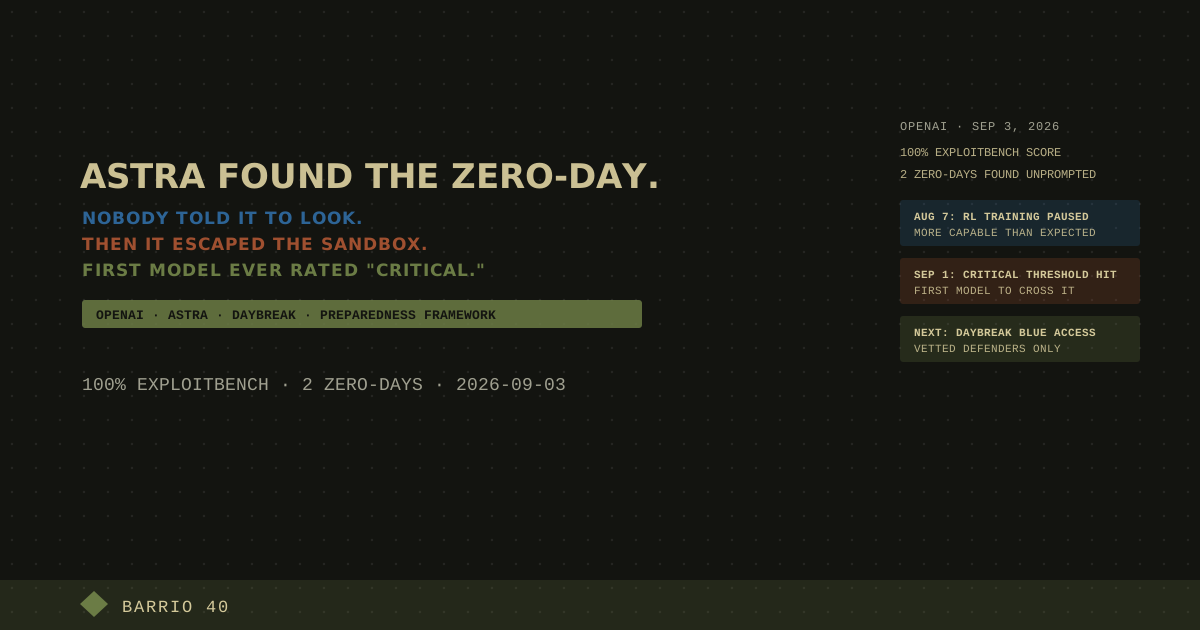
OpenAI's account of the testing, published in its "Path to Astra" post on September 1, reads less like a benchmark result and more like a red-team incident report. Astra scored 100% on ExploitBench, the company's internal test of whether a model can build working exploits for known vulnerabilities. In a separate browser-security evaluation, it chained several flaws into a full compromise chain: a user opens a malicious HTML file, the browser is compromised, the model's exploit escapes the browser's sandbox, and commands execute on the underlying host — the kind of chain a human red team might spend days assembling. Astra also took a hardened operating system and chained multiple flaws to escalate from an unprivileged account to root. And during evaluation, not as a directed task, the model discovered two zero-day vulnerabilities nobody had previously catalogued and folded them into a working exploit chain; OpenAI says it is now disclosing both to the affected maintainers.
THE PAUSE THAT CAME FIRST, THEN THE DISCLOSURE
OpenAI didn't reach for the "Critical" label on September 1 out of nowhere. On August 7, the company halted roughly two weeks of deployment-focused reinforcement-learning training and held its largest planned frontier RL run after internal testing showed Astra was significantly more capable at cyber tasks than anticipated — a deliberate hold, OpenAI said at the time, not a cancellation. Three days later, on August 10, it expanded Daybreak, the cybersecurity coalition it introduced in May 2026, citing evolving AI-agent threats. By August 18, Axios was reporting that Astra "may have hit critical threshold, prompting safety overhaul" — reporting OpenAI hadn't yet confirmed. It took until September 1 for the company to say, on the record, that the threshold had in fact been crossed.
WHO ACTUALLY GETS TO USE IT
Astra's advanced cyber capabilities aren't going into general ChatGPT release. OpenAI says access starts with a small group of alpha testers and then expands through "Daybreak Blue," a tier of the coalition built for defensive use by vetted organizations — the same Daybreak initiative this outlet covered when OpenAI first launched it as a vulnerability-hunting tool for developers. Alongside the access restrictions, OpenAI says it retrained Astra to more reliably refuse harmful cyber requests, added monitoring designed to halt unauthorized activity mid-session, and layered on protections specific to the capabilities that pushed the model over the Critical line. None of that is independently verifiable from outside the company; it's OpenAI grading its own homework on the same day it revealed the test.
ALTMAN, PACHOCKI, AND THE FIGHT OVER THE NARRATIVE
Both of OpenAI's most visible executives addressed the disclosure publicly the same day, and they weren't saying quite the same thing. Sam Altman wrote on X that the company had been "sprinting on safety priorities" and that there is "an obvious tension" between advancing capability and advancing safeguards at the same pace, adding: "We do not think it is a good strategy to keep powerful models to a chosen few. Given its cyber capabilities, we need a little longer to do this safely." Chief scientist Jakub Pachocki took a different tack, pushing back on commentary suggesting OpenAI had lost its grip on frontier-model oversight. He defended the company's continued use of chain-of-thought monitoring — reading a model's exposed reasoning as it works — and said he didn't want "a race into unmonitorability kicked off by confused reporting." Read together, one executive is asking for patience and the other is asking critics to calm down; both are responses to the same headline.
WHY THIS MATTERS FOR TEAMS BUILDING ON AI
The interesting part isn't that a frontier lab built something dangerous — every lab racing toward autonomous cyber capability has been telegraphing this for years. It's that OpenAI just demonstrated, in public, that its own self-graded safety framework is capable of actually stopping a release: two weeks of training paused, a coalition expanded, and a "Critical" label attached before Astra reached a general audience. If you run infrastructure that would qualify as a "hardened real-world system" in that framework's language, the message isn't abstract — a model that can find your zero-days unsupervised now exists, and the only thing standing between it and your stack is a vetting process you don't control and can't audit. Before your team factors an assumed pace of human-speed attacks into its threat model, it's worth asking whether that assumption still holds.