THE DEAL
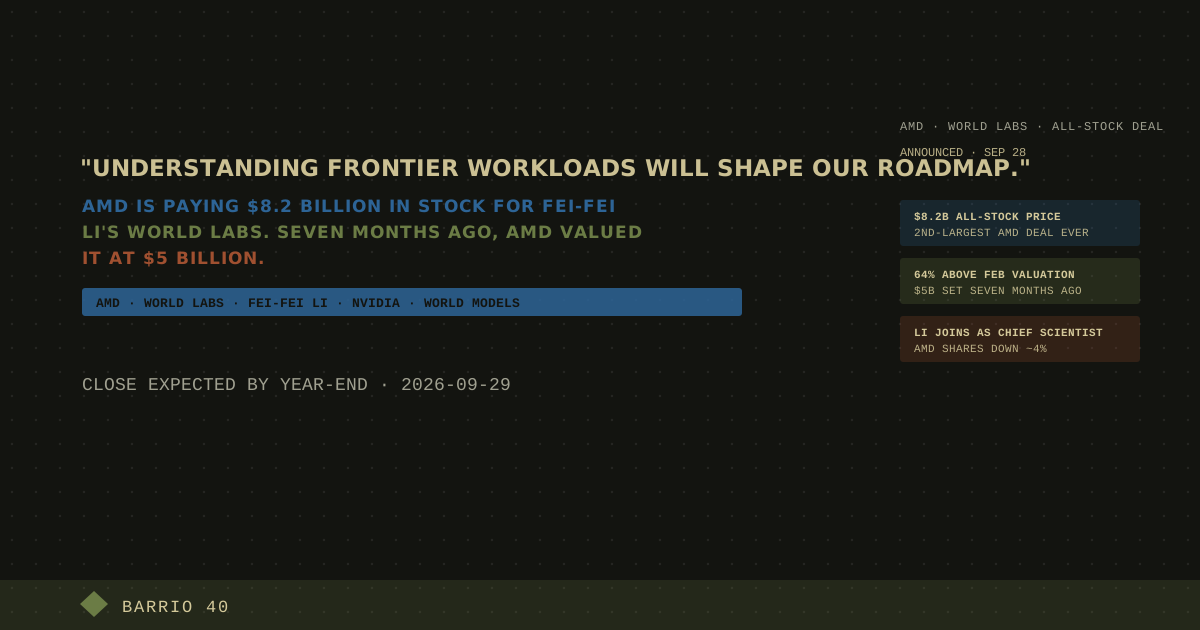
AMD announced on Monday, September 28, that it will acquire World Labs for approximately $8.2 billion, paid entirely in AMD shares. World Labs, founded in 2024 by Stanford professor Fei-Fei Li — best known for building ImageNet, the dataset that helped launch the modern deep-learning era — develops models that generate and understand three-dimensional environments. Li will join AMD as executive vice president and chief scientist, reporting directly to chair and CEO Lisa Su, and World Labs' team will move over with her; the companies did not say how many people that is. AMD said the transaction is expected to close by the end of the year, subject to regulatory approvals. Reports describe it as the second-largest acquisition in AMD's history, behind only its purchase of Xilinx.
FORTY-FOLD IN THIRTY MONTHS
The valuation path is the story inside the story. World Labs' first financing in April 2024 valued it at around $200 million. A few months later a $100 million round led by NEA pushed it past $1 billion. In February 2026, a $1 billion round valued it at $5 billion — with AMD among the investors, and Nvidia's venture arm in the same round. Seven months after that, AMD is paying $8.2 billion: a 64 percent markup on a price it helped set itself, and about forty times the company's first valuation in thirty months. Because the deal is all stock, AMD is paying in its own paper rather than cash, and the market's first read was skeptical — AMD's shares fell roughly 4 percent on the announcement.
WHAT AMD IS ACTUALLY BUYING
World Labs' public products are early. Marble, released in November 2025, turns a text prompt, a photo or a video into an editable 3D environment, with paid plans running up to $95 a month. On September 1, the company introduced Atlas, in early access with selected partners, which can build a virtual replica of a factory or warehouse from a handful of photos. Neither is a revenue engine that justifies $8.2 billion on its own. AMD's stated logic is different: understanding frontier workloads like the ones World Labs creates will shape its chip roadmap. World models are compute-hungry in a way that differs from chat models — they have to keep a consistent picture of physical space over time — and the applications people expect from them, robots, autonomous vehicles and industrial simulation, are exactly the markets both chipmakers want to own.
THE NVIDIA SHADOW
The competitive subtext is Nvidia, which is already further along. It ships a suite of open-weight world models under the Cosmos name and has partnered with the startup Wayve on world models for autonomous driving. AMD, by comparison, is only now acquiring a research team. Buying Li's lab is a way to skip years of hiring, and to put one of the field's most recognizable names in a senior role at a company that has spent a decade being described as the challenger. Regulatory review may also stretch into early 2027, some analysts note, given the deal's size and the number of strategic investors — Nvidia's among them — holding a financial stake in World Labs.
WHY THIS MATTERS FOR TEAMS BUILDING ON AI
Two practical takeaways. First, hardware vendors are moving up the stack: when a chipmaker pays $8.2 billion to own a model lab, expect its software, SDKs and reference models to be tuned to its silicon, which changes what "portable" means for anyone building on world models or physical-AI tooling. Second, an independent startup you depend on can become a division of a chip company on a Monday. If a spatial-AI or simulation vendor is in your stack, check what your contract and export paths say about a change of control, and keep your scenes, assets and pipelines in formats you can move. The most valuable thing in this deal wasn't a product. It was a team — and teams get reassigned.