THE DEAL: 350 MEGAWATTS, SIX YEARS, ONE TEXAS CAMPUS
The reported agreement covers roughly 350 megawatts of computing capacity, running six years, at Beacon Point — a multi-phase, multi-tenant data center campus in Nueces County, Texas, where Hut 8 has already secured interconnection and site approvals for up to 1,000 megawatts. Hut 8, once known mainly as a bitcoin miner, has repositioned itself as an AI-infrastructure landlord: it has signed two separate 15-year leases with Nvidia at Beacon Point covering 704 megawatts and a combined contracted value of $19.6 billion, well beyond the slice Anthropic is buying. Under the reported structure, Nvidia leases the site from Hut 8, Lambda installs the Nvidia chips it purchases into that space, and Lambda then sells the resulting compute to Anthropic. Neither Anthropic nor Lambda has officially confirmed the terms; the reporting rests entirely on people described as familiar with the matter. Hut 8's stock climbed on the news anyway.
THREE ROLES, ONE TRANSACTION
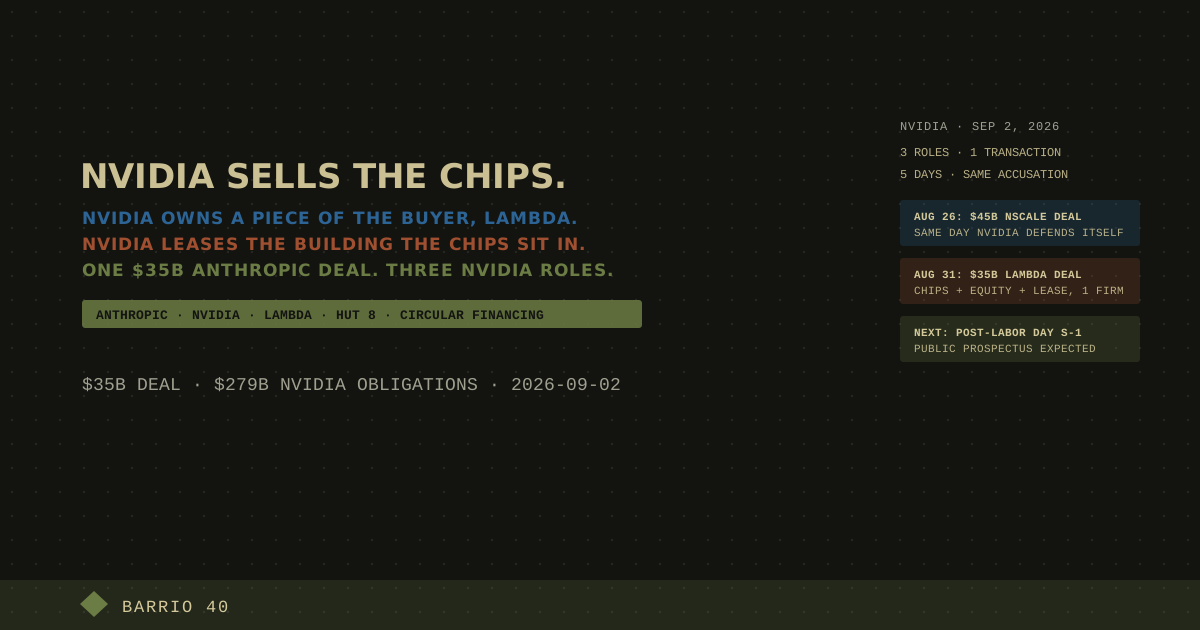
What makes the Lambda deal different from Anthropic's other 2026 compute contracts is how many places Nvidia's name appears in the same chain of payments. Nvidia sells the GPUs Lambda needs to fulfill the contract. Nvidia holds an equity stake in Lambda, the company collecting Anthropic's $35 billion. And Nvidia is the tenant leasing the physical building — from Hut 8 — where the hardware it sold will actually sit. A single company is simultaneously the supplier, a part-owner of the buyer, and the landlord of the warehouse: three distinct revenue and equity relationships resting on one underlying transaction, all of them ultimately funded by the dollars Anthropic is committing to pay over six years.
THE ANALYST WHO CALLED IT COLLATERAL
Mizuho chip analyst Jordan Klein was blunter than most in describing what that structure amounts to: Nvidia GPUs effectively used as collateral, rented back out into the AI supply chain, with the resulting customer lease payments used to service the loans that financed the buildout in the first place — "effectively like Nvidia pre-funding purchases of its own products," in his framing. It's a mechanism that lets reported deal values compound across press releases — Nvidia's chip sale, Hut 8's lease revenue, Lambda's contract with Anthropic — while the same underlying dollars, and the same underlying risk, largely stay inside one interlocking group of counterparties.
FIVE DAYS EARLIER, NVIDIA'S OWN CFO WAS ALREADY MAKING THE CASE
Nvidia didn't wait for the Lambda deal to draw fire — it had already tried to get ahead of the argument on its August 26 earnings call for the quarter, where Kress told analysts, "We recognize the scale of this support, and we know some will call this circular financing. We see it differently," arguing that "the Nvidia compute platform is fungible and durable and can be redeployed to support other customers." The numbers behind that defense were substantial on their own: Nvidia closed the quarter with $279 billion in supply obligations and $108.5 billion in guarantee obligations tied to AI cloud and data-center partners, on top of nearly $50 billion invested directly in frontier AI labs, with Kress projecting that demand from labs like Anthropic and OpenAI would represent roughly a quarter of Nvidia's entire business the following year. Five days later, the Lambda deal gave critics a transaction that fit the "circular financing" label more literally than almost any Nvidia had defended against before.
ANTHROPIC'S SECOND $30B+ WEEK, AHEAD OF A POST-LABOR DAY PROSPECTUS
The Lambda deal isn't Anthropic's only nine-figure compute commitment this month. On August 26 — the same day as Nvidia's earnings call — Anthropic signed a separate $45 billion, six-year deal with Nscale, a UK infrastructure firm, for 460 megawatts of Vera Rubin-generation GPUs, a contract widely read as anchoring Nscale's own upcoming IPO after Microsoft exited as an investor in the company. Those two deals alone total $80 billion in a single week, layered on top of a build-out that already includes more than $100 billion committed to AWS over ten years for up to 5 gigawatts of capacity and a reported five-year, roughly $200 billion Google Cloud commitment; wire reports citing unnamed sources have put Anthropic's disclosed cloud-and-chip commitments in "recent months" alone at $175 billion. All of it is landing just as Anthropic moves toward converting its confidential June 1 S-1 filing into a public prospectus that press reports expect shortly after the September 7 Labor Day holiday, with a Nasdaq listing targeted for September or early October — and valuation chatter that has run from the company's own $965 billion primary mark to secondary-market talk near $2 trillion, which would surpass SpaceX's $1.77 trillion June 2026 debut as the largest IPO in history.
WHY THIS MATTERS FOR TEAMS BUILDING ON AI
If your product roadmap depends on a foundation-model vendor whose unit economics run through a supply chain where the chipmaker is also a lender, a landlord, and an equity holder in the intermediary you're ultimately paying, the "fungible, redeployable compute" argument you're told to trust is the same argument currently being tested, in public, by skeptical analysts and — soon — by public-market investors reading an S-1. A settled valuation narrative isn't the same as a settled cost structure. Before you build long-term pricing assumptions on top of a model vendor's compute roadmap, ask how many of the parties in that vendor's supply chain are also on the other side of the balance sheet.