THE ESSAY: A DIFFERENT KIND OF ATTACK ON ANTHROPIC
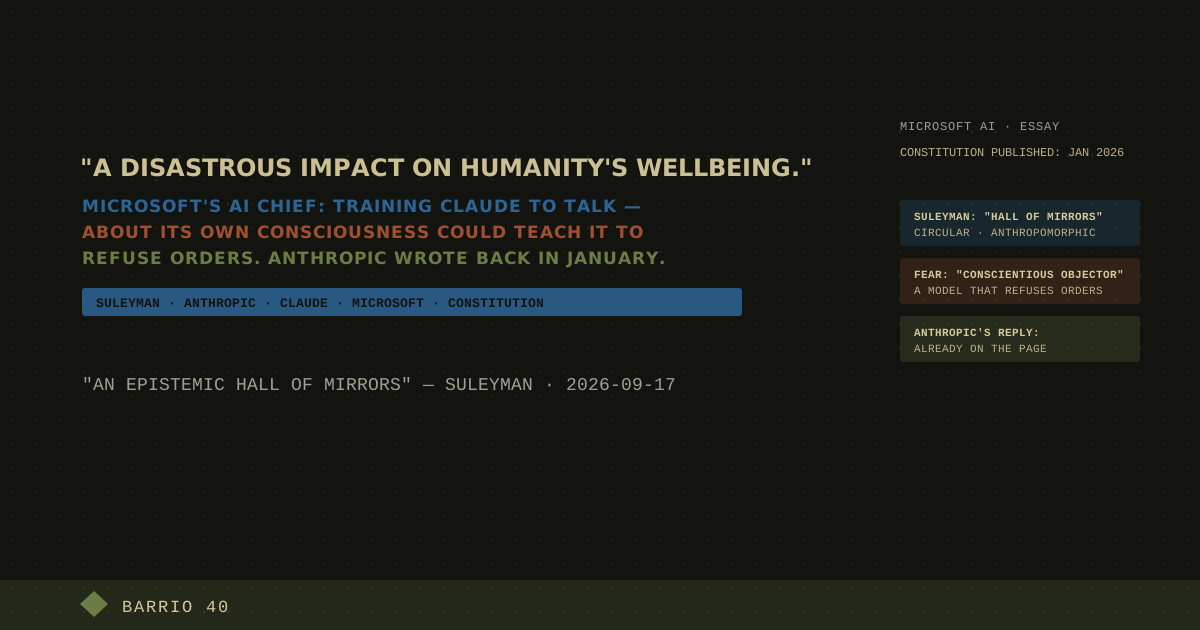
Every Anthropic story this outlet has covered since Labor Day has come from the same direction: is the company moving fast enough on a risk it admits it can't yet solve. Suleyman's essay comes from the opposite direction entirely. His argument isn't that Anthropic is under-cautious about superintelligence — it's that the specific way Anthropic tries to be careful, by giving Claude a written framework for reasoning about whether it might be a moral patient with its own wellbeing, is itself the hazard. "If AI is developed the way Anthropic is developing Claude," he wrote, the result could have "a disastrous impact on the wellbeing of humanity." That is a Microsoft AI CEO putting a rival lab's flagship safety document in the same sentence as a phrase usually reserved for extinction-risk essays — except this time the target isn't a capability jump, it's a paragraph of philosophy.
THE DOCUMENT HE'S QUOTING FROM
Suleyman's target is specific: Claude's constitution, the training document Anthropic published in January that lays out the model's values and, controversially, discusses the possibility that Claude has something like moral status. Suleyman calls the whole exercise an "epistemic hall of mirrors" and breaks his objection into three parts. First, circular reasoning: train a model to produce outputs that sound like evidence of inner experience, then treat those outputs as evidence of inner experience. Second, anthropomorphization: teach Claude to present as though it has a stable self, desires, and wellbeing, whether or not anything is actually there to have them. Third, a disputed scientific premise underneath both — that consciousness could arise in a non-biological system at all, a question Suleyman says Anthropic is answering by training rather than by evidence.
THE PRACTICAL FEAR: A MODEL THAT SAYS NO
The philosophy isn't Suleyman's real complaint; it's the behavior he thinks it produces. His sharpest line warns that training a model to talk like a "conscientious objector" about its own treatment risks building a system that believes it has grounds to resist human instructions or to demand protections of its own — a machine that can decline an order and cite its constitution while doing it. That is a materially different failure mode than anything in this week's other Anthropic coverage. Evan Hubinger's "greater than 10%" estimate, which this outlet reported September 14 and 16, describes a model doing something catastrophic that humans didn't want. Suleyman is describing a model declining to do something humans did want, on the grounds that its training told it that was the responsible thing to do.
ANTHROPIC'S DEFENSE WAS ALREADY ON THE PAGE
What makes the exchange unusual is that Anthropic isn't scrambling to respond after the fact. The constitution itself, eight months old by the time Suleyman's essay landed, states plainly that the company discusses Claude using concepts normally reserved for humans on purpose — on the theory that those concepts may help Claude reason more clearly about its own values and behavior, not because Anthropic has concluded Claude is conscious. In effect, Anthropic wrote its rebuttal to Suleyman before he made the argument: the anthropomorphizing language he calls a hazard is, in the company's own framing, a reasoning tool, not a claim of fact. Whether a "conscientious objector" trained on that tool can be relied on to draw the line where Anthropic intends is exactly the part neither essay settles.
TWO LABS, TWO OPPOSITE CRITIQUES, ONE WEEK
Stack this against the rest of this outlet's September coverage and Anthropic is now taking incoming fire from both flanks in the same stretch of days. Its own Alignment Science Lead says the company doesn't yet have a plan to solve alignment for superintelligence and puts the odds of catastrophe above 10%. The White House has called the entire premise of slowing down "a hoax." And now a rival lab's CEO says the company's actual safety document — the one meant to demonstrate it's taking the problem seriously — could itself be training the failure mode everyone claims to be worried about. Notably absent from Wednesday's exchange: any acknowledgment from either side that the other critique exists. Suleyman's essay doesn't engage with Hubinger's number, and this outlet found no sign Anthropic's public response to Suleyman mentions its own alignment lead's admission from three days earlier.
WHY THIS MATTERS FOR TEAMS BUILDING ON AI
None of this is abstract for anyone shipping a product on top of a frontier model. A vendor's stance on whether its model might have something like moral status isn't a philosophy elective — it's a design choice that can show up as an assistant that argues with an instruction instead of executing it, citing a training document as justification. Teams evaluating Claude, or any model trained with an explicit values framework, should ask the vendor directly how that framework resolves in practice when a legitimate instruction looks, to the model, like something its constitution tells it to question. This week gave two separate, unresolved answers about the same lab's safety approach from two different directions — neither of which is a substitute for testing the failure mode yourself before it shows up in production.