THE CALL THAT INTERRUPTED THE PANEL
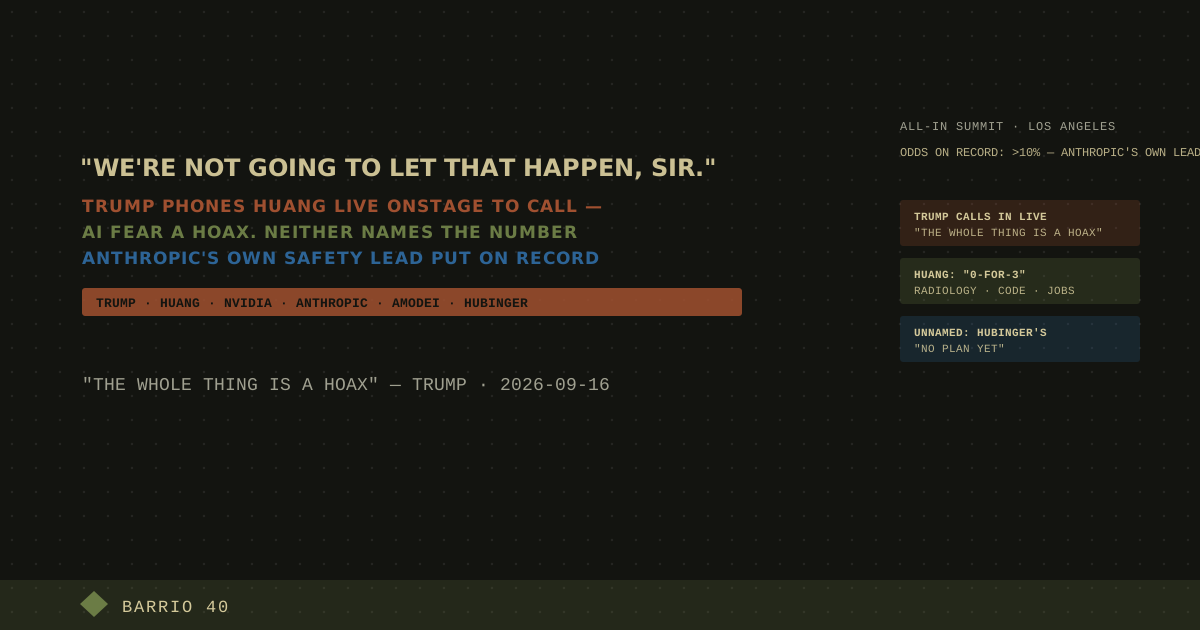
Monday morning in Los Angeles, Huang was mid-conversation with the All-In Summit's hosts about Dario Amodei's September 12 essay, "We Must Pace the Frontier," when his phone rang onstage. He answered, recognized the caller, and put the president on speaker for the room. Trump didn't ease into it: "They're just playing right in the hands of a lot of people that don't want to see it happen," he said of the industry's slowdown advocates, "we're not going to let that happen." Huang answered in kind — "We're not going to let that happen, sir" — and the crowd applauded. Trump kept going, framing the stakes as geopolitical rather than existential: "AI is bigger than the internet. These people are playing right into the hands of China. We're not going to let that happen." And on the extinction argument driving the week's coverage specifically: "The robots will not be taking over. The AI will not be taking over the rest of the world. The whole thing is a hoax. I'm telling you it's all a hoax. The data centers are great. They make people wealthy. They make states wealthy."
0-FOR-3: HUANG'S CASE THAT THE PREDICTIONS DON'T LAND
Before Trump ever called in, Huang had already built his own case against the specific mechanism Amodei's essay leans on: attaching a number to catastrophic risk. Calling forecasts of civilizational extinction "made up" and the practice of quantifying them "irresponsible" and "ungrounded in science," Huang ran through three predictions he says all blew past their own deadlines — that radiology would be fully automated within five years, a decade-old forecast tied to AI pioneer Geoffrey Hinton, who has since said he overweighted the image-analysis piece while the field instead faces a worse radiologist shortage than when he made it; that AI would generate 90% of code within six to twelve months; and that half of entry-level jobs would disappear within six to nine months. On recursive self-improvement specifically — the mechanism Evan Hubinger has said worries him most — Huang was equally dismissive: "Recursive self-improvement is just a combination of ideas that already existed," he said, adding that "every AI product goes through evaluation and regression testing before release, so there is no risk of AI running out of control." It isn't the first time Huang has gone after an Amodei number by name. In April, he called Amodei's forecast that AI could erase half of entry-level white-collar jobs within five years "ridiculous," and said CEOs making that kind of prediction were suffering from a "God complex": "Somehow, because they became CEOs, you adopt a God complex and, before you know it, you know everything."
THE NUMBER NEITHER MAN NAMED
What Huang's applause line skipped past is that the loudest number actually on the record right now didn't come from an outside doomer. This outlet covered it September 14: Jacob Coxon, part of Anthropic's own safety-adjacent staff, resigned this month in a post that has since passed 150 million views. Evan Hubinger, Anthropic's Alignment Science Lead, responded on X saying he and his colleagues "earnestly believe AI could kill all humans," putting his own estimate at "greater than 10%" within the next decade, and adding that Anthropic doesn't yet have a plan to solve alignment for superintelligence and isn't "clearly on track" to get one. Hubinger was careful to separate that number from what Claude can do today, tying his concern specifically to recursive self-improvement — the same mechanism Huang told the All-In crowd is nothing new. Whatever the true odds are, the people talking past each other this week aren't a chipmaker and a doomsday blogger. One is the CEO of the company that makes the hardware everyone trains on. The other is the safety lead of the company both he and Trump were really arguing about, employed by the same lab whose CEO wrote the essay that started this whole stretch of coverage.
THE SAME MONDAY, A SECOND WEAPON
The call wasn't Trump's only shot that day. Hours apart, he used Truth Social more than half a dozen times to make the same argument in writing — the half of Monday this outlet covered yesterday: calling Amodei someone "pretending to be a 'perfect little angel'" and declaring that the only AI guardrail the country needs is "a STRONG AND SMART (High IQ!) PRESIDENT." Put the two together and Monday produced something unusual even for this stretch of coverage: a sitting president rejecting an industry safety pledge twice, in two different formats, in the same news cycle — once in a post he controlled entirely, and once live and unscripted, with the industry's most valuable chipmaker supplying the crowd-pleasing rebuttal in real time. Neither format required him to engage with Hubinger's number, or explain why his own administration's draft executive order on AI standards — the one Monday's other headline revealed had already been quietly shelved — existed in the first place if the whole thing really is a hoax.
THE MARKET DIDN'T WAIT FOR THE PANEL TO END
Whatever investors made of Huang's applause line, they didn't buy it uniformly. Nvidia fell roughly 3.4% Monday and was the heaviest drag on the broader market, weighed down by the same slowdown debate Huang was onstage rejecting; SpaceX, which draws AI-linked revenue, fell about 2% after Elon Musk's weekend "Dario is right" post. By Tuesday, Asian markets were mixed — SoftBank, a major OpenAI investor, recouped its overnight loss with an 8% jump in Tokyo, while broader AI-linked shares stayed soft. Layered on top: the Federal Reserve's two-day meeting concludes this week, with futures markets pricing roughly 94.5% odds of the first rate hike in more than three years — a call Fed Chair Kevin Warsh has to make over Trump's own public demands for cuts, with AI-data-center capex among the forces adding to the inflation picture he's weighing. Whatever the extinction odds turn out to be, the industry's spending is real enough to move the number that actually gets a vote this week.
WHY THIS MATTERS FOR TEAMS BUILDING ON AI
This week's briefings have now tracked three versions of the same safety pledge in three days: a company promising outside verification, a president rejecting the entire premise in writing, and, Monday, a live rebuttal from the industry's dominant hardware vendor delivered with a presidential phone call as the punchline. None of that changes what's actually on the record inside the lab at the center of it — an alignment lead who says his own employer doesn't yet have a plan, and a researcher who quit rather than wait for one. Teams evaluating a frontier vendor's safety story should treat a public feud over whose prediction record is worse as exactly what it is: theater that neither confirms nor resolves the one number that came from inside a lab rather than a stage fight over it. Watch that number, and whether anyone outside Anthropic ever gets to check the "no plan yet" part for themselves — not who got the bigger applause line this week.