"HOAX," "SCAM," AND A NAME FOR AMODEI
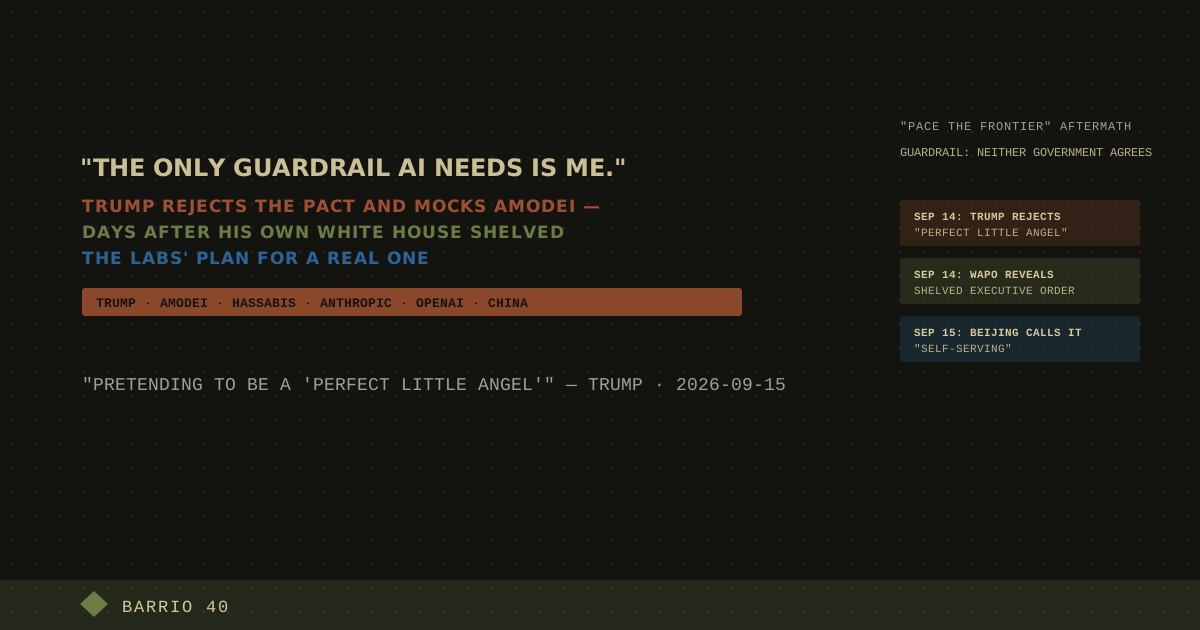
Three days after Dario Amodei's "We Must Pace the Frontier" essay set off the chain this outlet tracked through Sacks' rejection and Nadella's qualified yes on Sunday and Monday, Trump answered directly — and personally. In a Truth Social post Monday, he wrote that the people warning AI could destroy the world or that data centers are dangerous "are the same people that said, just a short time ago, that the World would be extinguished by 'Climate Change.'" He called the fears a "hoax" and a "scam," and argued the only reason for public backlash against AI and its data centers was "because the United States is leading, by a lot, every other country." Then he turned to Amodei specifically, describing him as someone "who is now pretending to be a 'perfect little angel.'" It's the first time in this stretch of coverage that a head of state has responded to the pacing debate by attacking one of the CEOs driving it, by name, rather than debating the substance of what he proposed.
THE GUARDRAIL TRUMP SAYS ALREADY EXISTS
Trump didn't stop at rejection — he offered his own alternative to every mechanism Amodei, Altman, Sacks, and Nadella had spent the previous four days negotiating in public. "The only control or 'guardrails' that AI needs," he wrote, "is a STRONG AND SMART (High IQ!) PRESIDENT, and the U.S.A. has that, in spades!" Set against Amodei's specific, mechanical pledge — permanent, employee-level access for METR, named and dated — Trump's version names no evaluator, no access level, and no outside party at all. The guardrail, on his account, is a person already in office. House Speaker Mike Johnson offered a narrower version of the same instinct on "Meet the Press" over the weekend: he said he'd recall the House and bring AI regulation to a vote "if we had the solution," but that Congress shouldn't rush into rules it doesn't understand — his preferred first move is a summit, not a bill, with Trump, congressional leaders, and the lab CEOs in a room together.
THE STANDARDS BODY NOBODY OUTSIDE THE THREE LABS KNEW ABOUT
What Trump's post left out is what made Monday's Washington Post story land as hard as it did: Anthropic, OpenAI, and Google had not been starting from zero. Representatives from the three labs had been meeting on a working-group basis since at least July, discussing a shared industry standards body — the same category of mechanism Amodei's essay gestures toward with its call for "industry-wide regulation." The catalyst was an essay Google DeepMind founder Demis Hassabis published that same month, "A Framework for Frontier AI and the Dawning of a New Age," proposing a U.S.-led standards body modeled on FINRA, the body that polices Wall Street under SEC oversight. Hassabis's design: a public-private partnership, government-overseen but industry-funded, staffed by "independent leading technical experts and open-source representatives," starting with voluntary pre-release submissions on a 30-day window and eventually becoming a prerequisite for U.S. deployment. Treasury Secretary Scott Bessent was reportedly considering a FINRA-like AI agency of his own around the same time. Two months of quiet, working-level coordination between three companies that spent this same week publicly disagreeing about how far a slowdown should go — and it never surfaced until Monday.
THE EXECUTIVE ORDER THAT DIED WITHOUT A PRESS RELEASE
The Post's more pointed detail is what happened to that plan inside Trump's own administration. A draft executive order meant to formalize a version of the labs' standards body reportedly circulated inside the White House — and lost momentum before it could secure sufficient backing internally, effectively shelved before summer ended. No announcement, no on-the-record explanation, just a proposal that stalled out and stayed stalled. That timeline matters against Monday's Truth Social post: Trump wasn't simply rejecting a hypothetical framework Amodei cooked up over the weekend. By the account now public, a concrete version of it had already been in front of his own government for months, and it didn't survive contact with the administration he leads. Axios's framing of the moment — Washington's AI politics as "let 'er rip" against "hit the brakes," with the president fully in the first camp from day one — reads less like commentary and more like a description of what just happened to a specific piece of paper.
BEIJING'S ANSWER: "SELF-SERVING"
Amodei's own essay had already named the one place his pacing plan doesn't reach — China, which he called the "toughest dilemma" his proposal can't solve, answered on his own terms this week. A Monday editorial in the state-owned China Daily argued that the American slowdown push is a "self-serving" attempt to preserve U.S. dominance now that export controls on chips and manufacturing equipment have failed to stop Chinese labs from fielding competitive open models — pointing specifically to the DeepSeek and Kimi K3 moments as proof restrictions aimed at hardware are now shifting toward software and voluntary pacing instead. Foreign Ministry spokesman Guo Jiakun put it more bluntly Tuesday: "fearmongering, confrontation and vicious competition will only disrupt the process of global AI governance and serve the interests of no one." Between Trump's rejection and Beijing's dismissal, Amodei's pledge now has no government-level backer at all — only the CEOs who signed onto it and the outside evaluators, like METR, who took jobs to go check it.
THE $2 TRILLION IPO ANTHROPIC IS PURSUING ANYWAY
None of this has slowed Anthropic's own march toward Nasdaq. The company has reportedly selected the exchange for a listing that could come as soon as October and value it near $2 trillion — a striking jump from the $965 billion mark it carried earlier this year, built on a confidential IPO filing submitted in June. Amodei is, in effect, trying to sell public investors on a five-year-old company at a historic valuation while simultaneously telling the industry it operates in — including, implicitly, itself — to slow down. AI-linked stocks fell sharply on Monday after his weekend essay first landed, a reminder that markets read "pace the frontier" as a growth-rate warning even when Amodei frames it as a safety commitment that avoids "sacrificing commercial advantage." Some analysts argue the slowdown pledge could work in Anthropic's favor at IPO — framing it as the responsible actor ahead of future liability fights — but that story requires the pledge to mean something. As of Monday, its only government-level answers are a president who calls it theater and a rival superpower that calls it a ploy.
WHY THIS MATTERS FOR TEAMS BUILDING ON AI
Yesterday's briefing closed on a version of this question and today sharpens it considerably: if a vendor's safety story depends on external verification or industry coordination, what happens when the two governments capable of backing either one both say no in the same week? Nothing in Monday's news changes what Anthropic promised METR, or what METR's newest hires are equipped to check. But it does mean that promise now rests entirely on the lab's own follow-through — voluntary, unbacked by regulation on either side of the Pacific, and running in parallel with a public offering that rewards growth over caution. Teams evaluating a frontier vendor's safety claims should treat "we're working with regulators" and "we're working with each other" as two very different sentences right now. This week, only the second one turned out to be true — and even that one, on the record so far, has produced a two-month-old proposal that a friendly White House still wouldn't sign.