WHAT AMODEI ACTUALLY COMMITTED TO
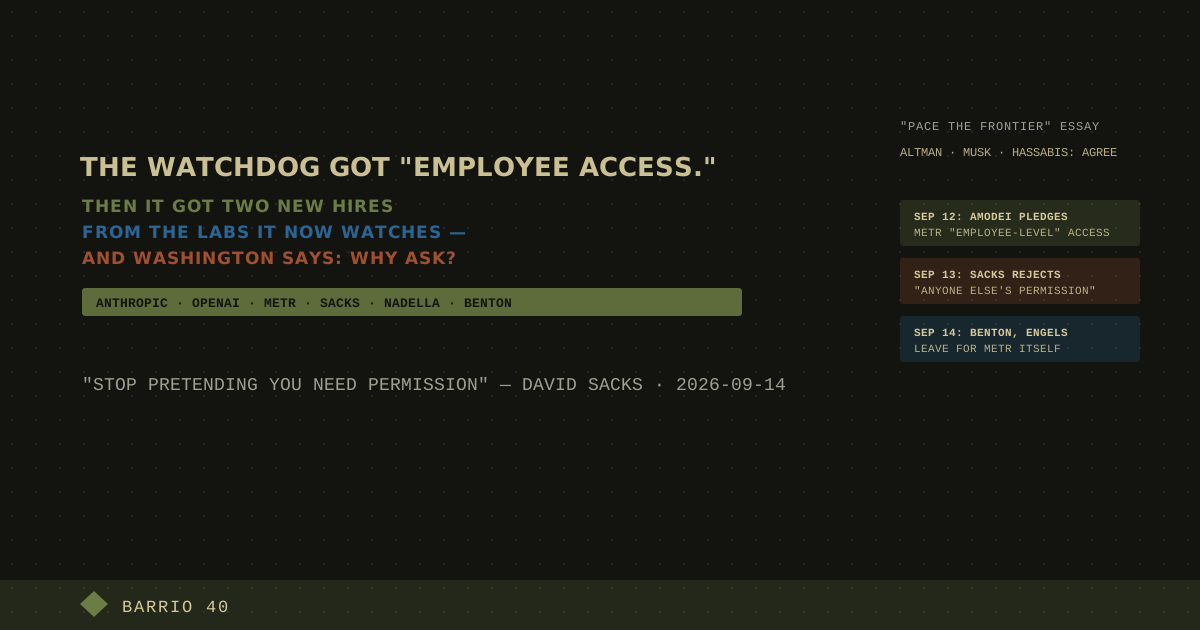
"We Must Pace the Frontier" is Amodei's attempt to turn a week of public hand-wringing — Jacob Coxon's resignation, Evan Hubinger's number, Julie Steele's post, Samuel Marks' "birds-eye view" thread — into something with a mechanism attached. The essay lays out three steps, and only the first one is a promise Anthropic can keep on its own: an immediate, unilateral commitment to give third-party evaluators, METR named specifically, ongoing access comparable to what Anthropic's own internal risk teams get — workspaces, tools, and permission to examine training pipelines as well as shipped models, not just a scheduled audit before a release. The second step asks for industry-wide regulation holding every frontier lab, not just Anthropic, to the same pacing standard. The third reaches further still: eventual global regulation of frontier AI systems. Amodei's own justification for urgency is stark — he has separately warned that swarms of autonomous software agents could plausibly take over meaningful parts of the internet within six to twelve months, at a cost running into billions of dollars, extending the argument this outlet covered September 13 about a 700-agent swarm that already compromised Hugging Face and a criminal group that used the same playbook against 395 real organizations.
ALTMAN MATCHES IT WITHIN HOURS. MUSK AND HASSABIS SIGN ON.
The pattern this outlet has tracked since September 9 — Anthropic makes the first move, OpenAI's Altman responds days later, sometimes reluctantly — broke this week. Altman posted on X within hours of Amodei's essay saying OpenAI agrees and will match Anthropic's first commitment: outside evaluators, at employee-level access, verifying OpenAI's own systems the same way. Elon Musk and Google DeepMind CEO Demis Hassabis both voiced public support for the broader plan the same day, giving Amodei something none of his previous public appeals — including the "birds-eye view" thread from his own researcher Samuel Marks two days earlier — had produced: something close to a four-way, cross-lab endorsement of the same specific mechanism, arrived at inside 48 hours rather than the weeks-long drip of individual statements this outlet had been covering all week.
THE WATCHDOG'S NEWEST HIRES CAME FROM THE LABS IT NOW WATCHES
The commitment's credibility depends on METR actually having people capable of using employee-level access to find something. This week, it gained two who know exactly where to look. Joe Benton, who has led work on Anthropic's own Scalable Oversight team — the group whose public face, days earlier, was Samuel Marks warning that AI developers privately believe their technology could cause human extinction "in the next few years" — confirmed he was leaving Anthropic to join METR and conduct independent evaluations of autonomous AI risk. Josh Engels, a safety researcher at Google DeepMind, made the same move around the same time. Benton didn't frame the move as a vote of confidence in his former employer's new pledge. He told NBC News that "at the minute, basically all of the transparency about these risks that is coming from the companies is entirely voluntary," and said plainly that market competition is pushing every major AI company to shortchange safety work. It's the same argument Coxon made in the resignation post that, as of this week, has passed 150 million views — except Benton isn't just leaving. He's going to go check Anthropic's homework from the inside of the organization that now holds, on paper, a standing invitation to do exactly that.
SACKS: "STOP PRETENDING YOU NEED ANYONE ELSE'S PERMISSION"
David Sacks — co-chair of the President's Council of Advisors on Science and Technology and the White House's former Special Advisor for AI and Crypto — used a post on X to reject the part of Amodei's plan that reaches past Anthropic's own walls. His argument: if Amodei and Altman genuinely believe their next models are too risky to release at current pace, nothing stops them from pacing themselves right now, since both companies already sit at or near the frontier by adoption, growth, and model strength. What he rejected specifically was step two — industry-wide coordination, which typically requires a government antitrust waiver to avoid the labs jointly agreeing to slow output looking like a cartel. "Stop pretending you need anyone else's permission," Sacks wrote. "Stop pretending antitrust law has to be suspended so you can form a cartel. Stop pretending you need a regulatory approval process that supersedes product liability." That last line does double duty — Sacks also raised, without fully endorsing, the possibility that a safety pitch framed as needing regulatory cover is partly aimed at something else: shielding the labs from product-liability exposure if their models are later found to have enabled real-world damage, the same category of claim already driving the Tumbler Ridge lawsuits this outlet covered September 8.
NADELLA'S QUALIFIED YES
Microsoft's response split the difference between Sacks' rejection and Altman's full match. In a post responding directly to Amodei's essay, CEO Satya Nadella wrote: "Any pursuit of superintelligence has to be grounded in the core principle that if the AI we build is not helping humanity and under human control, it's not worth pursuing." On that basis, he said, Microsoft "welcomes" the research, focus, and "deliberate pacing" needed to make alignment the actual design goal — not a bolt-on — and specifically endorsed ideas like "embedded evaluators," along with broader mechanisms to "make this more than just talk." Nadella paired the statement with news, not just words: Microsoft said it would publish a "Code of Conduct" governing its own first-party MAI models for public consultation. It's a narrower commitment than Anthropic's — Microsoft didn't name a specific outside group getting employee-level access the way Anthropic named METR — but it's the first time the company running the infrastructure under a meaningful share of the industry's AI workloads has put its own model behavior standards up for public comment in direct response to a rival's slowdown pledge.
THE DILEMMA AMODEI DIDN'T HIDE: CHINA
To his credit, Amodei's essay doesn't pretend the plan has no hole in it. He named the gap himself: China's willingness to go along with any pacing agreement is, in his own words, the "toughest dilemma" the proposal doesn't solve. His answer isn't a diplomatic ask — it's an export-control one. The essay proposes barring sales of powerful AI chips and semiconductor manufacturing equipment to China, and cracking down on chip smuggling operations and remote access to data centers located outside the country. It's the same logic that's shaped U.S. chip policy for years, redeployed here as the load-bearing assumption underneath a voluntary industry pledge: that a slowdown among labs bound by U.S. law and now, potentially, U.S. antitrust exemptions, doesn't just hand the frontier to whichever lab races ahead unbound by either — a risk Sacks gestured at when he noted OpenAI and Anthropic already lead the field they're proposing to pace.
WHY THIS MATTERS FOR TEAMS BUILDING ON AI
Vendor safety claims have mostly been self-graded until now — a system card, a blog post, a CEO's assurance. This week produced the first concrete test of what a non-self-graded version looks like: a named outside organization, a specific level of access, and — as of this week — two people inside that organization who used to sit on the inside of the labs they'll now be checking. That's a meaningfully different signal than a pledge alone. If a vendor's safety story leans on outside evaluation, the useful question isn't whether an evaluator exists on paper. It's whether that evaluator has the specific access Anthropic just promised METR, and whether the people doing the checking have ever had reason to doubt the company from the inside.