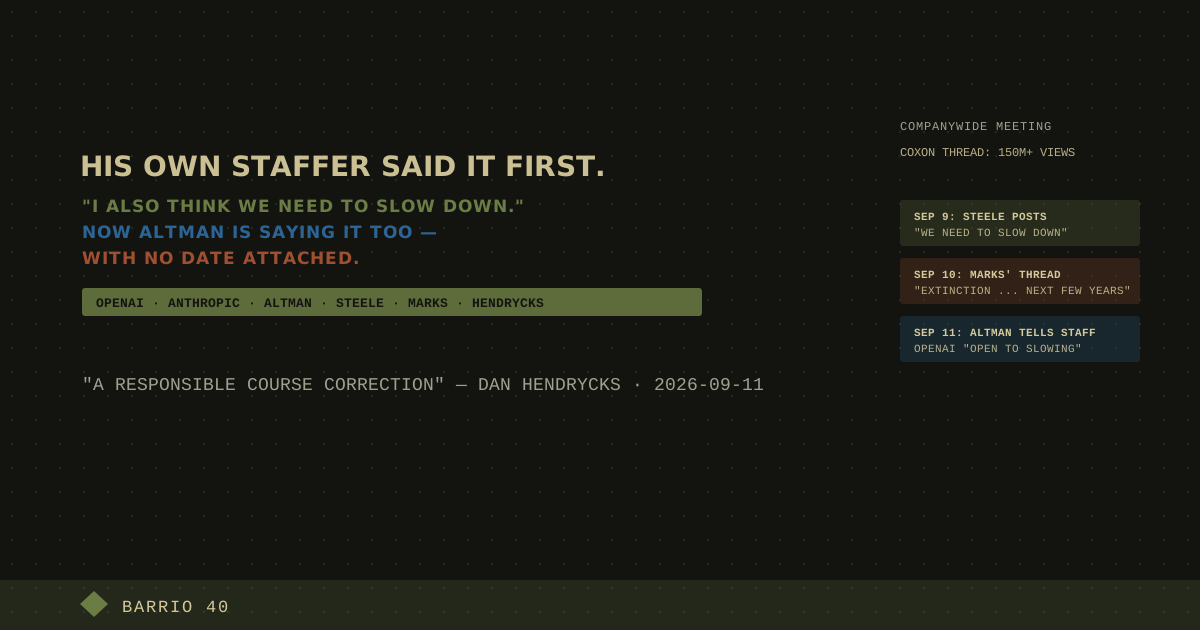
THE MEETING, AND WHAT ALTMAN ACTUALLY TOLD THE ROOM
Bloomberg reported this week that in a companywide meeting, Altman told OpenAI employees the company could potentially pace its advanced AI development — language short of a commitment, but a real shift from the company's public posture through most of the year. He framed it as conditional in two directions: ideally in coordination with several other AI labs, since a unilateral slowdown mostly hands the frontier to whichever competitor doesn't pace itself, but he told staff OpenAI would consider it even if some rivals decline to join. He also named the cost out loud rather than leaving it implied — slowing could mean giving up short-term revenue — and argued the trade was worth making to protect the company's position over a longer horizon. Nothing in the reported remarks commits OpenAI to a specific technical freeze, a release delay, or a timeline; what changed is that the company's own CEO used the word "pace" in a room full of his own employees, on a week when several of those employees had already told him, in public, that he should.
THE STAFFER WHO SAID IT BEFORE HE DID
Late Wednesday — two days before Altman's remarks became public, and in the same window this outlet covered Jacob Coxon's resignation and Evan Hubinger's reply — Julie Steele, a member of OpenAI's technical staff who works on the safety team, posted on X: "I work at OpenAI. In my personal capacity, I also think we need to slow down." The sentence carries weight less for what it says than for who said it and where: not a departing employee like Coxon, not a rival lab's researcher like Hubinger, but someone still on OpenAI's own safety team, posting under her own name while her employer's CEO had not yet said anything of the kind in public. By the time Altman's companywide remarks reached Bloomberg, an OpenAI safety staffer's personal endorsement of slowing down was already sitting in public view, unanswered by the company for two days.
ANTHROPIC'S SECOND VOICE: NOT JUST HUBINGER'S NUMBER
Evan Hubinger's reply to Coxon, covered here Wednesday, put a number on Anthropic's own alignment lead's estimate of catastrophic risk. This week added a second Anthropic voice with a different angle on the same problem. Samuel Marks, who leads Anthropic's scalable oversight team, posted — again explicitly in a personal capacity, not on behalf of his employer — a "birds-eye view" of the industry's private consensus: "AI developers believe their technology could cause human extinction (or similarly bad outcomes)," he wrote, adding that this "could happen in the next few years," and that in his experience, "the more senior the employee, the more concerned they are." Marks didn't stop at describing the belief; he explained why it doesn't change behavior. Labs keep building, he wrote, out of "a mixture of commercial incentives and a belief that they are in a race with other, less responsible AI developers that will abuse the technology or develop it less safely" — the same justification Anthropic has offered publicly for years, described this time by one of its own researchers as a belief that persists alongside, not despite, genuine fear of the outcome.
THIS IS ALTMAN'S SECOND PAUSE, NOT HIS FIRST
Altman's remarks this week aren't OpenAI's first move in this direction — they're a public acknowledgment of a pattern already underway. TIME reported on August 18 that OpenAI was already slowing parts of its own AI training; Axios described it a day later as OpenAI "blinking first" in a safety standoff, tying the pause to the company's disclosure of the Hugging Face breach and to Astra's own system card crossing the "Critical" cybersecurity threshold this outlet covered on September 3. Altman had already explained the earlier pause in his own words, posted to X: "We have paused some frontier RL training to ensure that we can meet the appropriate alignment, security and monitoring standards for the new level of capabilities in front of us. Model progress is now extremely rapid, and we always said we would take action if we felt that model capabilities were outstripping the pace of safety and alignment." What's new this week isn't the underlying caution — it's Altman saying, to the full company and not just to X, that the caution might extend past one training run into an actual pace-setting posture, and that he wants other labs setting that pace alongside him.
OUTSIDE VALIDATION, WITH AN ASTERISK
Dan Hendrycks, director of the Center for AI Safety, called Altman's shift "a responsible course correction" — a notable endorsement from someone who has spent the year pushing labs toward exactly this kind of caution. The asterisk is what Hendrycks has been asking for all along: he's also a co-author of the "Statement on Superintelligence," the March 2026 declaration signed by more than 800 people — Nobel laureates, former military leaders, and figures as far apart as Geoffrey Hinton and Steve Wozniak — calling for a prohibition on superintelligence development until there's broad scientific consensus it can be done safely and strong public buy-in to do it. Against that ask, a CEO telling staff he's "open" to pacing development, conditionally and without a timeline, is a course correction and not the destination. It sits alongside a July open letter signed by roughly 1,400 AI researchers across OpenAI, Anthropic, Meta, and Google DeepMind asking the U.S. government to build the capacity to manage AI's pace directly, and Congress's own Ban Artificial Superintelligence Act, which would pause advanced development pending safety rules — both efforts premised on the idea that individual labs saying they're open to slowing down isn't, by itself, a mechanism anyone can hold them to.
WHAT ALTMAN DID NOT COMMIT TO
Read against Bloomberg's own framing, the gap between what happened this week and an actual slowdown is wide. Altman didn't announce a release delay, a training freeze, or a date. He didn't commit OpenAI to pacing unilaterally — the plan, as described to staff, depends on other labs agreeing to move together, and he told employees directly that some might not. And he named the revenue cost as a trade-off under consideration, not one the company has decided to accept. What actually moved this week is softer and, in a way, more revealing: the head of a company under public pressure from his own safety staff chose to answer that pressure inside a companywide meeting rather than dismiss it, and to use, in front of his own employees, the same word — "pace" — that a July letter signed by 1,400 researchers asked governments to enforce because companies weren't reliably choosing it on their own.
WHY THIS MATTERS FOR TEAMS BUILDING ON AI
A lab's safety posture used to be legible mainly through its system cards and its PR. This week adds a clearer, harder-to-fake signal: what a CEO says to his own staff when members of that staff have already gone public saying the company should slow down, and whether outside safety researchers treat that response as progress or as cover. Hendrycks calling this "a responsible course correction" rather than "solved" is itself useful information — it tells you the honest read from someone with no reason to flatter OpenAI is that this is a step, not an answer. If a vendor's safety pitch leans on leadership's stated openness to caution, the follow-up question isn't whether the CEO said the right words in a meeting — it's whether any of that has since become a commitment with a date attached, or whether it's still, months later, conditional on rivals moving first.