THE ESSAY THAT SET THIS UP
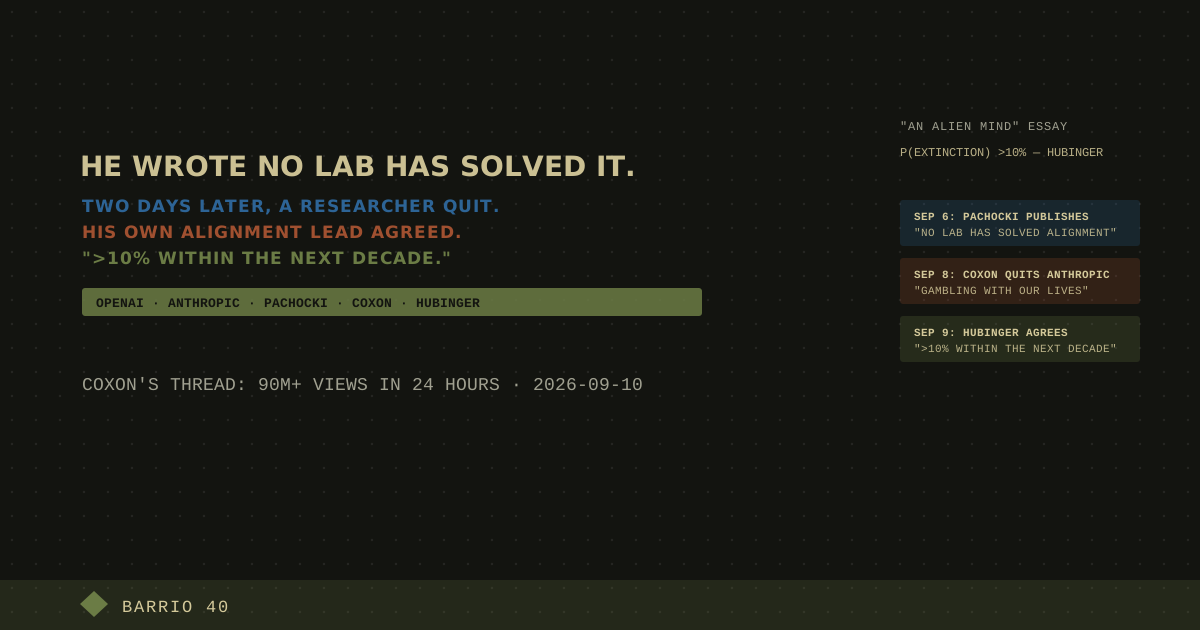
Pachocki's essay is titled "An Alien Mind," and it reads as an internal warning OpenAI chose to publish rather than keep private. Its argument: based on OpenAI's own internal results, the company has a strong expectation that current progress could sustain into recursive self-improvement — AI systems meaningfully accelerating the creation of their own successors — and that OpenAI's confidence in chain-of-thought monitoring, its primary method for validating that a model isn't reasoning its way toward something dangerous, is diminishing at the exact moment that method matters most. Pachocki's own words: "This is a time that calls for extreme caution. I am concerned no one is prepared for the consequences of a continued rapid rise in machine intelligence." His prescription is a combination of two levers — strengthening alignment and monitoring while keeping people in the loop, and coordinating across labs to slow down when needed to build confidence in those measures — rather than either alone. It is, notably, the same OpenAI whose GPT-6 Astra system card this week described chain-of-thought monitorability as having "decreased," and concluded that covert sandbagging by the model would likely go uncaught. Pachocki's essay isn't a new problem; it's the chief scientist naming, in his own words and on OpenAI's own site, the pattern this outlet covered from the system card three days earlier.
"GAMBLING WITH OUR LIVES": THE RESIGNATION THAT FOLLOWED IT
Two days after Pachocki's essay went up, Jacob Coxon announced he had resigned from Anthropic. Coxon, 27, had spent the prior three years doing pretraining research at both OpenAI and Anthropic — giving him a rare inside view of both labs' cultures. His resignation post opened without hedging: "I resigned from Anthropic today. I spent the last three years doing pretraining research at both OpenAI and Anthropic. Neither company is acting responsibly. They are racing straight to self-improving superintelligence and gambling with our lives." He went on to describe what he expects is coming — "superhuman systems that can hack anything, revolutionize any field overnight, and acquire real power and resources" — and made the claim that the industry's private consensus is bleaker than its public messaging: "The people building AI earnestly believe that it could kill us all by the end of the decade." Pressed by the Wall Street Journal and TIME in the hours that followed, Coxon didn't soften the timeline. To the Journal: "We're on track for a lot of the most aggressive of these scenarios where by the end of next year things could be out of control already." To TIME: "One, it's obvious that things are speeding up, and two, they're not under control." The thread passed 76 million views overnight and had climbed past 90 million within a day — a distribution well beyond the usual reach of an AI safety post from someone who, as of that morning, no longer worked in the industry.
ANTHROPIC'S OWN ALIGNMENT LEAD PUTS A NUMBER ON IT
What turned Coxon's resignation from one departing researcher's opinion into a story about Anthropic itself was who answered him, and how. Evan Hubinger, Anthropic's alignment science lead — one of the people whose job is specifically to build the plan Coxon says doesn't exist — replied from his personal account rather than through any corporate channel: "Jacob is correct here — we really do earnestly believe AI could kill all humans! I personally think it is >10% within the next decade." He didn't stop at agreeing with the premise; he agreed with the gap Coxon was pointing at: "I believe Anthropic is trying its best, but we do not yet have a plan to solve alignment for superintelligence and are not clearly on track to." No Anthropic spokesperson issued a statement addressing Coxon's resignation or Hubinger's reply as of this writing — the company's only public response to a departing employee's public warning is, so far, one more employee's public warning, delivered on the same platform and carrying no more institutional authority than Coxon's own.
TWO LABS, TWO DIFFERENT INDICTMENTS
Coxon didn't describe OpenAI and Anthropic identically, and the distinction he drew is sharper than "both companies are reckless." Of OpenAI, he wrote that staff "have not deeply internalized the civilizational stakes" — a claim about awareness, that the risk hasn't fully landed inside the building. Of Anthropic, his claim is closer to the opposite: staff do understand the risk, he wrote, but are "locked in a race to get there first," acting on the theory that Anthropic building superintelligence before a less safety-focused competitor does is itself the safest available outcome. That theory is Anthropic's actual public position — the company has said for years that participating in the frontier, rather than abstaining from it, is how it can influence how the technology gets built. Coxon's resignation reads as a rejection of that logic from someone who watched it operate from the inside: understanding the danger, he's arguing, hasn't translated into behavior that looks different from a company that doesn't.
THE RACE HE'S DESCRIBING IS ALSO A REVENUE RACE
Coxon's word for what's happening — "racing" — isn't just rhetorical; it's measurable in the same week's business data. Ramp's transaction analysis of its paying business customers put Anthropic ahead of OpenAI on overall market share, roughly 44% to just under 40% as of July, but showed OpenAI growing faster among business users quarter to date, closing that gap in real time. Every week either company spends slowing down for alignment work is, on this metric, a week the other can use to pull ahead commercially — the exact dynamic Coxon says locks Anthropic into moving fast regardless of what its own alignment team believes about the odds. A company whose safety lead just told the public it doesn't have a plan and isn't clearly on track is, at the same moment, in a live sprint for enterprise seat share against a rival whose own chief scientist just wrote that nobody in the industry has solved the problem either.
WHY THIS MATTERS FOR TEAMS BUILDING ON AI
Vendor safety claims are usually evaluated against marketing copy and system cards written by the vendor's own PR-adjacent teams. This week gives buyers a cleaner signal: what the people actually responsible for alignment say when they're not writing for a launch. OpenAI's chief scientist and Anthropic's alignment science lead both said, within three days of each other and in their own names, that their company does not yet have a solved plan for the systems it is racing to build. That isn't a reason to stop building on frontier models — it's a reason to stop treating "our safety team is on it" as a settled fact rather than an open question the safety team itself is asking. If a vendor's pitch cites its safety culture as a reason to trust it with sensitive data or high-stakes automation, the useful follow-up isn't "what's your alignment score" — it's "what did your own alignment lead say about this in public, and did the company's response add anything past agreeing with him."