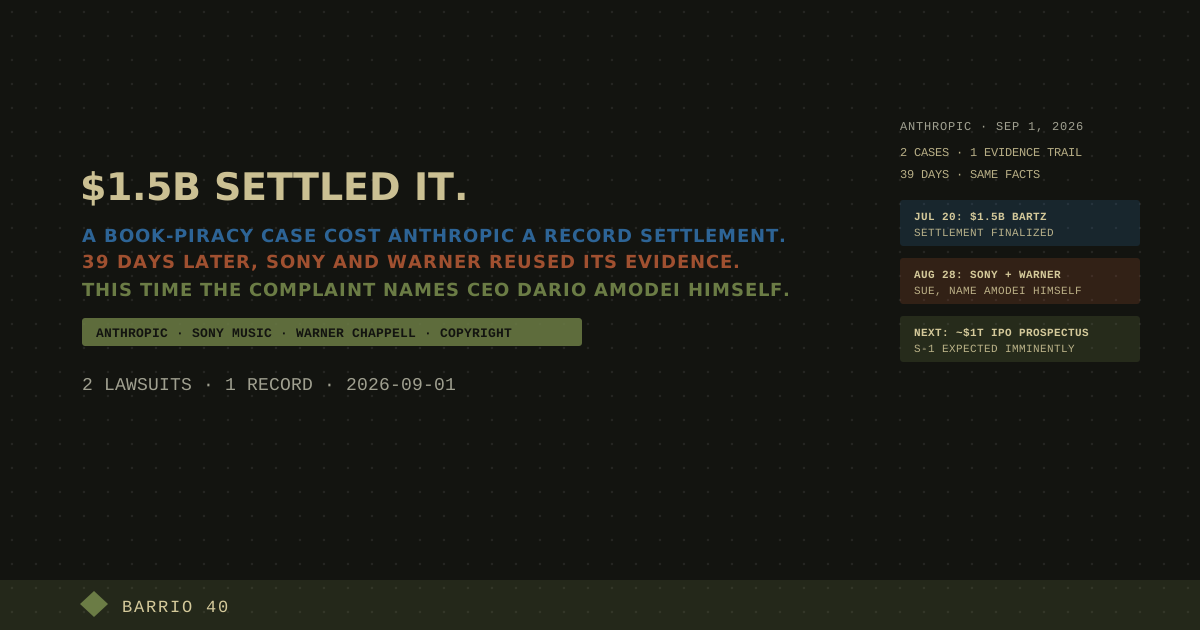
THE FRIDAY FILING: WHAT SONY AND WARNER ARE ACCUSING ANTHROPIC OF DOING
The complaint, filed Friday in the Northern District of California, accuses Anthropic of a "brazen campaign of illegally torrenting, scraping, and downloading copyrighted works on a massive scale" to train Claude, and claims the company obtained and used "tens of thousands" of copyrighted musical compositions without a license — a broader scope, the publishers argue, than earlier lawsuits over the same underlying conduct have alleged. The filing names specific works: "Eye of the Tiger," Marvin Gaye's "Ain't No Mountain High Enough," Taylor Swift's "Paper Rings," "Uptown Funk," "Hallelujah," Mariah Carey's "All I Want for Christmas Is You," and catalog compositions from the Beatles and Michael Jackson. Beyond torrenting from shadow libraries, the complaint alleges Anthropic scraped lyrics directly from licensed lyrics sites Musixmatch and LyricFind, and stripped copyright management information from the works it used — conduct that carries its own separate statutory penalty. Sony and Warner are seeking a jury trial, statutory damages of up to $150,000 for every work found to have been willfully infringed, and up to $25,000 for each instance of removed copyright management information; across "tens of thousands" of cited compositions, the arithmetic points toward a potential exposure in the billions of dollars.
THE EVIDENCE WASN'T NEW — IT WAS ALREADY ON THE RECORD, IN A DIFFERENT CASE
What makes this complaint unusual is where its most damaging specifics come from. Bartz v. Anthropic was a class action brought by book authors, not musicians, alleging Anthropic built its training library on pirated text. Discovery in that case forced into the open exactly how: that in June 2021, Benjamin Mann personally used BitTorrent to download at least five million pirated books from Library Genesis, and that Anthropic employees separately torrented at least two million more from Pirate Library Mirror in July 2022. Unsealed internal material from that same discovery captured Mann's own characterization of Library Genesis — "sketchy AF" — alongside testimony that he'd formed a view that downloading from it was fair use based on an opinion he'd developed earlier, while working at OpenAI. Sony and Warner's new complaint cites these same figures and quotes almost verbatim. The publishers didn't need their own investigators to establish how Anthropic acquired its training data at scale; a different set of plaintiffs' lawyers, suing over a different medium, had already done that work and put it in the public record.
JULY 20: THE SETTLEMENT THAT WAS SUPPOSED TO CLOSE THIS
The record didn't emerge from nowhere — it was the product of a case Anthropic had already resolved, expensively. On July 20, U.S. District Judge Araceli Martinez-Olguin granted final approval to the Bartz settlement, calling it "fair, reasonable, and adequate" and overruling all 53 objections filed against it. The $1.5 billion fund — believed to be the largest publicly reported recovery in the history of U.S. copyright litigation — covers roughly 500,000 works Anthropic is alleged to have pirated from Library Genesis and Pirate Library Mirror; as part of the deal, Anthropic agreed to destroy the original torrented files and any copies derived from them. Judge Martinez-Olguin also declined class counsel's request for 12.5% of the fund, instead setting their fee at $101,561,111 plus close to $3 million in expenses. The underlying liability had been narrowed by Judge William Alsup, who ruled on summary judgment that training on lawfully acquired books could qualify as fair use, but that retaining pirated copies in what he called a "central library" was a separate, uncovered harm — the finding that pushed Anthropic toward settling rather than trying the piracy question to a jury. Thirty-nine days after that settlement became final, the same underlying conduct is back in court, over a different set of copyrighted works entirely.
THE THIRD MAJOR PUBLISHER TO SUE — AND THE SECOND SUIT FROM THE FIRST ONE
Sony and Warner aren't the first music-rights holders to sue Anthropic, and this isn't even the first time the underlying LibGen and Pirate Library Mirror allegations have been aimed at Claude's lyrics training rather than its book training. Concord Music Group, Universal Music Publishing Group, and ABKCO Music first sued Anthropic in October 2023 over roughly 500 songs; Anthropic agreed to a partial injunction in that case in December 2024 while continuing to contest liability. That same group of publishers then filed a second, separate suit in January 2026 — covering more than 20,000 songs and seeking over $3 billion — alleging mass torrenting of lyrics from shadow libraries, a case that remains pending. Sony Music Publishing and Warner Chappell's August 28 filing means all three of the industry's dominant publishing groups now have live litigation against Anthropic running simultaneously, layered directly on top of, and cross-referencing, the book-piracy settlement Anthropic had just finished paying for.
WHY NAMING AMODEI AND MANN PERSONALLY CHANGES THE CALCULUS
Copyright suits against AI companies typically target the corporate entity; naming a sitting CEO and a co-founder as individual defendants is a deliberate escalation. It signals an intent to argue personal knowledge and direction of the infringing conduct rather than diffuse corporate policy — and Mann's own hands-on-keyboard role in the June 2021 downloads, established in Bartz, gives the theory a specific factual anchor rather than an inferred one. The timing sharpens the stakes further. Anthropic confidentially filed its S-1 with the SEC on June 1, 2026, following a $65 billion Series H round in May that set a $965 billion valuation; a public prospectus has been widely expected since, with a Nasdaq listing reportedly targeted for around October 2026, led by Goldman Sachs, JPMorgan, and Morgan Stanley, aiming to raise more than $60 billion — and some press accounts floating a valuation north of $1 trillion once the company lists. Prospective public shareholders reading that registration statement's risk-factors section will now be weighing not just corporate litigation exposure, but a live federal complaint naming the company's own CEO as an individual defendant, filed weeks before the filing window opened.
ANTHROPIC'S RESPONSE, AND WHAT THIS MEANS FOR TEAMS BUILDING ON AI
An Anthropic spokesperson dismissed the suit as an attempt to recycle "allegations from cases already before the courts," maintained that "training generative AI models is a transformative fair use," and said the company would "defend ourselves robustly." Both things can be true at once: the legal defense may be sound, and the optics may still be bad, because a settlement doesn't retire the facts that produced it — it publishes them, permanently, as a free evidentiary starting point for the next set of plaintiffs in an entirely different industry. If your team is evaluating a model vendor's data-sourcing representations for a product roadmap, a procurement decision, or an investment memo, the lesson from Bartz-to-Sony-and-Warner isn't about music rights specifically: it's that a settled case doesn't mean a closed question, and a paid-for evidentiary record from one lawsuit is often the opening brief of the next. Before you lean on a vendor's fair-use posture, ask whether the underlying acquisition facts have already been established — and litigated — somewhere else.