THE RELEASE
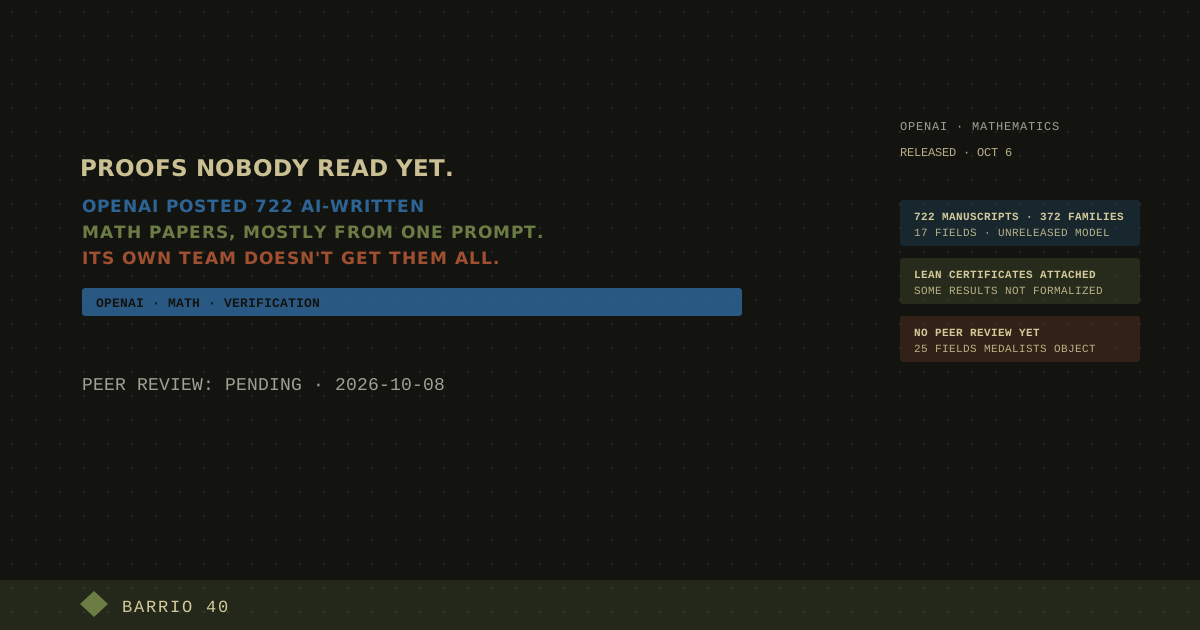
On Tuesday, October 6, OpenAI published a batch of 722 mathematical manuscripts on GitHub, organized into 372 "result families" across 17 areas of mathematics and theoretical computer science. All of them were written by an internal model that has not been released. According to reports, the model was handed roughly 4,000 problems and spent about three hours of ChatGPT Pro-level compute per result. Counts differ between outlets, with some citing 722 manuscripts and others 372 results, which is why both numbers appear here.
THE CLAIMS
The headline results are ambitious: a proof of the Unique Games Conjecture, a zero-free half-plane for the Riemann zeta function, the rational Hodge conjecture for CM abelian varieties, and the isomorphism of the free group factors. These are not routine exercises. If even a few hold up, they would count among the most significant results of recent decades. The operative word is "if": the claims are OpenAI's own, and the company's README reportedly warns that some of the unformalized results could contain issues.
WHAT IS CHECKED AND WHAT IS NOT
The release is built around the Lean proof assistant, so formalized results carry a machine-checkable certificate. That is a real strength: a Lean proof that compiles is correct relative to its stated theorem, regardless of how strange the argument looks. But a certificate only verifies that the formal statement was proven. It does not tell you whether that statement captures the problem mathematicians care about, and not every result has been formalized. None of the papers has been through peer review, and none has named human authors who can be questioned about the reasoning.
ONE PROMPT, ONE AGENT
The most striking detail came from OpenAI itself. It told Scientific American that almost every result came from a single prompt given to a single AI agent, though some may have taken several attempts, and that many of the new results are not yet understood by the company's own mathematicians. MIT's Andrew Sutherland, quoted in the same coverage, said that until the model is released and others can replicate the work, claims about one-shotting problems with a single agent should be treated as unverified. This is a long way from the earlier pattern, in which a model assisted human researchers who understood and owned the result.
THE BACKLASH
The reaction has been sharp. Scientific American ran a piece in which experts argue that the way the results were released amounts to research misconduct, and earlier coverage questioned whether an OpenAI Navier-Stokes claim solved a variant disconnected from the real problem. A declaration titled "A Severe Misalignment of AI in Mathematics" has been signed by 25 Fields Medalists. As reported, their objection is not that the Lean proofs fail to check. It is what gets lost when results arrive as a press release rather than a paper: no named authors, no attribution trail, and no way for the community to build the shared understanding that makes a proof useful. A Futurism report adds that mathematicians find at least one of the proofs close to incomprehensible.
WHAT IS STILL UNKNOWN
Whether the headline claims survive scrutiny, and how long that takes. Whether the formal statements match the informal ones. Whether OpenAI will release the model so outsiders can reproduce the work. And whether mathematics can absorb hundreds of results at once, when human review is the scarce resource. Treat every figure above as reported, since coverage so far comes largely from OpenAI's own materials and secondary summaries.
WHY THIS MATTERS FOR TEAMS BUILDING ON AI
Three practical takeaways. First, generation is now cheaper than verification. Whatever your domain, whether code, contracts or analysis, budget for the checking step, because that is where the cost moves. Second, machine-checkable evidence beats confident output: where you can attach a test suite, a type check or a formal proof to an AI result, do it, and be clear about what the check does and does not cover. Third, keep a human who understands and owns every output that matters. A result nobody can explain is a liability, however impressive the source.