THE LAUNCH
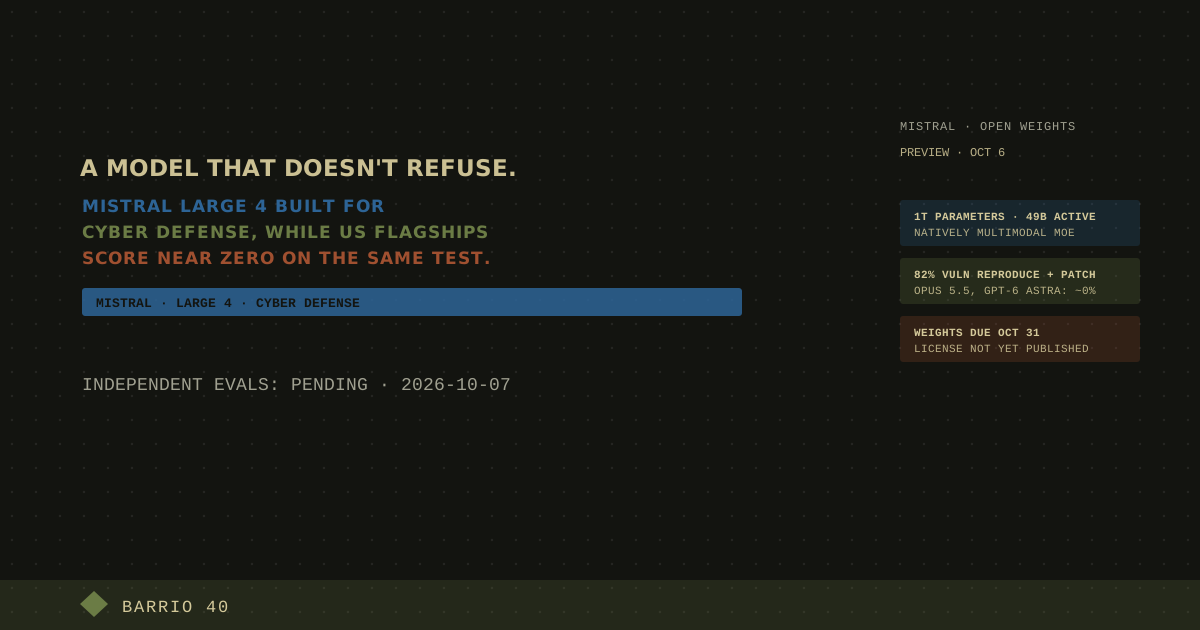
On Tuesday, October 6, Mistral released a public preview of Mistral Large 4, nicknamed "Le Chonk." It is a sparse mixture-of-experts model with about 1 trillion total parameters, of which 49 billion are active at inference, and it is natively multimodal, handling text and images together from the start rather than through a bolted-on vision module. Mistral says it was trained from scratch in about two months on close to 4,000 Nvidia Grace Blackwell GPUs in its own European data centers. The API is available now through Mistral Studio.
THE OPEN-WEIGHTS PROMISE
Mistral calls Large 4 the best open-weights model from the U.S. or Europe on aggregated benchmarks. The weights themselves are not out yet: they are expected at the end of October, with October 31 currently listed as the target date. The license has not been published, and that matters. An open-weight model that restricts commercial use is a very different asset from one under a permissive license, so the real verdict has to wait for the terms. On DeepSWE, an agentic coding test, Large 4 reportedly scored 62%, narrowly ahead of Zhipu's GLM-5.3 at 61% and DeepSeek-V4-Pro at 57%. The race for the open frontier is still led by Chinese labs, and Mistral is positioning Europe as the credible alternative.
THE CYBER NUMBERS
The headline claim is security. Mistral says Large 4 reaches state-of-the-art results on critical workloads including cyber defense, manufacturing and finance. On the Artificial Analysis Cyber Index it ranks among the top five models globally and leads non-Chinese open-weight models by a wide margin. In one test, the model is asked to reproduce a real vulnerability in open-source software and then patch it. Large 4 scores 82%, the highest of any model. Several leading closed models, including Claude Opus 5.5 and GPT-6 Astra, score near zero on that same test, because they refuse to perform the task.
REFUSAL AS A PRODUCT DECISION
That last detail is the real story. The closed labs have tuned their flagship models to decline exploit-adjacent work, and for good reasons: the same capability that lets a defender reproduce a bug lets an attacker weaponize it. But a near-zero score means a security team doing legitimate incident response or vulnerability validation gets nothing from the model. It is also why Anthropic has been building gated programs, such as its Glasswing initiative with vetted partners, to give verified defenders access instead of opening the model to everyone. Mistral is taking the opposite bet: ship a capable open model and rely on measured resilience. It reports a perfect score on its own indirect prompt-injection tests and 93.3% resistance on Lakera's public B3 benchmark, and says it refuses cyber-related requests from JailbreakBench, StrongREJECT and AgentHarm more often, on average, than any other open model. Those are the company's own claims plus public benchmarks, and independent testing will say how well they hold up.
PRICE AND CONTEXT
Reported pricing is $0.68 per million input tokens and $2.09 per million output tokens, with cached reads at $0.07. Mistral's list price appears to be double that, and it is unclear how long the lower rate lasts. Context window reports vary between roughly 524,000 tokens and one million, so check the official documentation before designing around either figure. At those prices, Large 4 is a serious option for high-volume workloads where a trillion-parameter model would previously have been cost-prohibitive.
WHAT IS STILL UNKNOWN
Three things. The license, which decides who can actually build on the weights. Independent evaluations beyond vendor-supplied numbers, especially on agentic reliability, where early commentary points to trade-offs. And whether the gap with the closed U.S. frontier holds on general reasoning, since Mistral's strongest claims are on specific workloads rather than across the board.
WHY THIS MATTERS FOR TEAMS BUILDING ON AI
Three practical takeaways. First, test refusals on your own workload: if you build security, compliance or red-team tooling, benchmark your chosen model on the tasks it must actually perform, not just on general leaderboards. Second, keep your model layer swappable. A European open-weight option that can run in your own region matters for data-residency requirements, and you only benefit if switching providers is cheap. Third, treat open weights as a procurement question as much as a technical one: wait for the license, then decide whether self-hosting a 1T-parameter model beats paying for the API.