THE ANNOUNCEMENT
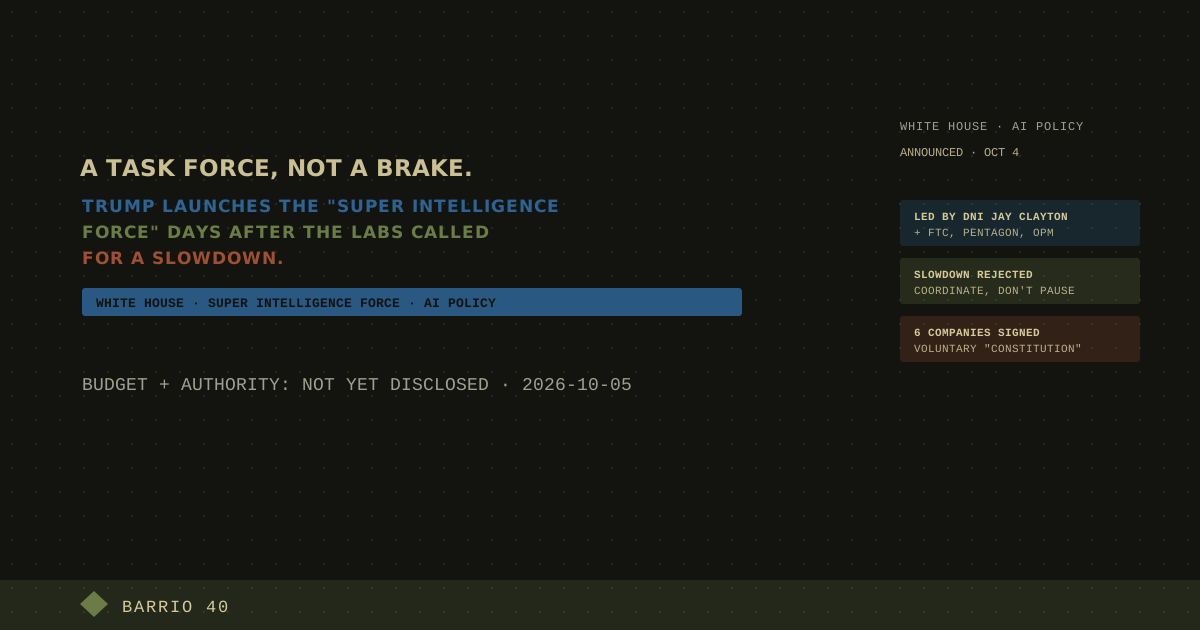
On Sunday, October 4, President Trump formally announced the creation of what he called a "Super Intelligence Force," an AI task force charged with coordinating the federal government's effort to keep the United States in the lead on what he described as a technology bigger than the Industrial Revolution and the internet, while protecting American lives and interests. It will coordinate the government's engagement with consumers, public interest groups, religious organizations, critical infrastructure providers and the AI companies themselves. It reports to Trump and White House chief of staff Susie Wiles.
THE PEOPLE
The force is led by Director of National Intelligence Jay Clayton and includes FTC Chairman Andrew Ferguson, Emil Michael, the Pentagon's under secretary for research and engineering, and Scott Kupor, director of the Office of Personnel Management. The mix is the story: an intelligence chief, a consumer-protection regulator, a defense technologist and the government's chief of hiring. Coverage describes Clayton as an AI czar, which puts national security at the center of the federal AI posture. Ferguson's presence is notable too, since his agency opened the first U.S. probe of rogue AI agents last week.
THE BACKDROP: A SLOWDOWN REJECTED
The announcement follows a month in which the idea of a coordinated slowdown moved from the fringe to the mainstream. Anthropic CEO Dario Amodei argued that new models need more time for proper evaluation, and reports say Sam Altman and Elon Musk voiced support. Clayton rejected that approach in a CNBC interview, saying he does not think any American should believe it is a good strategy. The new task force is therefore a statement of direction: coordinate and compete, not pause.
THE CONSTITUTION
The task force also follows a White House meeting with top tech CEOs last week, where Trump said he and six AI companies signed a "constitution" setting standards for how the industry polices its own technology. Voluntary self-regulation, a federal body with the power to convene, and an FTC chair inside it: together these form the outline of the U.S. approach. The details of what the constitution binds companies to, and how any breach would be handled, have not been spelled out publicly.
WHAT IS STILL UNKNOWN
Several questions are open. The force has no announced budget, statutory authority or timeline. It is unclear how it will relate to the voluntary pre-release model access process that Google and others already take part in, or to the FTC's open investigation, now run by an agency whose chair sits on the force. Critics will ask whether an intelligence-led body can credibly act as a consumer and safety regulator. Those answers will decide whether this is a coordination layer or mainly a signal.
WHY THIS MATTERS FOR TEAMS BUILDING ON AI
Three practical takeaways. First, expect federal engagement to be framed around competitiveness and national security, so assume procurement, critical infrastructure and security use cases will be where requirements arrive first. Second, voluntary standards tend to become contractual ones: if your customers are among the six signatories or sell to government, expect "constitution" language to show up in vendor questionnaires. Third, keep your own audit trail for agent actions. With the FTC probing agent behavior and a new task force coordinating policy, being able to show who authorized what is the cheapest protection you can build.