WHAT WAS ANNOUNCED
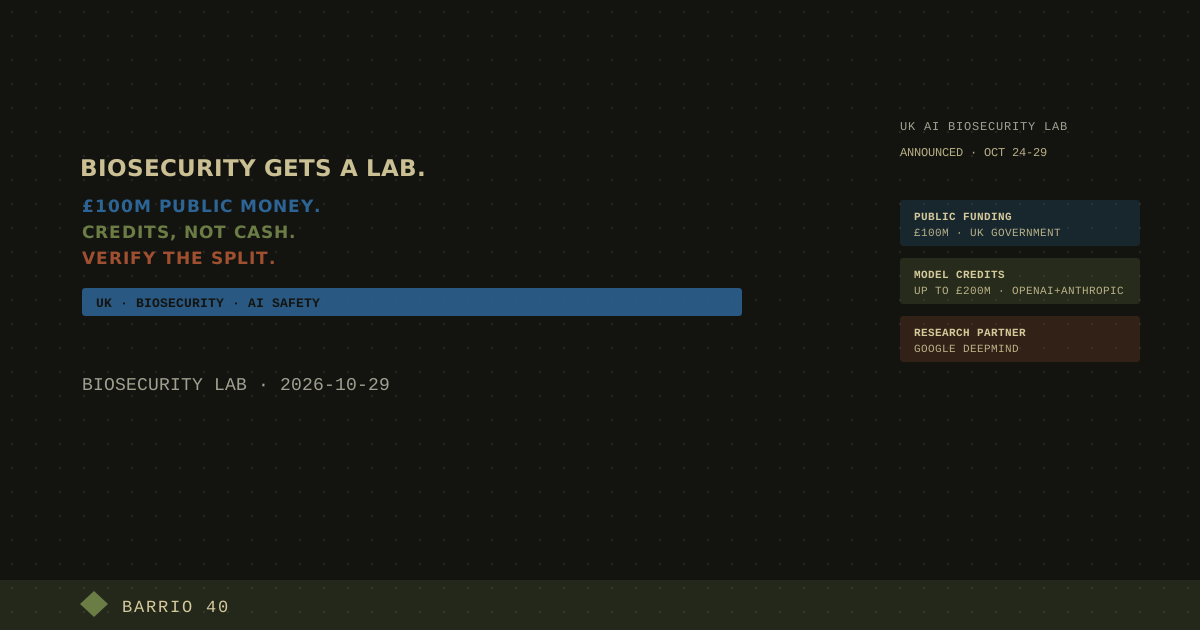
Around October 24, the UK government set out an AI security funding package of roughly £600 million, and the largest single item is a £100 million AI Biosecurity Lab. Coverage from The Next Web, City AM and others says the lab will study how frontier AI could be misused to help create biological threats, and how the same systems can be used to defend against them. An additional £65 million is reported as separate funding for countermeasures against pathogens. I am relying on secondary reports for these figures.
WHO IS PUTTING IN WHAT
According to the coverage, OpenAI is committing £100 million in compute and model credits, together with trusted access to its most capable relevant models through its Rosalind Biodefense programme. Anthropic is committing up to £100 million in model credits, trusted access and dedicated technical support. Google DeepMind is described as a research partner: its scientists will work with the lab and it will explore trusted access to Gemini and specialised scientific models. Some headlines list Google as a backer, which the reports I read do not support. London-based Basecamp Research is a named partner providing AI biology models and tools. One site gives a £300 million headline figure, which matches nothing else I found, so I ignore it.
CREDITS ARE NOT CASH
The most useful caveat in the analysis is that the £200 million is a ceiling expressed in model credits and access, not money transferred to the lab. Its value depends on how a lab prices its own compute, and it cannot be read as credits any applicant can claim. That does not make it meaningless. Trusted access to strong models for vetted biosecurity researchers is precisely the thing a government budget cannot buy on the open market. But it is a different kind of commitment from £100 million of public funding, and the two should not be added up as if they were the same.
WHAT IS STILL UNCONFIRMED
I have not seen the lab’s governance, the vetting rules for who gets trusted access, or how results will be published. Those details decide whether this becomes a working safety institution or a funding headline. The sources are mostly aggregators and trade sites that paraphrase each other, so the split between public money and company credits should be checked against the official announcement.
WHY THIS MATTERS FOR TEAMS BUILDING ON AI
Two practical points. First, frontier labs are increasingly gating their strongest capabilities behind vetted-access programmes, in biology as in cybersecurity. If your product depends on the top model for a sensitive domain, expect identity checks, use-case review and tiered access, and plan for the general-availability model to be a step behind. Second, governments are starting to treat model credits as a form of public-private funding. For anyone selling AI services into the public sector, that means procurement conversations will increasingly involve who controls access, audit rights and what happens to the data. Write those answers down before the tender arrives.