THE CHANGE
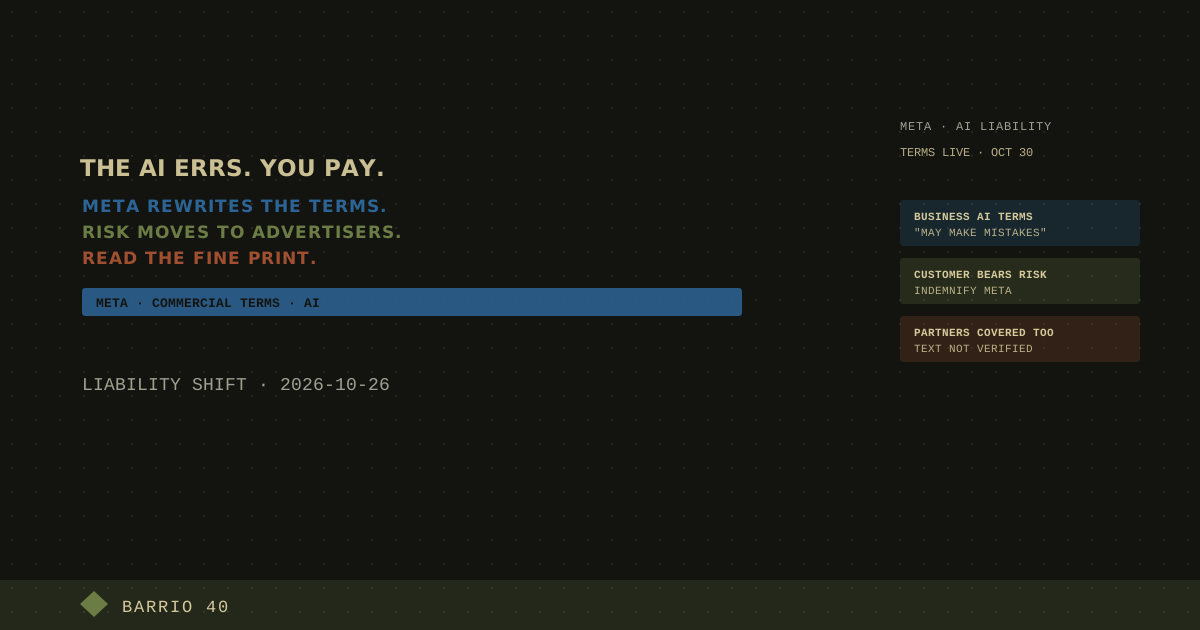
Meta has revised the commercial terms that govern how businesses use its advertising and business products, and the new version takes effect on October 30, 2026. CIO.com reported that the language shifts liability for mistakes made by Meta's AI models onto its business customers. Several outlets quote the same clause: Meta's AI features "may make mistakes and may not always produce accurate, complete, or suitable results." Adweek reports that "any and all risks" sit with the advertiser. These are secondary accounts, and I did not find Meta's own published text, so the exact wording should be checked against the source document.
WHAT CUSTOMERS WOULD TAKE ON
According to Startup Fortune, businesses would have to indemnify and hold harmless Meta, its affiliates, employees and agents for claims tied to Business Agents, with attorneys' fees included. CIO.com adds that customers would be responsible for anything a partner or contractor does with the AI tools, which matters for agencies running campaigns on a client's behalf. Commentary also says the terms give Meta a licence to content that a business or its partners put into the AI features. Those last points come from commentary sites rather than reporters, so treat them as claims to verify.
NOT ENTIRELY NEW, BUT WIDER
Beri, a commentary site, notes that the 2024 Commercial Terms already required indemnification and capped Meta's liability. Its reading is that the new AI clause widens what those provisions reach, rather than inventing a new idea. That is a fair framing: software vendors have long disclaimed responsibility for their output. What is different here is that the output is generated, can be wrong in ways nobody can predict, and goes out under a business's name in an ad.
WHAT META HAS SAID
One explainer says a Meta spokesperson told CIO.com that the crawling terms apply only to ads and business products. Another site, Lumien, reports that Meta partly walked something back in a late-Monday statement, again about crawling. Neither report describes a change to the AI liability clause itself, so as far as the coverage shows, that language stands. One source URL carries a different date, November 20, which does not match the October 30 date in the other sources and is another reason to read the primary document.
WHY IT LANDS NOW
The timing is awkward for Meta. Adweek recently reported advertisers pulling ads after Meta's AI applied unwanted "glow-ups" to their creative, so the risk in the clause is not hypothetical. When a platform automates creative, targeting and customer conversations, and then says the customer owns the result, the customer is paying for the automation twice: once in fees, once in exposure. Big advertisers can negotiate. Small ones mostly accept the terms as written.
WHY THIS MATTERS FOR TEAMS BUILDING ON AI
This is the pattern to expect from every AI platform: the model is offered as a convenience and the contract treats it as your decision. If you use Meta's AI features, have legal read the October 30 text, check whether automated features can be switched off for sensitive campaigns, and keep a human approval step on anything customer-facing. If you build AI products yourself, the same question applies in reverse: what do you promise your own customers about wrong output, and does your contract say it plainly? Reliable review and logging are cheaper than a dispute over who was responsible.