THE RELEASE
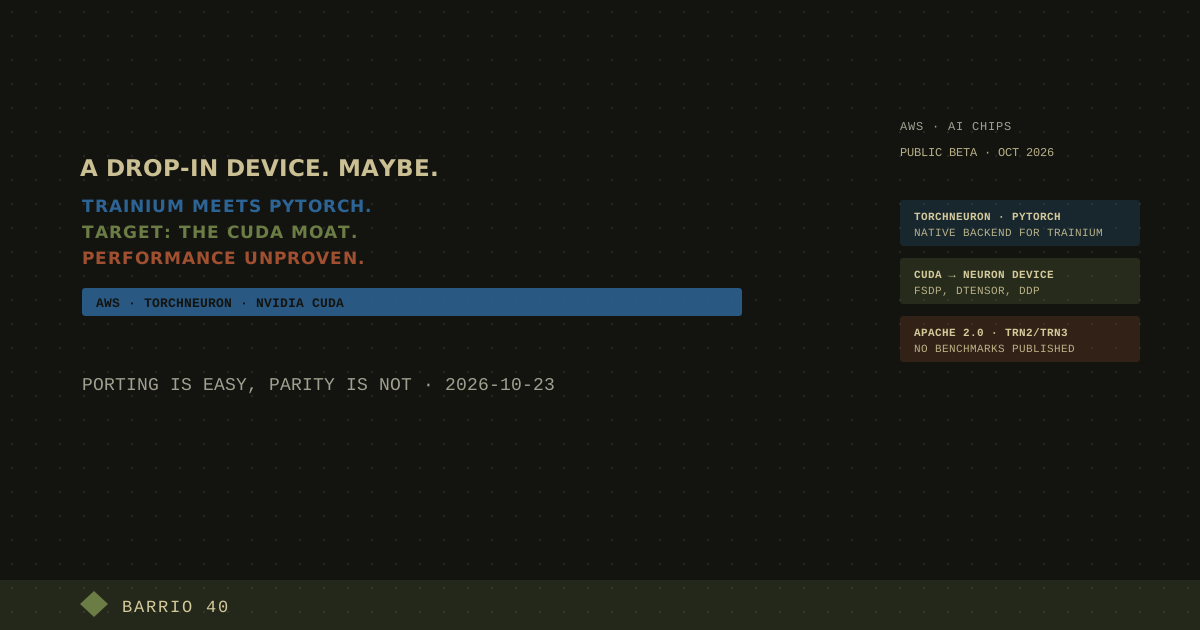
TorchNeuron is a native PyTorch backend for AWS Trainium, built on PyTorch's PrivateUse1 device mechanism and replacing the older XLA-based route. According to coverage of the PyTorch Conference North America, it was announced on the PyTorch blog on October 19 and opened as a public beta on October 20, with code released under the Apache 2.0 license and support for Trainium2 and Trainium3. The sources here are secondary write-ups and AWS's own documentation, and they disagree on status: the Neuron docs still say the backend is available only in a closed beta. The docs may simply lag the announcement, but the discrepancy is worth checking against the current release notes.
WHAT CHANGES FOR DEVELOPERS
The headline claim is low porting effort. In eager mode the main change is placing tensors on a Neuron device rather than a CUDA one, and distributed training with FSDP, DTensor and DDP is described as working natively, with sharding configuration the main exception. If that holds, a team with a working PyTorch training job no longer needs to rewrite it around a separate compiler flow to try Trainium. Trying a chip becomes an afternoon of testing instead of a migration project.
WHY CUDA IS THE TARGET
Nvidia's advantage has never been only silicon. Years of tuned libraries, kernels and tooling mean that PyTorch on an Nvidia GPU simply works, and that familiarity is what keeps buyers on Nvidia hardware even when alternatives are cheaper. TorchNeuron is an attempt to make Trainium look like one more PyTorch device. It is not unique in this: PyTorch users can already target AMD GPUs and Apple silicon with small configuration changes, and neither has dislodged Nvidia in large-scale training.
WHAT HAS NOT BEEN SHOWN
Running a model and running it well are different claims. AWS has not published benchmarks against Nvidia GPUs, pricing comparisons for equivalent jobs, or a list of operators and custom kernels that still need hand work. Performance-critical code, such as fused attention kernels and specialised inference paths, is often where CUDA lock-in actually lives, and a drop-in device change does not move it. A public beta also means rough edges, missing coverage and APIs that can still change.
HOW MUCH TO READ INTO IT
This is a meaningful reduction in switching cost, not a switch. For large buyers the question is whether Trainium capacity at a lower price justifies the engineering time to validate it, and a native PyTorch path shortens that evaluation. For Nvidia, the pressure is incremental: another credible way to say no at the negotiating table. Nothing announced shows customers moving workloads, and the proof will be case studies with real training runs, not a device string change in a demo.
WHY THIS MATTERS FOR TEAMS BUILDING ON AI
Most teams buy inference through APIs and never touch a chip, but accelerator competition decides what those APIs cost. Cheaper, easier-to-adopt alternatives to Nvidia put downward pressure on compute prices over time, though not on a schedule you can plan around. If you do train or host your own models, keep code free of CUDA-specific calls where you can, benchmark on your own workload before believing any vendor chart, and treat a beta backend as something to pilot, not something to depend on.