THE ANNOUNCEMENT
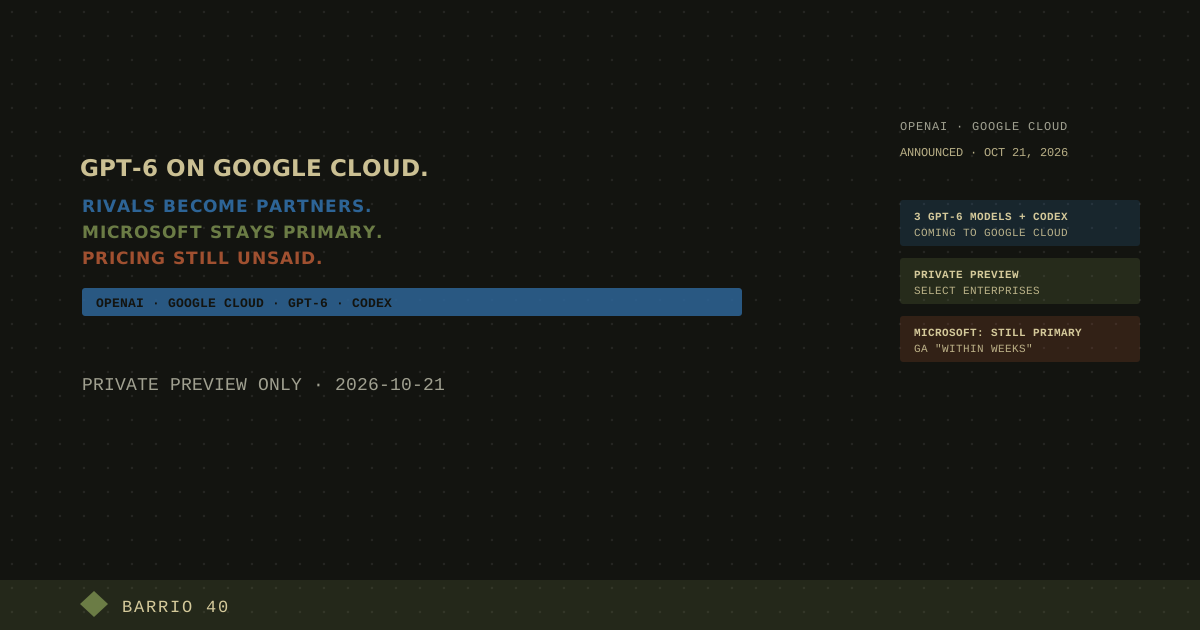
The deal was confirmed by both companies and reported by outlets including Ars Technica and CNBC. Three OpenAI models, reported as GPT-6 Astra, GPT-6.1 Sol and GPT-6 Luna, will be offered on Google Cloud, together with OpenAI's Codex agentic coding workflows. They enter private preview for select enterprise customers, and general availability is expected within weeks. Coverage disagrees on some model names (for example "GPT-6 Astra" versus "GPT-6.1 Astra"), so the exact names are worth checking against the official posts.
RIVALS, NOW PARTNERS
OpenAI and Google have competed directly in models, consumer assistants and coding tools for years, and OpenAI's models have until now been tied closely to Microsoft's Azure. Selling them through Google's platform is a notable change in posture for both sides. For Google Cloud it adds the most-requested third-party model family to a catalogue that already includes Claude and its own Gemini line. One trade report describes Google Cloud unifying GPT-6, Claude and Gemini on a single enterprise invoice, though the commercial details were not independently confirmed.
MICROSOFT STAYS PRIMARY
OpenAI said in its announcement that Microsoft remains its primary cloud partner. That sentence matters as much as the deal: the arrangement is framed as an expansion of distribution, not a replacement of the Azure relationship. What the wording does not settle is how workloads are split, whether any models or features reach Azure first, and what exclusivity, if any, still applies. None of that has been published.
WHAT HAS NOT BEEN SAID
There is no public pricing, no list of regions, no data-residency or compliance commitments and no firm general-availability date beyond "within weeks." Private preview means access is by invitation, so most teams cannot test anything yet. It is also unclear whether the Google Cloud versions match the models served from OpenAI's own API in latency, rate limits and features, or how Codex workflows will integrate with Google's existing developer tooling.
HOW MUCH TO READ INTO IT
This is a distribution deal, not a new model release, and the headline claims come largely from announcements and secondary write-ups. It does show where enterprise AI buying is heading: customers want several frontier models behind one contract and one security perimeter, and the clouds are competing to be that layer. Whether it changes real usage depends on pricing and on how close the Google-hosted models are to the originals, and neither is known.
WHY THIS MATTERS FOR TEAMS BUILDING ON AI
If your stack is tied to a single model vendor or a single cloud, this is a reminder to keep that choice reversible. Put model calls behind an interface, keep evaluation suites you can run against any provider, and avoid features that only exist in one vendor's hosted variant. When general availability arrives, compare cost, latency and behaviour on your own workload rather than on launch claims, and check where your data is processed before moving anything regulated.