THE ANNOUNCEMENT
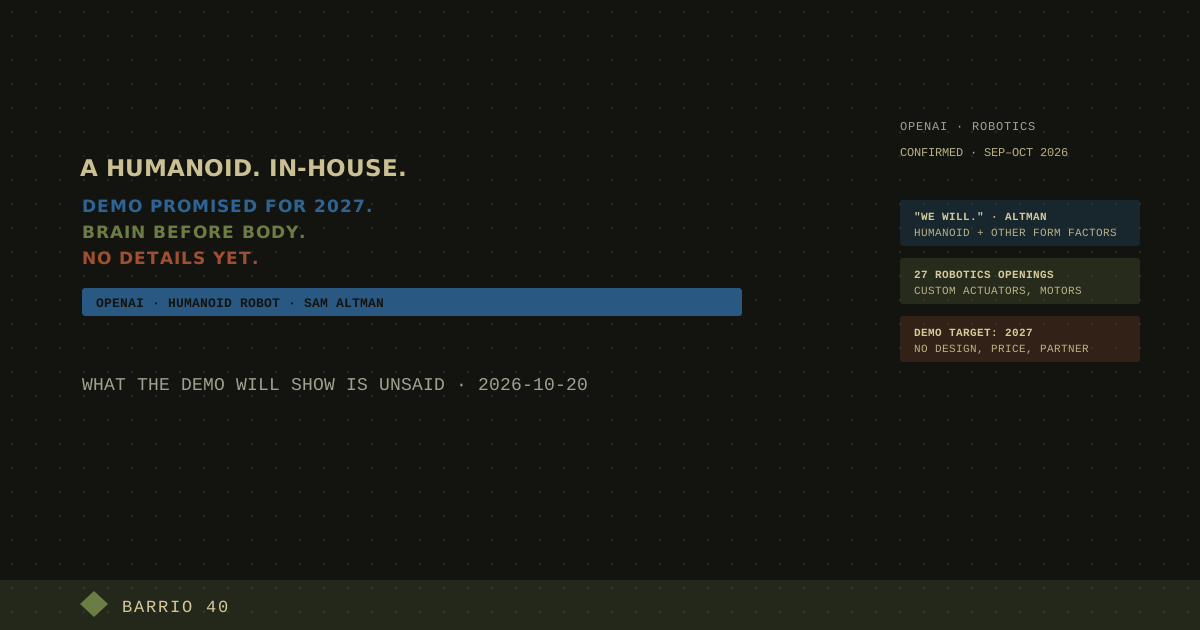
The confirmation came in interviews rather than a launch event. On the Sources podcast the host asked whether OpenAI would really build a robot itself, and Altman replied, "We will." He went further: "We will definitely do a humanoid. We will do other form factors as well," adding that there will "of course be data center robots that have like different form factors." In a separate Fortune interview he said he expects "a cool demo in 2027" and that robots walking city streets are a few years further out. Outlets disagree on the exact dates of the two interviews, and the quotes come mostly from secondary write-ups, so the wording is worth checking against the originals.
BRAIN FIRST, BODY SECOND
Altman's framing is that the mechanical body is the lesser problem. He called the design question "less important than really figuring out the brain that makes the robot work." That is consistent with OpenAI's position as a model company: the pitch is that a general model, not a clever actuator, is what separates a demo from a machine that can be trusted around people. It is also a convenient framing. Hardware timelines slip for reasons no model improvement fixes, such as supply chains, thermals, battery life, safety certification and repair, and the 2027 date is described as a target rather than a commitment.
WHAT THE HIRING SAYS
The clearest evidence of intent is not the interviews but the job board. Listings point to in-house work on custom actuators and motors, and OpenAI's careers page shows 27 robotics openings. Building actuators in-house is a different bet from licensing someone else's hardware. OpenAI previously took part in robotics through investments in 1X and Figure AI, but Figure ended its partnership in 2025 to pursue its own in-house models. Analysts now read the announcement as putting OpenAI on a direct collision course with Tesla's Optimus, Figure and Boston Dynamics, companies that have years of head start on bodies if not on models.
WHAT HAS NOT BEEN SAID
OpenAI has not disclosed a robot design, a price, a release schedule, a manufacturing partner or any commercial deployment. It has not said what the 2027 demo will show, whether it will be live or staged, or whether outsiders will be able to see the hardware. "A cool demo" is a deliberately low bar: a robot folding laundry on stage and a robot working a shift in a warehouse are very different claims, and the first says little about the second. Nothing announced so far indicates which of the two OpenAI is aiming at.
HOW MUCH TO READ INTO IT
This is a strategic signal, not a product. It tells the market that the largest AI labs no longer see the screen as the boundary of their business, and it gives robotics startups, component suppliers and rivals a reason to reassess their own roadmaps. It does not tell anyone when a humanoid will be available, how capable it will be, or whether general-purpose models transfer to physical work as cleanly as the framing implies. Robots add failure modes software never had: a wrong answer on a screen costs a retry, a wrong movement near a person costs far more, and nothing has been said about how OpenAI would test or certify one.
WHY THIS MATTERS FOR TEAMS BUILDING ON AI
For teams building products today, the practical effect is indirect but real. Model vendors are being pulled toward physical-world data and hardware, which will compete for the same compute, talent and attention as the APIs you build on. Treat any robotics roadmap as a long-dated option rather than a dependency, keep your integrations portable across vendors, and ask the questions this announcement leaves open: what is the safety case, who is liable when an embodied agent fails, and what happens to your use case if the vendor's priorities shift toward hardware.