THE LAUNCH
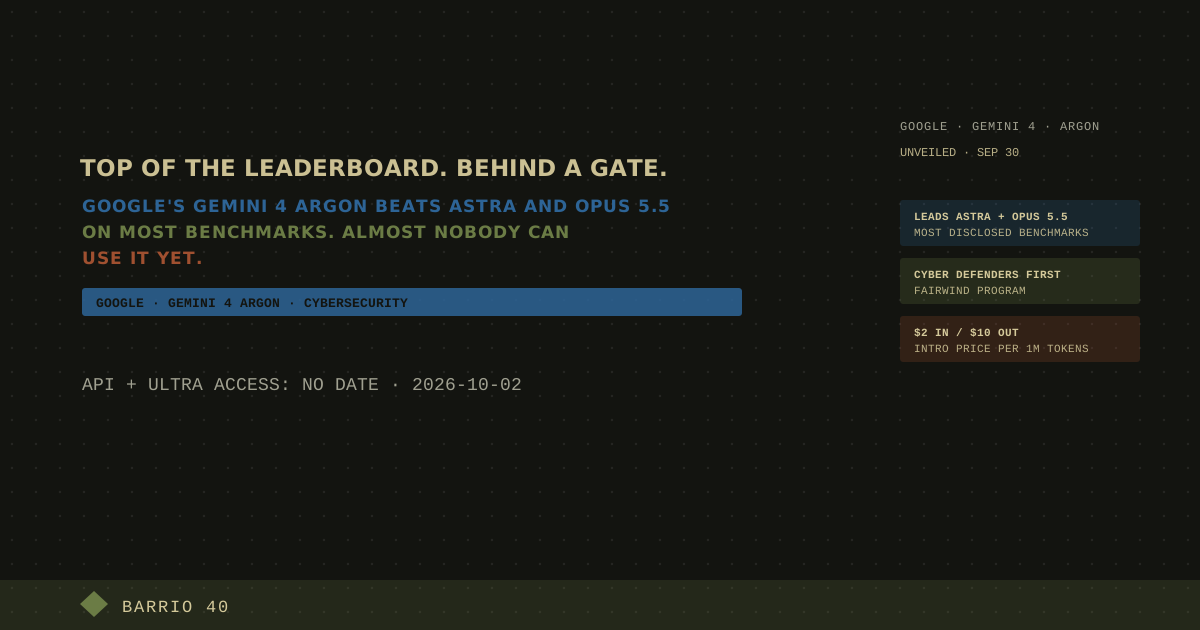
Google announced Gemini 4 Argon on Wednesday, September 30, calling it its most powerful model yet. In Google's own comparison it leads GPT-6 Astra and Claude Opus 5.5 outright on the large majority of the benchmarks it disclosed — coverage cites 12 or 13 outright wins out of 18 or 19 — with Astra ahead on three and Opus 5.5 on two. The wins cluster in work that enterprises pay for: long-horizon software engineering, cybersecurity vulnerability remediation, business automation and economic-impact knowledge work. Google also says the model can autonomously find, validate and patch critical software vulnerabilities. As always, these are vendor-selected numbers, and independent evaluations have not caught up.
THE GATE
Argon is not generally available. It is beginning rollout to a small group of trusted cyber defenders through the Fairwind Program, which Google introduced earlier this month, with US government partners included. Wider access is planned first for paid API customers and Google AI Ultra subscribers, then developers, enterprises and consumers, but Google gave no date beyond \"as soon as possible.\" The framing matters: the first users of Google's strongest model are the people who defend software, before the people who might be tempted to attack it. Google also said it is taking part in the US government's voluntary pre-release model access process, giving federal evaluators a look for national-security risk before a broader release.
THE PRICE
The numbers that will matter once the gate opens: an introductory API rate of $2 per million input tokens and $10 per million output tokens, with cached input at $0.10 per million, and an output limit of up to 1 million tokens for long, multi-step reasoning. Reports say that after the introductory period the standard price rises to $4 and $20, matching Claude Opus 5.5's base API pricing. So the pitch is a frontier-leading model at parity with Anthropic's flagship, with a temporary discount to pull teams across. It also lands one day after OpenAI priced GPT-6.1 Sol at a fraction of Astra, so the price war at the top of the market is now running on three fronts.
A DIFFERENT KIND OF RACE
Two days ago the story was cost and always-on agents. Yesterday it was the FTC asking who is accountable when an agent acts. Argon sits between them: the strongest model in the market, released to defenders first, with government evaluators in the loop. That sequencing is a response to the same pressure. When a model is good enough to find and patch vulnerabilities on its own, it is good enough to find and exploit them, and staged access is how the labs are choosing to manage that — voluntarily, and ahead of the regulators who are now asking questions.
WHY THIS MATTERS FOR TEAMS BUILDING ON AI
Three practical takeaways. First, do not re-platform on a launch benchmark. The scores are Google's, the access is gated, and the price is introductory; wait for independent evaluations and for the model to be available to you before you plan around it. Second, keep your model layer swappable. With Astra, Sol, Opus 5.5 and now Argon trading the lead in weeks, an abstraction that lets you route by task and price is worth more than loyalty to any one vendor. Third, if you build or run security tooling, watch Fairwind closely: this is the first major frontier model whose launch audience is defined by defensive use, and its terms will likely shape what the others do next.