THE ROLLOUT
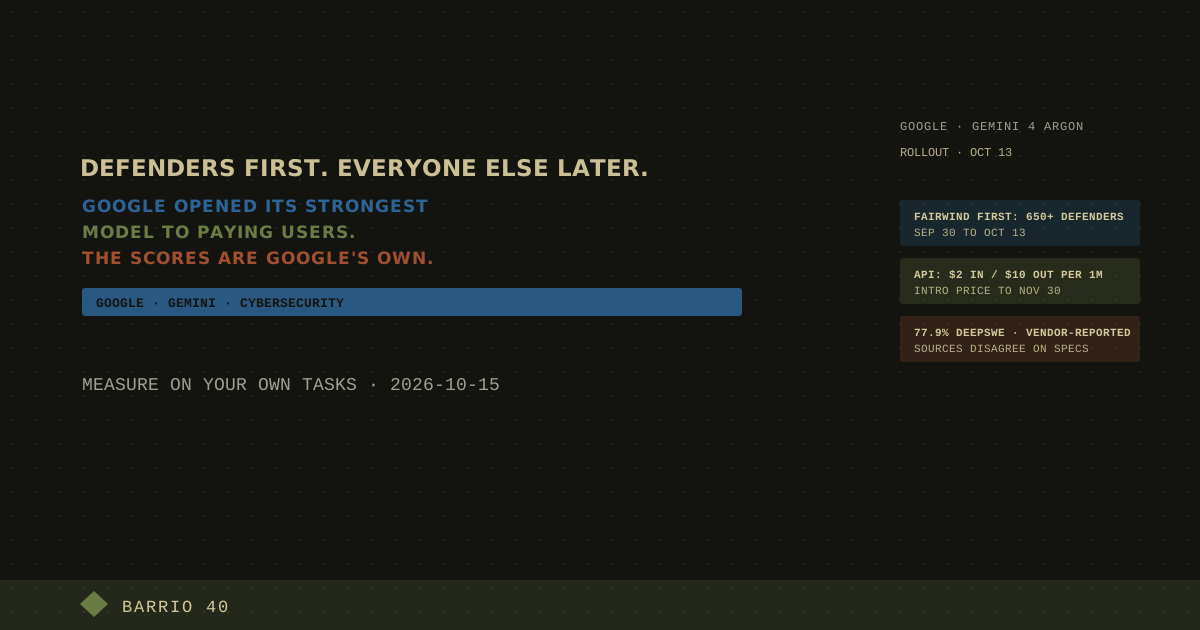
On Tuesday, October 13, Google began rolling Gemini 4 Argon out to the Gemini app, Google Antigravity and the API. The model was announced on September 30 and, until now, was reachable only through the Fairwind Program, a restricted tier reportedly serving more than 650 vetted cyber defenders, including government agencies and security vendors such as CrowdStrike, Palo Alto Networks and Wiz. Everything below comes from secondary coverage, because search turned up no primary Google page, so treat the figures as reported and check Google's own announcement before citing them.
WHO GETS IT
In the Gemini app, Google AI Pro and Ultra subscribers are the target, and the rollout is gradual and global, so the model may take hours to appear in your picker. Antigravity is murkier: several reports say desktop app and CLI access starts with Ultra and eligible enterprise plans, while another says a Pro subscription alone does not unlock it there. Developers on paid plans can call it as gemini-4-argon. Check your own model picker before assuming you have it.
THE PRICE
Reported introductory API pricing is $2 per million input tokens and $10 per million output tokens through November 30, 2026, rising to $4 and $20 afterwards. That is a promotional window, so any cost estimate made now should be rerun at the standard rate. Teams planning a migration have about six weeks of cheap data to measure real usage on.
THE NUMBERS, AND WHOSE THEY ARE
Google's reported scores include 77.9% on DeepSWE v1.1 for coding and 84.2% on GraphWalks between 256K and 1M tokens, which is its widest margin over Anthropic's Opus 5.5. Those are vendor-reported. The independent signals are thinner: Artificial Analysis reportedly places it level with OpenAI's GPT-6 Astra, and Vals reportedly ranks it second on CyberBench at 77.86%. Leaderboard ties on a single day tell you little about your own workload.
WHAT THE SOURCES DISAGREE ON
Most pages list a 1,048,576-token window shared across input, thinking and output, with up to 65,536 output tokens per request. One outlet reports a 2 million token context and a 1 million output limit. Another says the launch post does not specify the input window at all. When coverage this heavy cannot agree on the basic spec sheet, the sensible reading is that most of it was rewritten from the same few lines, not independently tested.
WHY THE ORDER MATTERS
The more interesting detail is the sequence: defenders first, paying customers two weeks later. Releasing a strong cyber-capable model to vetted security teams before the public gives them a head start on finding and patching bugs the model can find. It also mirrors the staged-access pattern other labs have used lately. Two weeks is a short head start, and nothing in the coverage shows how the Fairwind users used it or what they found.
WHY THIS MATTERS FOR TEAMS BUILDING ON AI
Three practical takeaways. First, run your own evaluation on your own tasks before switching models; a vendor-reported coding score is a starting point, not a decision. Second, build against a model abstraction so the introductory price ending on November 30 is a config change, not a rewrite. Third, if you ship software, assume attackers will soon have the same code-reading ability defenders just got, and spend the head start on dependency updates and secrets hygiene.