WHAT WAS REPORTED
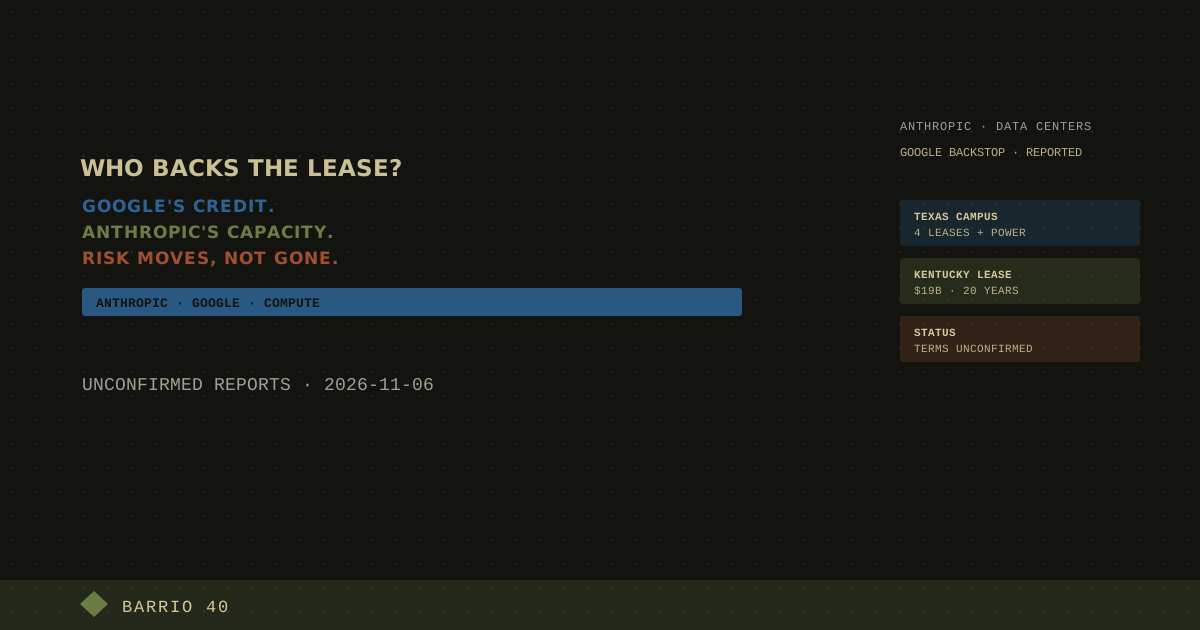
Two strands of coverage point the same way. Reuters, citing the Wall Street Journal, reported that Google has agreed to guarantee billions of dollars of Anthropic’s lease and power-payment commitments if the startup defaults. The guarantees reportedly cover four data-center leases at a Texas campus developed by Nexus Data Centers, plus power contracts tied to an on-site gas plant of about 1.6 gigawatts, with Google expected to receive roughly a 20% stake in the project. Separately, a KBW analyst note on TeraWulf’s 20-year, $19 billion lease of a Kentucky campus to Anthropic says the company’s SEC filing expects Anthropic’s payments to be backed by an investment-grade credit, with the provider not yet named. A digest dated November 5 describes Google credit support for an Anthropic-linked data center, but I could not trace it to a primary source.
WHAT IS UNCONFIRMED
Quite a lot. None of the parties confirmed the Texas deal; Anthropic and Nexus declined to comment. The Texas and Kentucky stories are different projects, and I found nothing tying Google’s backstop to the TeraWulf lease. Earlier reporting counted five backstopped sites, later reports four leases, so even the headcount is unsettled. Dollar figures vary by outlet, and I did not read any filing myself. The Kentucky backstop is described by the analyst as still expected, not signed.
WHY A BACKSTOP MATTERS
A lender financing a data center for a fast-growing but unprofitable tenant wants a creditworthy name behind the rent. If Google provides it, the debt can be priced like a Google obligation rather than a startup one, and the lab can commit to far more capacity than its own balance sheet would support. The cost is shifted, not removed: Google takes contingent risk, and in return reportedly gets equity and a deeper tie to a customer that also competes with its own models. For readers of yesterday’s briefing, this is one way the roughly $895 billion of commitments becomes financeable.
WHAT TEAMS BUILDING ON AI CAN TAKE FROM IT
The practical point is concentration. Your model vendor’s capacity may depend on a cloud provider’s credit, so a dispute or repricing between the two can reach you as limits or prices. Three habits help. Know which cloud actually serves the models you rely on. Keep your integration portable across at least two vendors. And treat financing headlines as a slow signal: they do not change your bill tomorrow, but they hint at who has room to keep adding capacity. Anthropic builds Claude, which some of our own tools use; that does not change how these reports should be read.