WHAT WAS REPORTED
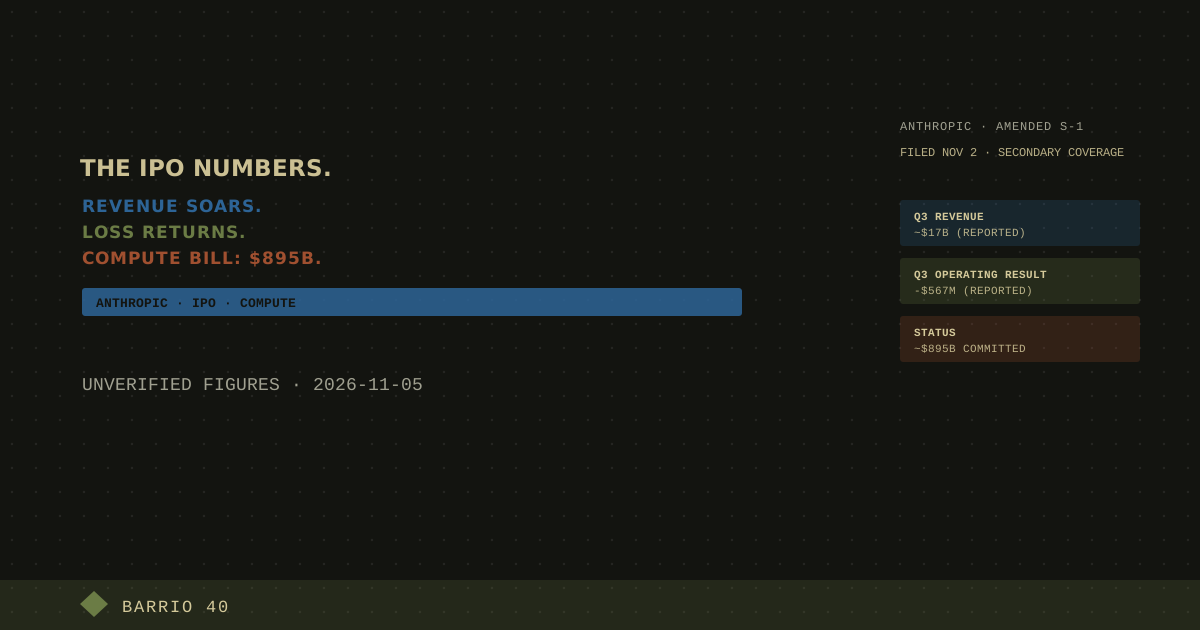
According to several outlets summarising the amended S-1, Anthropic’s third-quarter revenue was about $16.96 billion, up from about $11.56 billion in the second quarter. Nine-month revenue is reported at around $33 billion. The company is also reported to have booked a $567 million operating loss in Q3, after $974 million of operating income in Q2. For the first time, the filing reportedly totals the company’s commitments: about $895.4 billion, “substantially all of which is related to compute and infrastructure”. Reported breakdowns put about $69.8 billion due within twelve months and about $447.5 billion by the end of 2030, with a large share tied to Google and Broadcom.
WHY THE LOSS MATTERS MORE THAN THE REVENUE
One excerpt attributes the swing to loss in part to “$5.0 billion of compute under short-term commitments”, which the company says costs significantly more than comparable multiyear arrangements. If that reading is right, the loss is less a sign of weak demand than of a company buying capacity at spot-like prices because demand outran what it had contracted. Growth also slowed: coverage cites about 47% quarter-on-quarter, against about 144% the quarter before. That is still fast, but it is the number a public-market investor will watch.
WHAT IS STILL UNCONFIRMED
The outlets agree on the headline figures but not on everything. Rounding differs, one summary gives a different Q3 compute charge, and one outlet reports a very large Q3 net loss that I could not reconcile with the operating figures. About $214 billion of the commitments are reportedly subject to termination rights or counterparty conditions, which changes how “firm” the $895 billion really is. I could not open the filing, so treat every figure here as provisional until checked against the SEC document. Anthropic builds Claude, which several of our own tools use; that does not change how these numbers should be read.
WHY THIS MATTERS FOR TEAMS BUILDING ON AI
For builders, the lesson is about dependency, not valuation. Frontier model providers carry enormous fixed compute obligations, and those obligations shape prices, rate limits and which products survive. Three habits are cheap. Keep a thin abstraction between your product and any one model vendor, so a pricing or capacity change is a configuration edit. Track cost per task rather than cost per token, because that is what your margin actually depends on. And keep a tested fallback model, because capacity decisions made in a data-centre contract today surface as your latency tomorrow.