WHAT WAS REPORTED
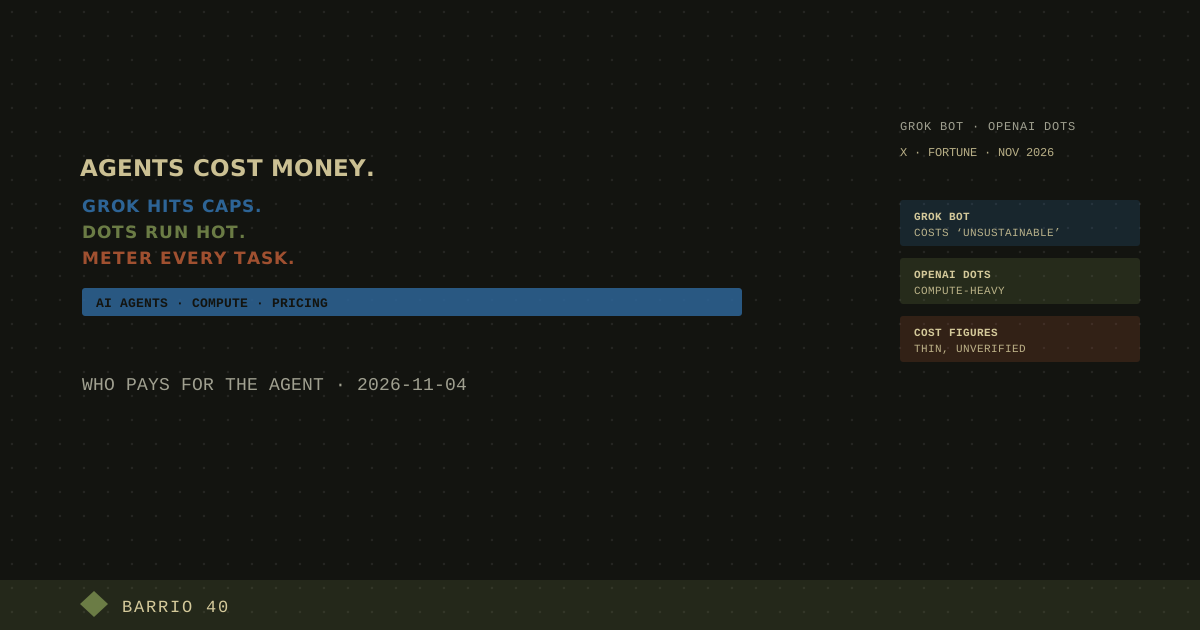
According to coverage from Forbes, TechRadar, The Next Web and others, Musk wrote on November 1 that “the cost of serving Grok Bot was unsustainably high relative to revenue.” Subscribers had complained that weekly usage limits were exhausted early, and the post was read as confirmation that compute allocated to the assistant is being pulled back. The remark came weeks after Musk had called Grok Bot the fastest-growing product he had seen; SpaceX president Gwynne Shotwell was reported to have cited about 800,000 paid weekly users in early October.
THE OPENAI SIDE
Fortune’s framing pairs Musk’s comment with OpenAI acknowledging that its Dots agents are “compute heavy.” One outlet, CryptoBriefing, puts the cost of OpenAI’s agent activity at more than half a million dollars a day across thousands of GPUs. That figure comes from a single source and I could not verify it, so treat it as indicative at best. Both episodes point at the same economics: a proactive agent that works in the background consumes compute whether or not the user is looking at it, which is very different from a chatbot that only spends when asked.
WHAT IS STILL UNCONFIRMED
Musk’s statement was short and gave no per-user or total cost. Neither company has published what an active agent costs to run, what the new limits are in detail, or how many users are affected. “Dead on arrival” is Fortune’s question, not a finding, and demand for these products appears real. The open point is price: whether subscriptions can cover agents that run continuously, or whether limits, tiers and usage-based billing become the norm.
WHY THIS MATTERS FOR TEAMS BUILDING ON AI
If you are designing an agent feature, cost per task is a product requirement, not an afterthought. Three habits help. Meter usage per user and per task from day one, so a spike shows up before the invoice does. Set hard budgets and sensible fallbacks, such as a smaller model or a queue, instead of letting a runaway loop spend freely. And tell users about limits up front: the sharpest complaints in this story are about caps that arrived without warning, not about caps existing.