WHAT WAS REPORTED
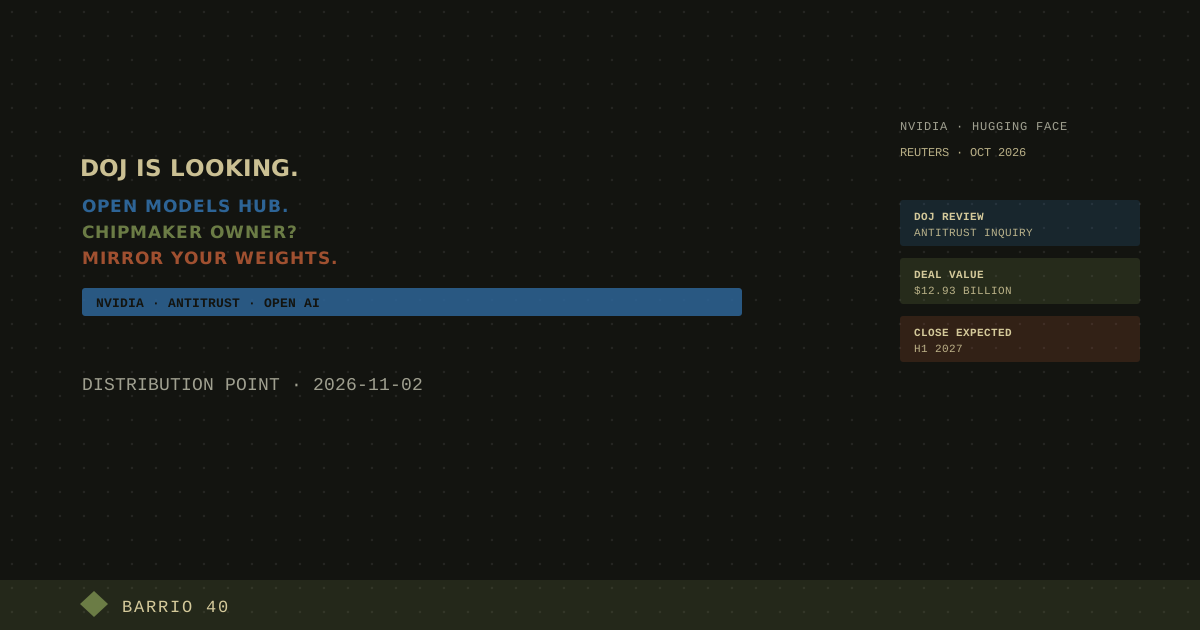
According to coverage of the Reuters report, the Justice Department is reviewing Nvidia’s planned $12.93 billion purchase of Hugging Face and has folded questions about it into a broader, multi-year antitrust investigation of the chipmaker. Reuters cites two anonymous people familiar with the matter. Officials are reportedly asking whether Nvidia could “capture a fundamental distribution point for AI” and whether it could use Hugging Face to disadvantage rivals. Nvidia has said it expects the deal to close in the first half of 2027.
WHY HUGGING FACE IS THE PRIZE
Hugging Face is where open-weight models, datasets and demos are published and downloaded, and much of the open ecosystem’s tooling assumes it. A chip company that owns it would control a default path between model builders and the hardware that runs their models. Regulators tend to ask the same questions in this situation: could search ranking, hosting terms, default integrations or early access quietly favour the owner’s products, and could competitors still reach their users on equal terms? The reported scrutiny of Nvidia’s earlier purchases of Run:ai and SchedMD, and its 2025 licensing and talent arrangement with Groq, fits that pattern of looking at the whole stack rather than one deal.
WHAT IS STILL UNCONFIRMED
This is an inquiry, not a challenge. The DOJ has published no formal action, no violation has been alleged, and the sources are anonymous. Outlets differ on rounding, quoting $12.9 billion or $13 billion for the same $12.93 billion figure. I could not open the original Reuters piece or any Nvidia or Hugging Face statement, so I cannot say how either company responded, or what remedies, such as commitments on neutrality, might be discussed.
WHY THIS MATTERS FOR TEAMS BUILDING ON AI
If your product pulls models, datasets or libraries from Hugging Face, the deal is a supply-chain question as much as a market one. Three habits cost little. Mirror the weights and tokenizers you depend on, so a change in terms or access does not stop a build. Pin model versions by hash rather than by name. And keep your serving stack portable across accelerators, so that a default tuned for one vendor stays a default and does not become a requirement. Closing is expected in 2027, which leaves time to plan rather than react.