THE NEW NAME STRUCTURE AND WHAT IT ACTUALLY SOLVES
The GPT numbering scheme that carried OpenAI from GPT-2 through GPT-5.5 was always a rough map of two different things: the model's generational position, and where it sat in the capability hierarchy relative to its siblings. GPT-4o was simultaneously a generation designation and an optimized-tier designation. GPT-4o mini meant something about size and cost, but "mini" next to a flagship name is not a durable way to signal a product line. The confusion compounded with o1, o3, and o3-mini sitting beside the GPT-4 and GPT-5 families, each with subtly different reasoning modes and pricing models that users and developers had to memorize rather than infer from names.
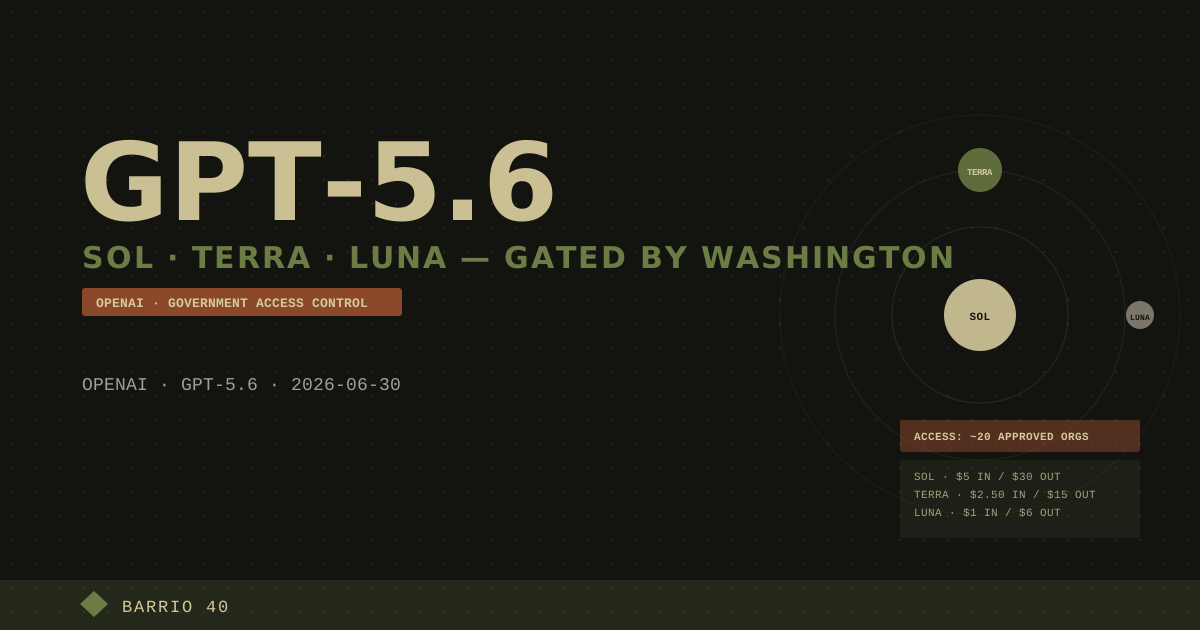
Sol, Terra, and Luna are an attempt to fix the second problem without changing the first. The number — 5.6 — still marks the generation; it still tells you where this family sits in OpenAI's development sequence relative to GPT-5.5 and what will presumably follow. The celestial names are the tier system: Sol is the high end, where compute is not a constraint and the goal is the best possible answer; Terra is the middle, tuned for everyday work at roughly comparable quality to GPT-5.5 but at half the cost; and Luna is the low end, designed for high-throughput applications where cost and latency matter more than squeezing out a few more points on a reasoning benchmark. The important design choice is that each tier can be updated on its own schedule. A Terra-tier model can get better without waiting for Sol to catch up, and vice versa. That is a meaningfully different release cadence than "we are updating GPT-4o, and here is a slightly adjusted GPT-4o mini at the same time." Whether OpenAI will actually maintain that discipline across generations remains to be seen, but the structure at least makes it possible.
THREE TIERS, THREE PRICE POINTS, AND THE MATH THAT MATTERS FOR PRODUCT TEAMS
The pricing OpenAI published for the preview is the clearest signal of where this family is positioned competitively. Sol costs $5 per million input tokens and $30 per million output tokens, which puts it in the same range as GPT-5.5's flagship pricing. Terra is $2.50 input and $15 output — half the Sol price, roughly matching GPT-5.5's cost while offering comparable benchmark performance, which is the headline number OpenAI wants product teams to see. Luna comes in at $1 input and $6 output, making it the cheapest frontier-quality model OpenAI has shipped to date, positioned explicitly for applications where volume and cost dominate the design conversation.
For teams already building on GPT-5.5, Terra is the argument OpenAI is making for an upgrade cycle: similar quality, half the price, and a cleaner product line to explain to stakeholders. For teams that have been constrained to smaller, cheaper models because the frontier pricing did not pencil out, Luna is a different pitch — frontier reasoning at a cost structure that starts to compete with the open-weight models from Zhipu and others that have been picking up usage share on OpenRouter. Whether these prices survive contact with general availability unchanged is a separate question. Preview pricing has historically been a placeholder, and the history of frontier models suggests the cost floor tends to drop over time as inference efficiency improves — but the initial structure tells you something about how OpenAI has positioned this family relative to both its own prior generation and the competitive field.
WHY THIS SPECIFIC MODEL TRIGGERED A GOVERNMENT REVIEW
The government-coordination piece of this announcement is the part that sits furthest outside the normal pattern of a model launch, and it is worth being precise about what OpenAI actually said. The company stated that at the US government's request, the preview is limited to a small group of trusted partners and organizations, and that the government has flagged national security implications of GPT-5.6's particular capabilities in cybersecurity and biology. OpenAI says this is voluntary. No regulation required it. No statute authorized the Commerce Department to gate the model. It happened because OpenAI agreed to it.
That context matters for understanding what precedent is and is not being set. What happened is not an export control in the technical legal sense — that would require a formal rule, notice and comment, and a definition of what "covered" means. What happened is closer to a handshake arrangement of the kind the Trump administration's June 2 executive order gestured at: asking AI companies to voluntarily provide the federal government with early access to frontier models for national security review before broader release. GPT-5.6 appears to be one of the first instances where that arrangement has been implemented at the API level, creating a real-world gate that determines which organizations can call the model and which cannot. The "trusted partner" designation is not publicly defined, the criteria for inclusion are not published, and the appeal process — if one exists — is not described. It is a working relationship operating through informal channels, not a formal framework with legal clarity about who is in, who is out, and why.
THE PRECEDENT THAT CONCERNS DEVELOPERS MORE THAN THE MODEL
The developer community's reaction to GPT-5.6 has split in a way that is instructive. The technical response — benchmark comparisons, pricing calculations, analysis of the Sol versus Terra trade-off for specific workloads — has been largely positive. A frontier model at half the previous generation's cost is, by almost any measure, good news for teams building AI products. The structural response has been considerably more wary, and it has centered on a question the pricing table does not answer: what happens the next time?
If the GPT-5.6 preview structure becomes a template for how OpenAI launches models at the frontier, the planning horizon for every team depending on OpenAI's API just acquired a new dimension that has nothing to do with technical readiness or commercial pricing. A team that has built a product on OpenAI's API has historically needed to plan for pricing changes, rate limits, deprecation schedules, and the possibility that a model that works well for their use case gets superseded by one that does not. They now also need to plan for the possibility that a future model they want to use is not available to them, for reasons that are determined by a relationship between OpenAI and the US government rather than by anything in the developer's control. That is a qualitatively different kind of dependency than the ones that were already in the risk model.
The parallel that is resonating in developer discussions is the one this site flagged in June when Anthropic's Fable 5 and Mythos 5 were pulled from general availability under a Commerce Department directive: the question is not whether any given restriction is justified on national security grounds, but whether the access model for frontier AI is shifting in a way that makes it systematically less reliable as infrastructure for commercial products. Two separate frontier labs have now had their latest models subjected to government-coordinated access restrictions in the same month. The mechanism differs — a voluntary partnership at OpenAI, an export-control directive at Anthropic — but the pattern is the same: the US government has established, through different channels, the ability to gate who can use the most capable AI models available.
WHAT TEAMS BUILDING ON THE OPENAI API SHOULD PLAN FOR NOW
The most immediate planning question is the simplest: when does general availability actually happen, and what does "coming weeks" mean in practice? OpenAI has said it; the history of preview periods suggests the gap between "trusted partners" and "everyone" is rarely longer than a few months, and often shorter. For most teams, the near-term practical answer is that GPT-5.6 Sol, Terra, and Luna will be available to them before any product built on GPT-5.5 needs to change to use them. The preview restriction is a temporary inconvenience for almost everyone, not a permanent exclusion.
The more durable planning question is about redundancy. The pattern that has emerged across the past month — GPT-5.6 previewed to 20 organizations, Anthropic's Fable 5 pulled from global availability, government review windows embedded in AI company release processes — is not a one-off. It is a direction. Teams that have built single-vendor dependencies on frontier API providers are implicitly betting on continued unrestricted access, and that bet has become materially less certain than it was six months ago. The practical response is not to panic and rebuild on open-weight models — that comes with its own constraints around quality, safety, and operational complexity that need to be weighed honestly. The practical response is to map the failure modes: which parts of your application break if your primary API provider becomes unavailable for two weeks, and which parts you could route to an alternative at what quality cost. That is an exercise most teams have not done, and this month has provided two compelling reasons to do it now.
The longer arc of this is likely to look more like the evolution of export controls on semiconductors than like a reversion to the frictionless API world of 2023. The US government has demonstrated, twice in the same month through two different mechanisms, that it can and will intervene in frontier AI access when it judges the national security stakes to be high enough. That is not going away. The question for anyone building on these models is not whether to accept it — that is not a choice available to you — but how to architect products and vendor relationships that remain resilient when the access landscape shifts again, as it will.