WHAT ADOBE IS ACTUALLY BUYING
Topaz Labs did not start as an AI company. It built its reputation over more than a decade selling desktop plugins for photographers — sharpening, noise reduction, upscaling — back when those were hand-tuned filters rather than learned models. The pivot to deep-learning-based enhancement, starting with Gigapixel AI's neural upscaling, turned Topaz into the default recommendation in photography and video forums for one specific job: taking footage or stills that are soft, noisy, or low-resolution and recovering detail a traditional filter chain cannot. That reputation is what Adobe is paying an undisclosed sum for. The company's own description of the rationale is narrow and technical: Topaz "brings deep expertise in optimizing large, complex AI models to run directly on device," work that Adobe says is "trusted by professionals of all creative crafts." Topaz Astra, the company's latest model, is already a third-party partner model inside Firefly today, alongside more than 30 others — so this is not Adobe discovering Topaz. It is Adobe deciding a long-standing partner is valuable enough to own outright rather than license.
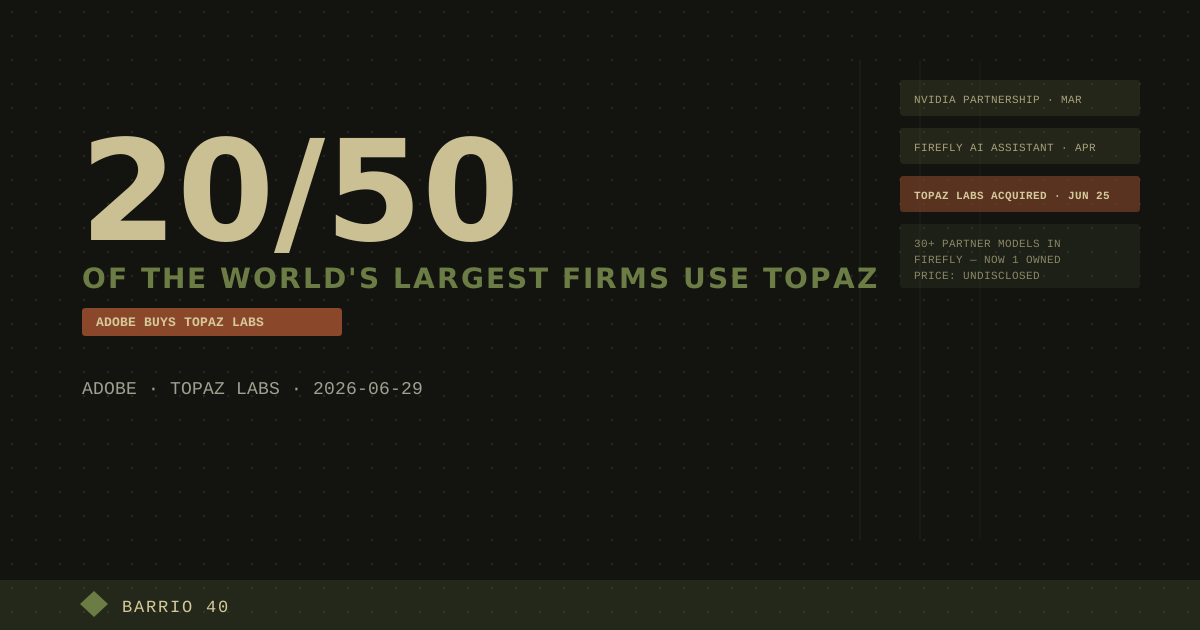
The number Adobe chose to put in its own announcement — professionals at 20 of the world's 50 largest companies use Topaz's tools — is the kind of detail companies disclose when they want a deal to look inevitable rather than opportunistic. It is also, on its own terms, a real signal: enhancement and upscaling are not a hobbyist niche, they are a step embedded in enterprise video pipelines wherever footage arrives in worse condition than the final deliverable requires, which is most of the time.
WHY OWNERSHIP NOW, AFTER A PARTNERSHIP ALREADY WORKED
The Topaz deal lands four months into a visible pattern of Adobe consolidating its AI strategy around Firefly as the single front door for creative AI, rather than treating it as one tool among many. In March, Adobe and NVIDIA announced a strategic partnership aimed at the next generation of Firefly models and "agentic workflows." In April, Adobe shipped Firefly AI Assistant, built on what the company calls its creative agent — a system that lets a user describe an outcome in plain language while the assistant orchestrates multi-step work across Creative Cloud applications rather than requiring a human to chain tools manually. Firefly itself has grown into an aggregator of more than 30 partner models: Google's Nano Banana 2 and Veo 3.1, Runway's Gen-4.5, Luma AI's Ray3.14, Black Forest Labs' FLUX.2[pro], ElevenLabs' Multilingual v2, and Topaz's own Astra among them. Adobe has also been deepening enterprise distribution partnerships with Accenture, Omnicom, WPP, Microsoft, and Anthropic to push agentic creative and marketing workflows into large customer organizations.
Read against that buildout, buying Topaz is the logical next move rather than a surprising one: an orchestration layer with 30-plus partner models is only as durable as Adobe's ability to keep licensing the best ones on acceptable terms, and on-device enhancement — sharpening, denoising, upscaling — is exactly the category where Adobe has the least leverage if it doesn't own the underlying technology, because the value proposition for the end user is explicitly "you don't need anyone's cloud for this." Owning Topaz converts a dependency Adobe was renting into one it controls.
THE TENSION THE PRESS RELEASE DOESN'T MENTION
What Adobe's announcement does not address — and what trade coverage and Topaz's own user community picked up on almost immediately — is pricing. Reporting on the deal has noted that Adobe's statement makes no mention of pricing, subscription structure, or how Topaz's tools will be positioned relative to Creative Cloud subscriptions going forward, even as Adobe confirms the underlying NeuroStream technology will be integrated into Firefly itself. That omission matters more here than it would for a typical acquisition, because NeuroStream's entire technical premise cuts against how Firefly is built to make money: Firefly's generative features are metered through usage credits inside a cloud-rendering model, while NeuroStream's selling point to Topaz's existing customers has always been the reverse — large models running locally on a customer's own graphics card, with no cloud dependency and no per-use cost once the software is purchased.
Topaz CEO Eric Yang's public framing of the deal is unambiguously upbeat — he has said the move will "dramatically expand what's possible for filmmakers and creators everywhere" — and Adobe's commitment that standalone Topaz products keep shipping is a real, near-term commitment, not nothing. But "for now" is doing real work in every account of this deal that has looked past the press release. The structural worry voiced across photography and video-editing communities is not that Adobe will shut Topaz down on day one; it's that the roadmap stops belonging to Topaz's customers the moment it belongs to Adobe, and that a no-cloud, no-recurring-fee product sitting inside a company whose entire roadmap is pointed toward rented, metered, cloud-delivered AI is an asset more likely to be absorbed into native Premiere Pro and After Effects features over time than preserved indefinitely as a separately licensed, locally-run alternative.
THE COMPETITIVE LOGIC: LOCKING UP BEST-OF-BREED BEFORE SOMEONE ELSE DOES
Adobe's broader motive sits in plainer sight than the pricing question. Canva and Picsart have both spent the past two years pushing AI-backed editing further into territory Adobe used to own by default — faster, cheaper, more consumer-friendly tools that compress the gap between "amateur edit" and "professional finish" that justified Creative Cloud's premium for two decades. Owning a best-of-breed enhancement engine that 20 of the world's 50 largest companies already trust is a way to keep a clear technical edge in one specific, high-value step of the pipeline — recovering detail in degraded footage — that a faster, cheaper consumer competitor cannot easily replicate without years of the same domain-specific optimization work Topaz has already done. It also keeps that capability out of a rival's hands; the same logic that makes Topaz valuable to Adobe would have made it just as valuable bolted onto Canva's or Picsart's stack instead.
WHAT THIS MEANS FOR TEAMS BUILDING WORKFLOWS ON SPECIALIST AI TOOLS
The lesson here generalizes well beyond photographers and video editors. Any team that has built a production workflow around a specialist AI vendor — because that vendor's model is simply better at one narrow job than the generalist platform's equivalent feature — is implicitly betting that the vendor's independence, and its pricing model, survive long enough to matter. That bet got harder to make with confidence this week, not because Adobe has done anything wrong yet, but because the announcement itself demonstrates how these deals actually get communicated: real commitments about team continuity and near-term product support, paired with total silence on the economic terms that determine whether the tool that made a vendor worth buying stays priced and licensed the way it was before the acquisition. A procurement team that has standardized on a point solution for the same reason Topaz's customers did — better output, lower ongoing cost, no cloud dependency — should treat that vendor's acquisition by a platform giant as the moment to revisit the workflow's assumptions, not the moment to assume nothing material has changed because the founder said something reassuring on launch day.