FOUR EXITS, SIX DAYS, AND A COHORT THAT LOOKS LESS LIKE CHURN THAN A TRANSFER
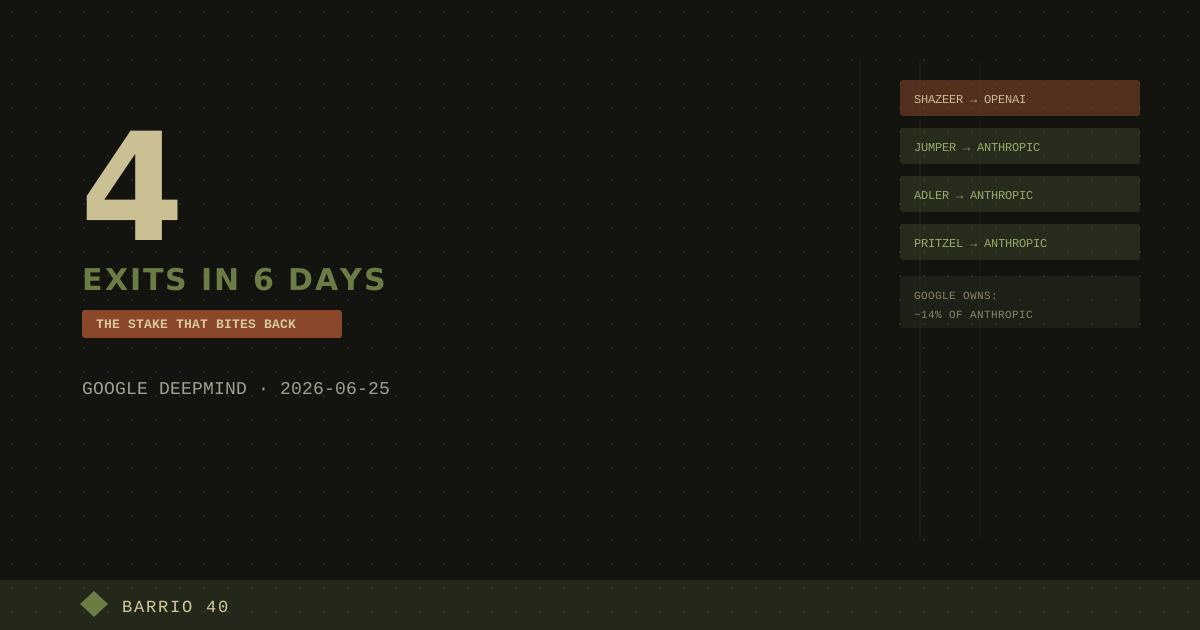
Laid out in sequence, the roster reads less like routine attrition and more like a small lab relocating itself one hire at a time. Shazeer, vice president of engineering and co-lead on Gemini's pre-training, announced on June 18 that he was joining OpenAI — notable on its own because computing capacity tied to one of his projects had reportedly been reassigned to a London-based DeepMind team shortly before his exit, in a move Google described internally as an effort to boost cross-team collaboration. Jumper, who shared the 2024 Nobel Prize in Chemistry for AlphaFold and had spent nearly nine years at the company, announced the following day, June 19, that he was leaving for Anthropic. Wednesday's report adds Adler, a London-based research scientist who worked on Google's AI coding effort and contributed to AlphaFold3 alongside Jumper, and Pritzel, who led pre-training work on the Gemini team and was a core developer on AlphaFold2 before that. Read as a list of individual departures, this is four people taking better offers. Read as a cohort, it is the AlphaFold-and-pretraining bench — the group that built Google's most decorated scientific achievement and then helped scale its flagship language model — relocating to a single competitor inside a single week.
That distinction matters more than the raw headcount. A generic talent raid that picks off one researcher per lab spreads thin and rarely changes what either side can build. A cohort departure that reassembles a working team's prior collaborators inside a new organization is a different kind of risk entirely, because it transfers not just individual expertise but the tacit knowledge of how that expertise was coordinated. Anthropic has not stated what Adler, Pritzel, and Jumper will work on together, but the structural fact that they already know how to work together is the part Google cannot easily replace by hiring three equally credentialed strangers.
THE MARKET'S SECOND REACTION IS THE MORE INTERESTING DATA POINT
Alphabet's first reaction to this story was unambiguous: shares fell as much as 7.2% intraday on Monday, June 22 — the first trading day after both the Shazeer and Jumper news had time to land over the prior Thursday and Friday — closing roughly 6% lower on what was the stock's worst single session in more than a year and erasing nearly $250 billion in market capitalization in one day. Wednesday's reaction to the Adler-Pritzel report was an order of magnitude smaller: an early gain reversed into a 1.16% decline, closing at $342.07. The smaller move is not evidence that the news mattered less. Losing two more senior researchers to the same rival, three days after the market had already priced in a research-talent crisis, is arguably worse news than the first round, not better. What the smaller move actually reflects is that the market had already updated its model of Google's AI talent risk on Monday and is now treating each subsequent confirmation as incremental rather than revelatory — the kind of repricing that happens once a thesis has shifted from "surprising" to "the new baseline." That shift, more than the dollar figure on any single day, is the thing institutional investors will be modeling into Alphabet's valuation going forward.
WHY NOW: THE PRE-IPO WINDOW BOTH LABS ARE RACING TO HOLD OPEN
The timing of all four departures lines up with a structural fact this site has tracked since Anthropic's confidential S-1 submission on June 1: both Anthropic, sitting on a $965 billion valuation from its late-May $65 billion Series H, and OpenAI, separately racing toward what reporting has described as a trillion-dollar offering, are inside the window where joining now means receiving equity that is still privately priced and has the furthest room to re-rate before a public listing locks in its value. A senior researcher joining Anthropic in June, ahead of a public offering some reporting places as early as October, is in a meaningfully different financial position than the same researcher joining after the IPO prices and the equity's upside is already reflected in a trading multiple. One industry talent-flow analysis circulating this week put the probability of a DeepMind researcher moving to Anthropic at roughly eleven times the probability of the reverse move — a ratio that has nothing to do with researchers preferring Claude to Gemini and everything to do with which side of the table currently has the more attractive unvested equity.
None of this is unique to AI, and the underlying mechanism — talent flowing toward the company with the better pre-liquidity equity story — is the same one that has driven hiring at every late-stage startup approaching a listing for decades. What is unusual is the concentration: two of the industry's most valuable pending offerings are competing for the same several hundred people who can credibly claim to have built the systems either company needs to defend its position once it is public and facing quarterly scrutiny.
THE STAKE THAT CUTS BOTH WAYS
Alphabet's position here is structurally stranger than a simple competitor-poaching-talent story, because Alphabet is not merely Anthropic's rival — it is also one of Anthropic's largest investors, having built a roughly 14% equity stake across the rounds it has participated in since 2023. That stake means the same Series H that priced Anthropic at $965 billion and helped fund the offers Adler, Pritzel, and Jumper just accepted also marked up the value of Google's own balance sheet position in the company. Every researcher who leaves DeepMind for Anthropic this month makes Google's investment portfolio look better and Google's product roadmap look worse, in the same transaction. It is the same dynamic this site flagged on June 23 when SpaceX's Colossus data centers turned out to be renting compute to Anthropic, Google, and Cursor simultaneously, profiting from infrastructure demand regardless of who wins the model race beneath it — except here the asset isn't compute capacity, it's the people who write the training code, and the holder of the stake is the company watching its own bench walk out the door.
GOOGLE'S ANSWER, AND WHY IT IS GETTING HARDER TO DEFEND
Google's public response, repeated again after Wednesday's report, leaned on the same line DeepMind chief executive Demis Hassabis has used since the Shazeer and Jumper exits: "There's a lot of talent movement between all the leading labs and we win our fair share of the top talent. We have by far the biggest and broadest research bench of any of the labs out there." A Google spokesperson echoed the framing, describing the company as confident in its overall position in the market for AI talent. The claim was defensible after one high-profile departure, and arguably still defensible after two. It is harder to sustain as a description of four senior exits in six days, three of them to the same company, drawn disproportionately from the specific team that produced Google's most celebrated research result. "We win our fair share" is a statement about aggregate flows across an entire industry; it does not obviously describe what happens when a single rival recruits a working cohort out of one lab inside a single week.
WHAT THIS MEANS FOR ENTERPRISES BETTING ON GEMINI
None of this changes what Gemini can do today, and enterprises with production workloads running on Google's models have no reason to migrate on the strength of a personnel story alone — model capability and personnel churn are not the same metric, and Google's broader research organization remains, by any external measure, one of the largest in the industry. What this week's run of departures should change is how procurement teams weight vendor-research-continuity risk when comparing frontier labs for multi-year commitments, a question this site raised in a different form during the Fable 5 export-control shutdown: capability today is not the same guarantee as capability maintained through the next eighteen months of competitive pressure. A buyer evaluating Gemini against Claude or GPT for a long-horizon contract is now implicitly betting on which lab retains the people who can keep improving the model after the contract is signed, not just on which model benchmarks best this quarter. Four departures in six days does not answer that question. It does mean the question is now harder to dismiss than it was a week ago.