THE ORDER: WHAT COMMERCE LIFTED, AND THE THIRTY-DAY STRING ATTACHED
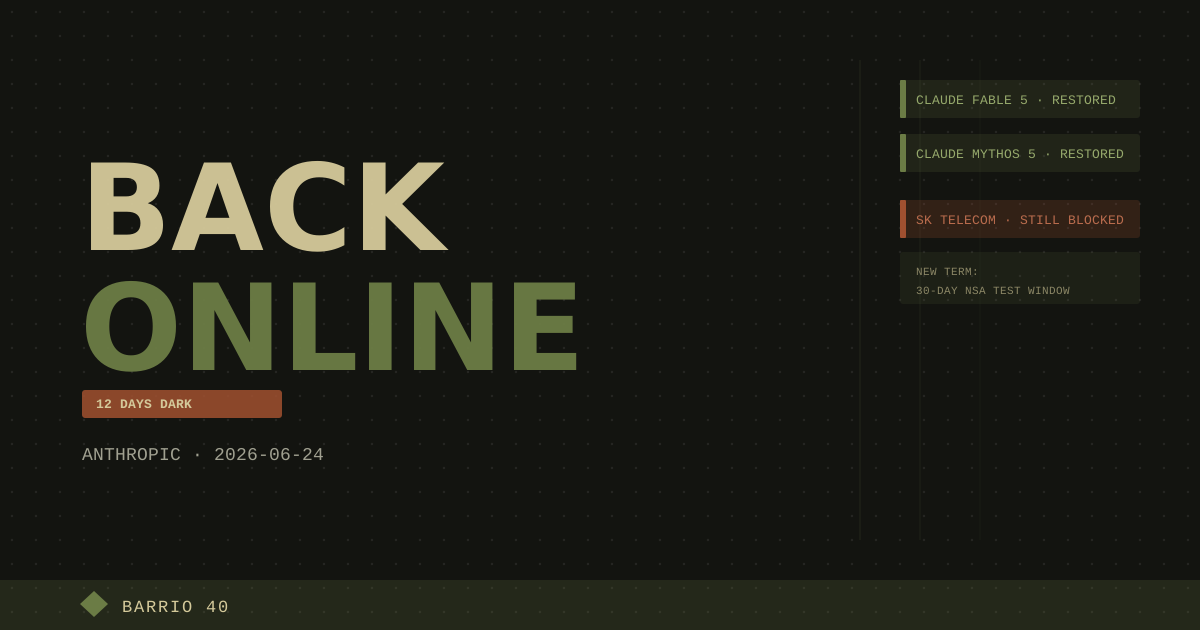
The amended determination, issued jointly by Commerce and the NSA Tuesday evening Washington time, does two things at once. It rescinds the worldwide export-control suspension that grounded Fable 5 and Mythos 5 on June 12, restoring API and model-weight access for verified customers without requiring Anthropic to ship a materially different model than the one that went dark — confirmation, in itself, that the underlying technical fix was the comparatively narrow one Trump adviser David Sacks described from the start: a patch to the "fix this code" guardrail bypass Amazon's security team flagged. But the order also creates something that did not exist twelve days ago: a standing requirement that Anthropic give the NSA's AI Security Center and Commerce's Bureau of Industry and Security no less than 30 days of red-team access before deploying any future model that crosses the same frontier-capability threshold used to classify Mythos as requiring case-by-case export licensing. Anthropic has run its own pre-release evaluations voluntarily since well before this episode; what changes is that the government now has a contractual right to test first, on its own timeline, rather than a courtesy briefing on Anthropic's.
Dario Amodei's statement framed the trade as one the company could live with: "We fixed a real vulnerability quickly, and we're formalizing a testing partnership with the government that, candidly, looks a lot like what we already do." Sacks's statement leaned harder into vindication, calling the outcome proof that "the administration acted reluctantly, narrowly, and got exactly the structural commitment it was looking for" — a notably more expansive characterization than his June 19 framing that "the ball is in Anthropic's court," and one that effectively concedes the dispute was never only about one jailbreak.
WARNER GETS THE POLICY HE ASKED FOR, TWO DAYS AFTER THE LINE THAT WENT VIRAL
The timing is difficult to read as coincidence. Warner's June 22 remarks to reporters — relaying Gen. Rudd's line that Mythos "broke into almost all of our classified systems, not in weeks, but in hours" — were offered explicitly in service of an argument that "we are not going to solve this problem if we rely on a less ethical CEO operating on the basis of plain voluntary testing alone." Within 48 hours, the administration produced an order that does precisely what Warner described wanting: a mandatory, government-verified pre-release testing regime, codified through an executive determination rather than the legislation Warner has separately introduced and which remains stalled in committee. Whether the order was already in negotiation before Warner's remarks went viral, or whether the viral weekend accelerated a settlement that was otherwise weeks away, is not something either side has detailed, and Barrio 40's prior coverage has already flagged how much of this saga has been driven by secondhand characterizations outracing the underlying facts. What is verifiable is the sequence: classified-briefing leak Sunday, viral mischaracterization through the weekend, restoration order Tuesday, with mandatory testing as its central new term.
That sequence matters for how the broader industry should read this resolution. A standing 30-day government review window, once established for one lab over one dispute, is the kind of precedent regulators tend to generalize rather than retire — and every other frontier lab now has a concrete worked example of what triggers it, how long it lasts, and what it costs to refuse.
SK TELECOM IS WHERE THE BAN DOESN'T END
The restoration's most consequential omission got far less attention Tuesday than the headline lift, but it is the detail that keeps this story from being a clean resolution. SK Telecom's Project Glasswing access — revoked, reporting indicates, over suspected undisclosed ties between SK Group affiliates and Chinese state-owned interests, separate from and reportedly earlier than the Amazon-flagged vulnerability — is not addressed in Tuesday's order at all. A Commerce spokesperson, asked directly Tuesday night whether the SK Telecom-linked review was related to or resolved alongside the broader restoration, would say only that "matters involving specific entities under national-security review remain under review," leaving open whether SK Telecom's case is a five-minute formality or an open-ended freeze. SK Telecom has not commented since its earlier denial that "anonymous claims circulating in foreign media lack verified facts."
The practical effect is that Tuesday's announcement, read carefully, confirms what Barrio 40's June 22 coverage first reported: this was a two-cause shutdown, and Tuesday's order resolves one cause while leaving the other exactly where it was. Customers and partners with no SK Telecom exposure have every reason to treat this as the blackout ending. Anyone whose access, supply chain, or consortium membership runs through an entity under a similar undisclosed-ties review should not assume the same clock applies to them.
THE MARKET FINISHES PRICING WHAT COMMERCE JUST CONFIRMED
Kalshi's "Fable 5 restored before July 1" contract, sitting at 57 cents as of June 19, traded above 95 cents within an hour of Commerce's announcement and effectively resolved YES by Tuesday's close; Polymarket's equivalent market showed the same pattern. The bigger number, less easily priced by a single contract, is the twelve days of lost or diverted usage the shutdown generated across an industry that, by Anthropic's own account, had built Fable 5 into Pro, Max, Team, and Enterprise plans at no extra cost specifically to drive adoption. That free window, designed to run 13 days from the June 9 launch, ran only four days before the shutdown intervened, then technically expired on June 22 — meaning the population Anthropic most wanted to convert into paying Fable 5 users got, across the entire promotional period, roughly four working days of access to the actual product. Anthropic said Tuesday it will restore full plan inclusion "within 48 hours" as capacity normalizes; in the interim, reactivated usage is still billed at the $10-per-million-input, $50-per-million-output API rate that took effect June 23 — meaning the literal first hours of restored access, for many subscribers, are also the most expensive hours Fable 5 has ever been priced.
KOREA, AND EVERYONE WHO SWITCHED AWAY, FACE A "SWITCH BACK?" DECISION
NAVER, Samsung SDS, LG CNS, and Nexon — the four organizations that committed to record-scale Claude Code deployments on June 17 despite an active, undated shutdown — are the most immediate and least conflicted beneficiaries of Tuesday's order: their contracts assumed restoration eventually, and none of them had to make a contingency decision in the meantime because Claude Code itself, unlike Fable 5 and Mythos 5, was never suspended. The harder decision sits with the engineering teams who did make a contingency call during the twelve dark days — the ones who shifted reasoning-heavy workloads onto the open-weight coalition this site has tracked since the shutdown began: Mistral, Perplexity, LangChain, Black Forest Labs, Cursor's own infrastructure before SpaceX bought it outright, and Reflection, the open-weight lab now renting $6.3 billion of compute from SpaceX's Colossus 2 specifically to compete with labs like DeepSeek. Those teams now have working evaluations of at least one credible alternative under real production load, twelve days of cost and latency data to compare against Fable 5's restored-but-pricier API, and a fresh, contractually documented reminder that "available capacity" and "available regardless of the next export-control determination" are not the same guarantee.
That is the calculus restoration doesn't resolve: switching back is not free, evaluating alternatives during a forced outage was not free either, and the twelve days produced real comparative data that didn't exist on June 11. Some of those teams will return to Fable 5 because its underlying capability still outperforms what they tested under pressure. Others will conclude the test was worth running for its own sake, independent of how this particular shutdown ended.
WHAT THIS MEANS FOR TEAMS BUILDING ON FRONTIER APIS
The headline lesson from twelve days is the obvious one: a single export-control determination, triggered by a vulnerability report routed through one customer's relationship with one cabinet official, can take a flagship model offline globally with no advance warning and no committed restoration date, and the eventual fix can arrive with new standing obligations attached that nobody analyzing day one of the shutdown could have priced in. The less obvious lesson is in the asymmetry of who absorbed the cost. Anthropic absorbed reputational damage, a scrambled pricing calendar, and a new compliance obligation it will carry on every future frontier release. The customers who had already diversified — running production workloads on Claude Code, which was never suspended, or maintaining a working integration with an open-weight alternative — absorbed almost none of it. The customers who had concentrated entirely on Fable 5 or Mythos 5 absorbed twelve days of exactly the dependency risk this site has been flagging since the shutdown began, and now inherit a model that comes back more expensive, more encumbered by mandatory government review, and with no guarantee the next geopolitical trigger looks anything like this one. Vendor concentration risk stopped being a hypothetical the moment Commerce signed the original order on June 12; Tuesday's resolution is the clearest evidence yet that it has not stopped being a live one.