THE DEAL: REFLECTION AI BUYS ITS WAY INTO COLOSSUS 2
The mechanics are straightforward. Reflection — the four-year-old open-weight lab founded by ex-DeepMind researchers Misha Laskin and Ioannis Antonoglou — gets immediate access to Nvidia's GB300 chips inside Colossus 2, the newer expansion of SpaceX's roughly 2-gigawatt Memphis-area compute complex, where the company has already deployed some 555,000 Nvidia GPUs at a cost of about $18 billion. Reflection starts paying $150 million a month on July 1, with the contract running through 2029 if neither side exercises the 90-day termination clause available after the first three months; run to term, the payments total the $6.3 billion figure attached to every headline about the deal. Reflection has not yet shipped a public frontier open-weight model — CEO Laskin said in May that one is coming "later this year" — which makes this less a deal to support an existing product than a bet, by both parties, that the compute will be there the moment the model is ready to need it.
It is also, notably, the second time in three months a Reflection deal has leaned on someone else's infrastructure rather than its own. The startup is simultaneously the AI model provider for the Department of Energy's Genesis Mission, serving as what DOE has called the "foundational intelligence layer" across all 17 national laboratories, and has signed on alongside other firms for Pentagon work in classified environments — government contracts that establish Reflection's national-security credibility well before it has shipped the open-weight model those contracts implicitly assume exists. The Colossus deal is the compute commitment that has to show up before that assumption can be tested.
THE PATTERN NOBODY HAS HAD TO EXPLAIN: COMPETITORS KEEP RENTING FROM MUSK ANYWAY
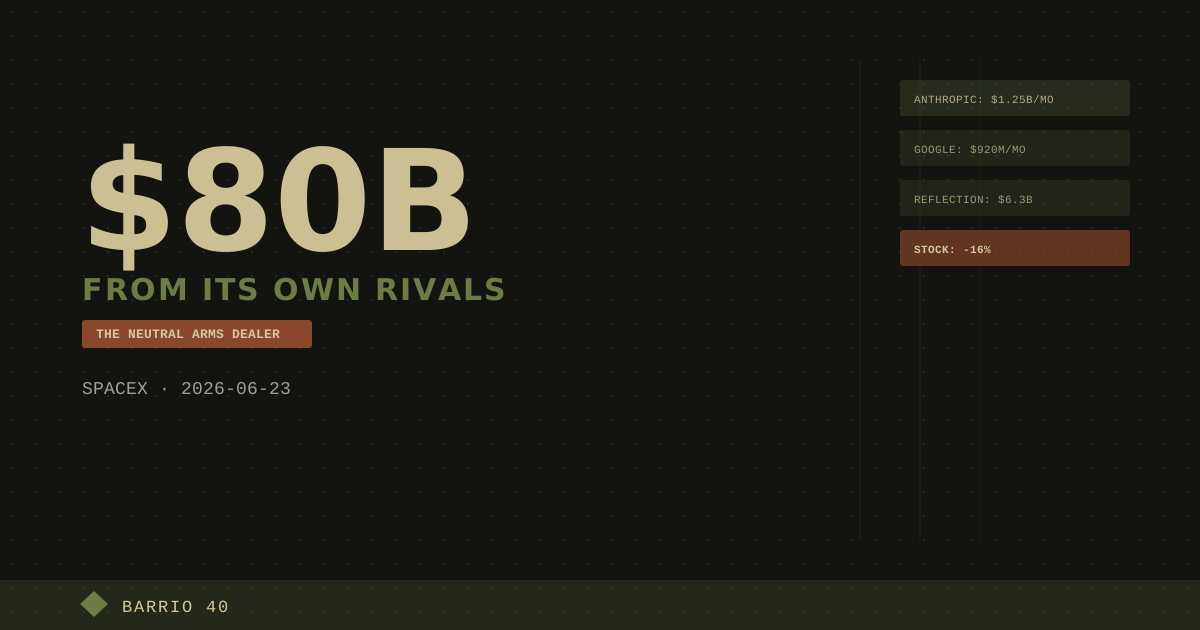
What should be the more surprising detail in this story — that three of Grok's most direct competitors now depend on Grok's own builder for compute — has by Monday stopped generating much commentary at all, which is itself worth noting. Anthropic's arrangement, disclosed when SpaceX filed for its IPO, has it renting the entirety of Colossus 1's output through May 2029 for $1.25 billion a month, more than 300 megawatts of capacity across upwards of 220,000 GPUs. Google's deal, struck at $920 million a month through June 2029, covers roughly half of what Anthropic gets. Cursor's relationship runs deepest of all: a $10 billion collaboration option disclosed in April became a $60 billion outright acquisition that closed on June 16, the same week this site covered in last week's roundup, folding Cursor fully into SpaceXAI alongside xAI's own infrastructure.
Reflection's arrival makes a pattern that was already hard to dismiss as coincidence. SpaceX is not selling Colossus capacity opportunistically to whoever happens to need GPUs — it has become, by deal count and by dollar volume, the default overflow compute provider for the frontier AI industry broadly, regardless of how directly a given customer's model competes with Grok. That arrangement works because none of these companies have a faster way to get equivalent capacity at comparable speed, and because Musk's calculus, at least so far, has treated rental revenue from rivals as more valuable than the marginal competitive edge of denying them access. Whether that calculus survives the moment Grok itself needs every watt Colossus can produce is the open question sitting underneath all four deals, and nothing disclosed Monday answers it.
THE SAME-DAY IRONY: A $20 BILLION BOND SALE AND A STOCK THAT DROPPED 16%
The Reflection news landed on a day SpaceX would otherwise have preferred to spend differently. The company filed Monday morning for its first debt offering since its June 12 Nasdaq debut — senior unsecured notes targeting at least $20 billion, with maturities staggered from five to thirty years, underwritten by the same consortium of Bank of America, Citigroup, JPMorgan Chase, Goldman Sachs, and Morgan Stanley that had extended the original bridge loan. The stated purpose is unambiguous in the SEC filing: repay in full the roughly $20 billion bridge facility SpaceX drew in February to fund its $1.25 trillion all-stock merger with xAI, a loan that matures in September 2027 and accounts for the bulk of the $29.1 billion in long-term debt SpaceX carried as of March 31.
Investors read the filing as confirmation that the merger's financing, ten days into public trading, was still an open liability rather than a settled one, and the stock fell as much as 16% intraday before paring some of the loss — its worst single session since the IPO priced at $135 a share and closed its first day up 19% at a $2.1 trillion market cap. The Reflection deal, announced the same day, did essentially nothing to offset the reaction; a $6.3 billion compute contract is real revenue, but it is dwarfed, in market-moving terms, by the prospect of $20 billion in fresh interest-bearing debt landing on a balance sheet ten days removed from the largest IPO in history. The juxtaposition is the whole story in miniature: SpaceX's compute business is genuinely, durably valuable to four of the largest AI labs on earth, and SpaceX's capital structure is leveraged enough that the market still treats every new debt instrument as a reason to sell first and read the footnotes later.
WHY REFLECTION SPECIFICALLY: GENESIS MISSION, THE PENTAGON, AND AN ANSWER TO DEEPSEEK
Reflection's profile explains why this particular deal carries weight beyond its dollar figure. The company was valued at $545 million roughly a year ago; it is now in talks to close a $2.5 billion round at a $25 billion pre-money valuation — a nearly 46-fold increase in under twelve months — with backers reported to include Nvidia and JPMorgan's Security and Resiliency Initiative, a fund explicitly built around companies the bank considers critical to national economic stability. Reflection is also a founding member of Nvidia's Nemotron Coalition, the industry group pushing open frontier models alongside Mistral, Perplexity, LangChain, Black Forest Labs — and Cursor, which makes Monday's deal a moment where SpaceX is now bankrolling two members of the same open-model coalition under one roof, one of them by ownership and the other by lease.
The framing Reflection and its government partners have used consistently is explicit: an American-built, openly weighted alternative to the open models coming out of China, with DeepSeek named directly in the company's own fundraising materials. That framing is precisely why Genesis Mission and Pentagon contracts arrived before a public model did — national-security buyers are backing the entity and the mission, not yet a benchmarked product — and it is why a compute deal this large, signed before Reflection has shipped anything the public can test, reads as a statement of confidence from SpaceX rather than a routine vendor transaction. If Reflection's promised model ships later this year as Laskin has said, Colossus 2 will be where the world finds out whether the compute commitment was warranted.
WHAT THIS MEANS FOR TEAMS BUILDING ON FRONTIER INFRASTRUCTURE
The practical lesson is not really about Reflection, which most teams reading this have no direct exposure to yet. It is about how concentrated the physical layer underneath the entire AI industry has become, even as the model layer keeps fragmenting into more labs, more open weights, and more competitive noise. Four organizations with genuinely different missions and genuinely competing products — a closed frontier lab, a cloud hyperscaler, a coding tool, and an open-source government contractor — are all now paying rent to the same landlord, on a campus that landlord financed partly with debt the market is still pricing nervously ten days into public trading. That is not a structure any of the four customers chose for ideological reasons; it is what happens when one company builds gigawatt-scale capacity faster than anyone else and prices it competitively enough that even direct rivals decide dependency is cheaper than building their own.
For engineering and product teams whose roadmaps assume cloud or model-provider capacity will simply be there when needed, Monday is a useful, low-drama reminder that "available capacity" and "available from a financially stable counterparty" are not the same guarantee, and that the gap between them can be priced by the market in a single afternoon. Vendor concentration risk has mostly been discussed on this site in terms of model access — the Fable 5 and Mythos 5 shutdown that has run for eleven days now is the clearest recent example — but Monday's pairing of a record compute deal with a record-bad trading session is the same risk one layer down the stack, where fewer teams are used to looking for it.