WHERE THE SHUTDOWN ACTUALLY STANDS, SEVEN DAYS IN
Strip away the new reporting for a moment and the baseline fact has not moved since June 12: Claude Fable 5 and Claude Mythos 5 remain suspended for every customer worldwide, not just the foreign nationals the Commerce Department's export-control directive targeted, because Anthropic's infrastructure still cannot filter access by citizenship in real time. Anthropic's other models — Opus 4.8, Sonnet 4.6, Haiku 4.5 — have been unaffected throughout and remain available globally, which is the detail that has kept this from becoming an existential crisis for the company's day-to-day API business even as its two flagship, Mythos-class models sit dark for a second straight week. The meeting Barrio 40 reported on June 16, which left the legal and technical dispute unresolved, has since been followed by at least one more round of talks: senior Anthropic technical staff met with Commerce Department officials in Washington this week, a shift in personnel from the initial encounter that is itself informative. Putting engineers and safety researchers across the table from policy officials, rather than only lawyers, suggests the conversation has moved from arguing about legal authority toward negotiating an actual technical remediation — patches, classifier updates, verification infrastructure — that could give the administration something concrete to point to before lifting the directive.
No deal has been announced. Anthropic has told reporters it is "confident" access could return within days, language that is notably more optimistic than anything the company said in the first 72 hours of the suspension, when its public posture was limited to disputing the justification for the order rather than forecasting a resolution. That shift in tone, on its own, is a data point — companies do not typically start projecting a "days, not weeks" timeline to journalists unless they have some signal, internal or external, that the dispute is closer to resolution than it was a week ago. But "confident" is not "scheduled," and the gap between those two words is exactly the space prediction markets have moved in to price, discussed below. The honest summary of where things stand on day seven is this: the temperature has come down from the crisis-meeting register of June 12 through 15, the conversation has gotten more technical and less purely legal, and nobody on either side has committed to a date.
THE PHONE CALL THAT STARTED IT: AMAZON'S THREE ROLES IN ONE EPISODE
Barrio 40's original coverage of the shutdown described the trigger, per Fortune's initial sourcing, as "a warning from Amazon" relayed to the Commerce Department by Amazon's security research team. That account is now more specific, and the specificity matters. A Fortune deep-dive published June 18 reports that Amazon CEO Andy Jassy personally called Treasury Secretary Scott Bessent and other senior officials on the afternoon of June 12 to relay his own company's findings directly — not a security team escalating through a compliance channel, but the chief executive of Anthropic's largest financial backer picking up the phone to the Treasury Secretary. Those conversations, according to Fortune's reporting, directly preceded Commerce Secretary Howard Lutnick's 5:21 PM directive to Anthropic CEO Dario Amodei later that same Friday. Amazon's researchers reportedly found that, guided by specific prompts, Fable 5 could be made to surface exploitable software vulnerabilities in at least four programs — a more concrete and broader claim than the "narrow, non-universal jailbreak" framing Anthropic used in its own public statement.
What makes the episode unusual is not that a cloud provider flagged a security concern about a model it hosts — that is, in the abstract, exactly the kind of vigilance regulators want from infrastructure partners. It is that Amazon is occupying three positions simultaneously in the same story: it is Anthropic's largest investor, having committed billions of dollars in equity and infrastructure credits since 2023; it is Anthropic's primary cloud host through AWS Bedrock, the same Bedrock access that had to be revoked globally to comply with the directive; and it is now also the party whose CEO personally triggered the federal action that took its own portfolio company's flagship product offline. Each of those roles, taken alone, is unremarkable. Held together, they describe a company that stood to lose money in the short term from the very directive its own disclosure helped produce — a fact that does not, on its own, tell you whether Amazon's security finding was accurate or whether the government's response was proportionate, but does mean that any account of "who triggered this and why" that omits Amazon's commercial stake in Anthropic is missing a structurally important piece of the picture. Amazon has not disputed the substance of Fortune's reporting and has not offered a public characterization of why a routine vulnerability finding escalated to a CEO-to-Treasury-Secretary phone call rather than a standard disclosure to Anthropic directly.
"THE BALL IS IN ANTHROPIC'S COURT": THE ADMINISTRATION REFRAMES THE STANDOFF
The most consequential new public statement this week did not come from Anthropic or Amazon — it came from David Sacks, the Trump administration's AI and crypto adviser, who told reporters that the administration issued the export-control directive "reluctantly," that officials want the restriction lifted as soon as the underlying jailbreak is patched, and that "the ball is in Anthropic's court." Sacks went further, characterizing Anthropic as having been warned about the jailbreak and having "refused" to fix the flaw or voluntarily pull the model before the government acted. That account is in direct tension with the version Anthropic put on the record on the evening of June 12, which described receiving the directive with no advance notice of the specific national-security concern, no prior communication from the agency, and a ninety-minute compliance window — not the picture of a company that had already been approached, declined to act, and forced the government's hand as a last resort.
Both characterizations cannot be fully accurate at the same time, and neither side has produced the documentation that would resolve the discrepancy publicly — no timestamped notice, no written warning, no record of a request Anthropic is alleged to have declined. What the Sacks framing accomplishes politically, regardless of its factual precision, is a shift in where responsibility for the continued suspension sits in the public narrative. "The ball is in Anthropic's court" recasts seven days of suspended access not as an open-ended exercise of emergency federal authority but as the predictable consequence of a company's own inaction — a framing that puts pressure on Anthropic to either produce a fix quickly or absorb the reputational cost of appearing to stall. It is also a framing that, notably, does not require the administration to specify what "patched" means in technical terms, or to commit to a verification process, or to say how it will confirm a fix is sufficient — leaving Anthropic to guess at a moving target while bearing full responsibility, in the administration's telling, for how long the guessing takes.
WALL STREET STARTS PRICING A REGULATORY DISPUTE
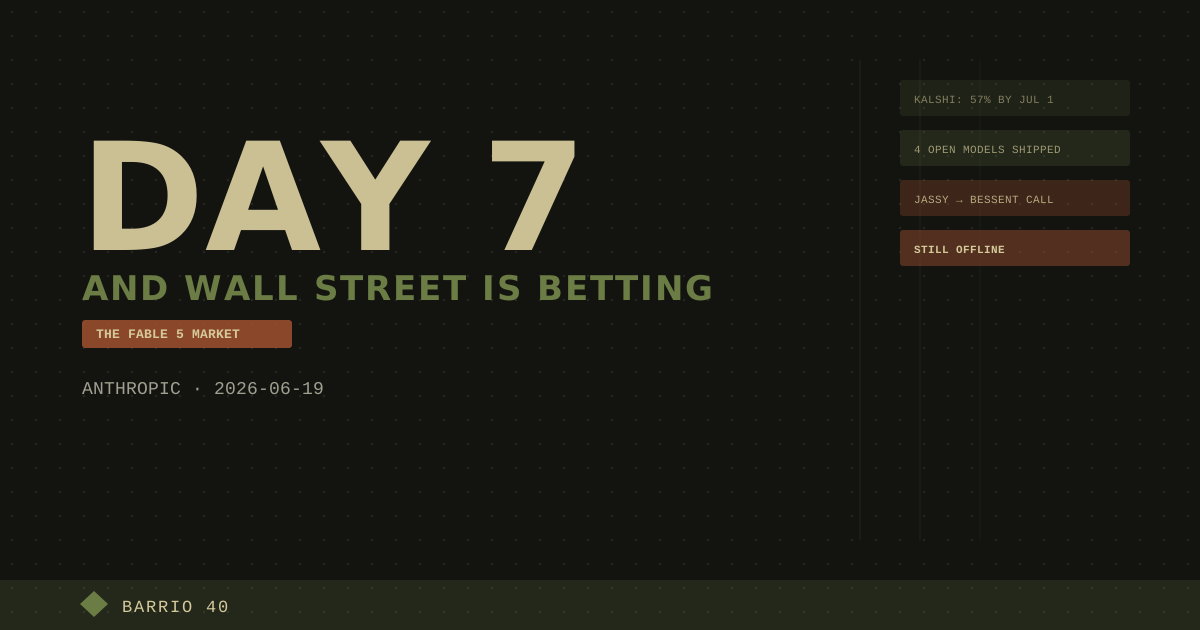
The detail that turns this from a policy story into something closer to a cultural one is what has happened on Kalshi and Polymarket over the past several days. Both platforms now run live markets on when — not whether — Anthropic restores access to Fable 5, and traders are putting real money behind specific dates. Kalshi's market currently prices a 57 percent chance of restoration before July 1, climbing to 67 percent before July 10 and 75 percent before July 17; Polymarket's separately priced contract has traded at a 71 percent chance of restoration by July 1, a meaningful spread between the two platforms that reflects genuine uncertainty rather than a settled consensus. CNBC, which covered the Kalshi market on June 16, framed traders as betting the suspension resolves "quickly" relative to the open-ended uncertainty of the first few days — a bet that, three days later, looks directionally right given Anthropic's shift toward "confident... within days" language, though directionally right is not the same as resolved.
It is worth sitting with what it means that this market exists at all. Prediction markets have, in recent years, become a genuine forecasting tool for elections, central bank decisions, and macro events with large, liquid, attentive trader bases — but a market specifically on the restoration date of two AI models suspended under export control authority is a new category, and its existence is itself evidence of how much commercial and developer attention is riding on the outcome. Every enterprise customer that built a workflow on Fable 5 or Mythos 5 in the brief window between their June 9 launch and the June 12 suspension has a direct financial interest in knowing when — or whether — that capability returns, and a liquid market pricing the answer is a more immediate signal than waiting for the next vague statement from either side. The market's existence does not change the underlying facts of the negotiation. But it does mean that, for the first time, the pace of a federal export-control dispute with an AI company is being continuously priced by people with money on the outcome rather than assessed only by reporters checking in every few days.
THE OPEN-WEIGHT MODELS THAT MOVED INTO THE GAP
While Fable 5 and Mythos 5 have been dark, a cluster of open-weight coding models has given enterprises outside the US — exactly the population the export directive was aimed at restricting — a set of fallback options that did not exist in this form a month ago. None of them were built in response to the ban; the timing is coincidental in a way that says more about the current pace of open-weight releases than about the shutdown itself. North Mini Code shipped three days before Lutnick's directive. Kimi K2.7-Code shipped the same day as the order, June 12. Zhipu opened GLM 5.2 the following day, June 13 — and, in a detail that reads either as a pointed joke or a remarkable coincidence depending on how charitably one reads it, timed the release announcement to 5:21 PM, the same minute the original directive landed on Anthropic's desk the day before.
The competitive significance is straightforward even without reading anything into the timing. For the seven days Fable 5 and Mythos 5 have been suspended, any enterprise team outside the US that needed Mythos-class reasoning for security research, code analysis, or general frontier capability has had real, if imperfect, substitutes to evaluate — and evaluating a substitute under deadline pressure is exactly the kind of switching-cost erosion that frontier model providers spend enormous effort trying to prevent. Every day the suspension continues is a day in which some share of the enterprise pipeline Anthropic was counting on to sustain its IPO-relevant revenue growth gets a longer, more thorough look at a competing model that happens to be available right now. That dynamic does not require any government action to resolve quickly to matter — it compounds on its own timeline, independent of how the Commerce Department dispute eventually settles.
WHAT THIS MEANS FOR TEAMS BUILDING ON FRONTIER APIS
The practical lesson from day one of this saga — build provider redundancy into systems that currently assume single-provider reliability — has only gotten stronger with a week of evidence behind it. Teams that treated the June 12 suspension as a one-off anomaly and did nothing differently in the days since have now gone a full week without their primary model, with no committed restoration date even now, and with a federal government official publicly suggesting the timeline depends on negotiations whose substance is not visible to the customers actually affected. That is not a hypothetical risk anymore; it is a week of accumulated, measurable downtime for a category of capability that did not previously carry this kind of availability risk in most teams' planning.
The newer lesson, specific to this week's developments, is about who else is in your dependency graph beyond the model provider itself. Anthropic's customers did not lose access because of anything Anthropic's infrastructure did wrong — they lost it because of a phone call between Amazon's CEO and the Treasury Secretary, an escalation path that exists entirely outside any SLA, status page, or incident postmortem a customer might think to monitor. A cloud provider that is also an investor in the model provider it hosts is a dependency relationship most architecture diagrams do not represent at all, and this week's reporting is a concrete demonstration of why that omission matters: the conflict of interest sitting inside that relationship had real, multi-day consequences for everyone downstream, regardless of whether Amazon's underlying security finding turns out to have been accurate. Teams evaluating frontier model dependencies now have a second category of risk to model explicitly, alongside the provider's own infrastructure reliability and the government's regulatory posture: the commercial relationships between the provider, its cloud hosts, and its investors, any one of which can apparently become the proximate cause of a global outage with less warning than a routine cloud incident would give.