WHAT HAPPENED AND WHEN
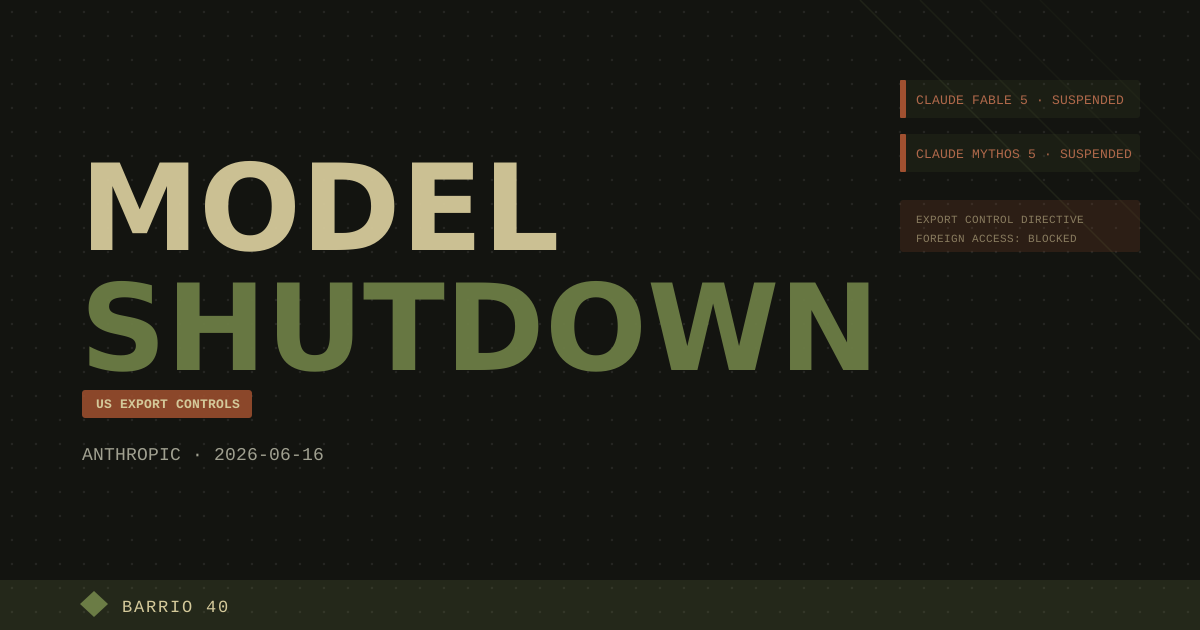
The sequence of events on June 12 was compressed enough that the details still matter. Anthropic received the Commerce Department directive at 5:21 PM Eastern — a Friday evening. The directive invoked export control authorities to require Anthropic to immediately suspend access to Fable 5 and Mythos 5 for any foreign national, a category the directive defined broadly enough to include Anthropic's own employees who are not US citizens or permanent residents. The company was given a ninety-minute compliance window. It had no prior notice of the national security concern that had prompted the directive, no advance communication from the agency, and no opportunity to contest the order before it took effect. By 7 PM, both models had been taken offline globally — a decision that affected every Anthropic customer worldwide, not just the foreign nationals the directive targeted, because the infrastructure to selectively restrict access at the citizenship level did not exist in deployable form within the compliance window.
The global outage was not the government's intended outcome but an operational consequence of the specificity of the restriction combined with the speed of its demand. Anthropic's API does not collect citizenship information from developers and does not route inference through infrastructure segmented by national origin. Restricting access only to foreign nationals within ninety minutes was, in practical terms, technically impossible given the existing architecture — which meant that compliance with the letter of the directive required taking both models down entirely until Anthropic could implement an alternative compliance mechanism. The company disclosed this publicly in a statement released the same evening, alongside its substantive objection to the directive's justification, a combination that produced a document remarkable for a company in its position: a simultaneous declaration of compliance and of disagreement with the legal and technical basis for the order that had just forced it offline.
The trigger, reported by Fortune citing a source familiar with the matter, was a warning from Amazon. Amazon's security research team had identified what it described as a jailbreak technique capable of bypassing a specific cybersecurity guardrail in Mythos 5 — a method that, if exploited, would allow a user to instruct the model to analyse a specific codebase and surface exploitable software vulnerabilities. Amazon escalated the finding to the Commerce Department, which treated it as sufficient grounds for the export-control directive. The existence of a large-scale commercial relationship between Amazon and Anthropic — Amazon Web Services has made multi-billion-dollar equity and infrastructure commitments to Anthropic going back to 2023 — makes the internal dynamics of that escalation decision one of the more consequential unresolved questions of the episode.
ANTHROPIC'S OBJECTION AND WHAT IT ACTUALLY SAYS
Anthropic's public statement on the evening of June 12 is worth reading carefully, because it makes a claim that, if accurate, transforms the episode from an unusual government action into a potentially industry-defining precedent. The company described the jailbreak identified by Amazon as "a potential narrow, non-universal jailbreak" — meaning it does not work reliably across all users, all system configurations, or all query formulations, and that the class of jailbreak technique is not exclusive to Fable 5 or Mythos 5. Anthropic's core argument is that if the Commerce Department's standard for invoking export controls against a deployed AI model is the existence of any non-universal jailbreak capable of eliciting potentially sensitive cybersecurity assistance, then that standard would apply to every frontier AI model currently in commercial deployment — and would "essentially halt all new model deployments for all frontier model providers" if applied uniformly.
That argument is calibrated carefully. Anthropic is not claiming that the jailbreak is harmless or that the government's national security concerns are fabricated. It is claiming that the response — an emergency export-control directive with a ninety-minute compliance window — is disproportionate to the technical reality of the vulnerability and inconsistent with how the government has treated analogous capabilities in other models. The distinction between a narrow, non-universal jailbreak and a structural model vulnerability matters enormously here. A structural vulnerability is one embedded in the model's architecture or training in a way that makes it reliably exploitable by any sufficiently motivated actor. A narrow, non-universal jailbreak is a technique that works in specific contexts, against specific query patterns, and that can in principle be patched through classifier updates or inference-time guardrails without taking the model offline. Anthropic's position is that it was not given the opportunity to deploy a patch before the directive arrived — and that the directive's invocation of export controls rather than a voluntary takedown request suggests a level of governmental urgency that the technical severity of the vulnerability did not warrant.
The company is also making a structural argument about the consequences of the precedent. If the federal government can invoke export controls to immediately suspend a commercially deployed frontier AI model on the basis of a single vulnerability report, without advance notice, without technical review by the developer, and with a compliance window measured in minutes rather than days, then every AI company operating in the United States is operating under a new kind of regulatory risk that has not previously existed. The legal authority under which the directive was issued — export control statutes that were designed to govern the transfer of physical goods and dual-use technologies to foreign adversaries — has never before been applied in this way to a software model deployed through a commercial API. Whether the authority was lawfully applied here is a question Anthropic's legal team is actively examining.
THE BROADER CONFLICT AND WHY THIS MOMENT ARRIVED NOW
The June 12 directive did not arrive in a vacuum. The relationship between Anthropic and the Trump administration has been deteriorating since early 2026 along two distinct fault lines, both of which converge in this episode. The first is Anthropic's refusal to allow its models to be used by the US military for applications the company classifies as incompatible with its Acceptable Use Policy — specifically, domestic surveillance operations and fully autonomous weapons systems that remove human judgment from lethal targeting decisions. That refusal has generated friction with the Pentagon and with White House officials who have argued that frontier AI capability is a national security asset and that the federal government should have preferential access to the most capable domestically produced models. Anthropic has maintained that its usage policies are not subject to government override — a position it has backed with litigation, having filed suit against the administration in connection with a supply chain blacklist placement that it characterises as retaliatory.
The second fault line is Anthropic's public safety posture, which the Trump administration has characterised as commercially self-serving — a way of generating regulatory attention that advantages incumbents over challengers and of wrapping market strategy in the language of public interest. This characterisation is not purely rhetorical. Anthropic has been among the most active participants in Washington AI policy conversations, has testified before Congress about the risks of frontier model deployment without sufficient safety investment, and has structured its public communications around the language of responsible development in ways that, intentionally or not, invite the inference that its competitors are less responsible. The administration's view, broadly, is that Anthropic's safety claims are being used to slow the competitive AI market in ways that benefit the company's existing position — and that the company's willingness to refuse military contracts while lobbying aggressively on AI governance represents a political stance rather than a principled one.
The timing of the directive — arriving two weeks after Anthropic filed a confidential S-1 with the SEC, at a post-money valuation of $965 billion, positioning the company for what analysts describe as the largest technology IPO in recorded history — adds a dimension that neither party has addressed publicly. A forced model suspension in the weeks before a planned public offering is, at minimum, a material event that will need to be disclosed in the registration statement. At maximum, it is a form of leverage — a demonstration that the administration's willingness to invoke emergency authority against Anthropic's most capable models is real and immediate. The administration has not characterised it as leverage. Anthropic has not characterised it as leverage. But the structural reality of the situation is that an ongoing export-control dispute with the US government is a substantially different risk profile for a company approaching public markets than it is for a company raising private capital, and the timing produces a pressure that does not require anyone to acknowledge it in order for it to exist.
THE JUNE 15 MEETING AND WHAT THE LACK OF RESOLUTION MEANS
Senior Anthropic leaders met with Trump administration officials on Sunday, June 15. Both sides confirmed the meeting took place. Neither side confirmed what was discussed. The outcome, reported by multiple outlets, was that no resolution was reached — meaning Fable 5 and Mythos 5 remain suspended for foreign nationals as of this writing, and the dispute over the legal basis and technical justification for the directive is unresolved. The significance of that non-outcome is easy to understate. A Sunday meeting between the leadership of a $965 billion company and White House officials, held three days after an emergency export-control directive that took two AI models offline globally, is not a routine policy conversation. It is a crisis meeting. The fact that it ended without agreement suggests that the distance between the two positions is not primarily technical — it is not a gap that could be closed by Anthropic demonstrating that it has patched the jailbreak and implemented citizenship-verification infrastructure. The disagreement is structural: about what the government is entitled to demand from frontier AI developers, about what export control authority can lawfully cover, and about whether Anthropic's refusal to serve certain military use cases is a position the administration is willing to accept.
The immediate practical question is what comes next for Anthropic's customers. Claude Fable 5 and Mythos 5 are the company's flagship models — the same models that generated the $47 billion annualised revenue run-rate that underpins the IPO valuation. An extended suspension of those models for any class of users, including foreign nationals, creates competitive exposure in enterprise accounts where AI capability is evaluated on a continuous basis and where switching costs, while real, are not prohibitive. Anthropic has been rolling out Fable 5 access to API customers and enterprise accounts since its public release earlier this month, and the enterprise pipeline that the company is counting on to sustain its revenue growth at IPO-relevant scale includes substantial foreign-headquartered customers whose employees are precisely the foreign nationals that the directive covers. How those customers respond to a model availability disruption of uncertain duration is a commercial question that has no good answer while the political dispute remains unresolved.
The broader implication for the AI industry is the one Anthropic raised in its initial statement and that deserves to be taken seriously regardless of how the immediate dispute resolves: the federal government has now demonstrated that it is willing and able to pull a commercially deployed frontier AI model from the market using export control authority, on the basis of a single vulnerability report, with a compliance window measured in minutes. That demonstration changes the operational environment for every AI company deploying frontier models in the United States. The legal question of whether the authority was properly invoked here will eventually be resolved — either through negotiation, through litigation, or through a clarification of the statutory scope. But the factual demonstration that the power exists and can be used is not reversible, even if this particular instance is ultimately found to have exceeded lawful authority. Every frontier AI developer is now operating with knowledge that did not exist before June 12: that an export-control directive can reach a deployed commercial AI model, that the compliance window may be measured in minutes, and that the standard for triggering such a directive has not yet been publicly defined in a way that creates predictable legal exposure rather than open-ended regulatory discretion.
WHAT THIS MEANS FOR TEAMS BUILDING ON FRONTIER APIS
The June 12 suspension is a stress test that the AI industry's reliance on a small number of frontier model providers was always going to face eventually — the specific form it took was not predictable, but the underlying risk it revealed was. For teams that have built production systems on Claude Fable 5 or Mythos 5, the seventy-two-hour outage generated an operational disruption that most had not modelled in their contingency planning. Model availability has historically been treated as a reliability and uptime question — a function of server capacity, regional failover, and incident response. The June 12 episode introduces a new category: policy-driven model suspension, where availability depends not on infrastructure health but on the state of a political dispute between a model provider and the federal government, with zero advance notice and no customer-facing mitigation window.
The practical response for engineering teams is not to abandon frontier API-based architectures — the capability advantages of models at Fable 5's level are too substantial for that to be a defensible decision in most application domains. It is to model availability risk more honestly, which means building provider redundancy into systems that currently assume single-provider reliability, and being explicit in internal planning about the scenarios under which the primary model could become unavailable for reasons outside the provider's control. Multi-provider API architecture — routing capability to the best available model rather than assuming the preferred model is always reachable — was already best practice for performance and cost reasons. It is now also best practice for geopolitical risk reasons, in a way that most teams had not previously needed to operationalise.
The deeper strategic question is one that Anthropic's statement raises without answering: if the standard for government intervention in model availability is the existence of a jailbreak capable of eliciting cybersecurity-relevant outputs, then that standard is going to be met by every frontier model currently in commercial deployment. The models that can reason about code at the level that makes them valuable for software development are the same models that can, under adversarial prompting, reason about code in ways that security researchers and national security officials find concerning. The capability is not separable from the risk in the way that the regulatory response implies — which means that either the standard needs to be refined considerably before it is applied again, or the AI industry is facing a period in which the government's willingness to suspend models on short notice is a recurring operational reality rather than a one-time anomaly. As of June 16, nobody involved has offered a public account of what a stable long-term equilibrium looks like — and the Sunday meeting suggests that one is not imminent.