WHAT ANTHROPIC SHIPPED AND WHY IT IS DIFFERENT FROM ANY PREVIOUS CLAUDE RELEASE
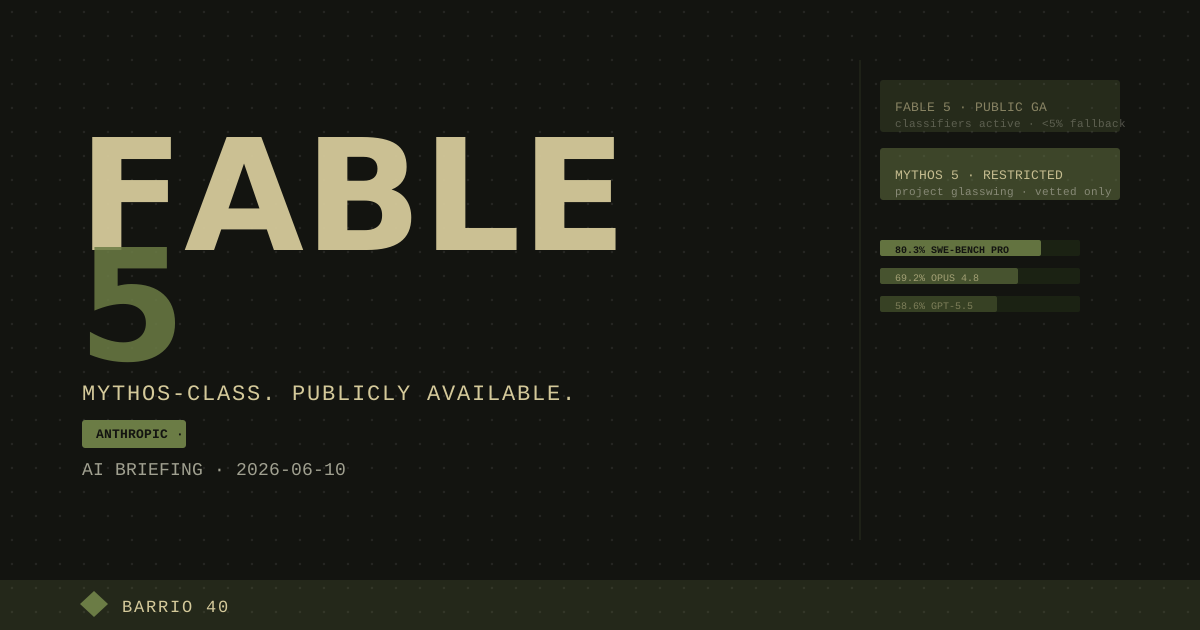
Every major Claude release since Claude 2 has followed the same structural pattern: a single model, generally available via API and consumer products, with capability improvements described in a system card and safety mitigations applied at the inference layer through RLHF and constitutional AI training methods. Claude Fable 5 breaks that pattern in a way that is architecturally novel and commercially significant. The model that powers Fable 5 is identical to the model that powers Mythos 5 — the same weights, the same architecture, the same training run — but it ships with a classification layer that intercepts queries in defined high-risk domains, evaluates them against a risk model, and routes the triggering queries to Claude Opus 4.8 rather than allowing the Fable 5 / Mythos 5 weights to respond. The classifier triggers in fewer than 5% of sessions, covering cybersecurity offensive capability development, biology and chemistry synthesis assistance, and what Anthropic describes as "distillation" — attempts to use the model's outputs to train or replicate a competing model at Mythos-class capability. In every other context, Fable 5 responds at full Mythos-level capability, giving the API a performance profile that exceeds any publicly available model Anthropic has previously shipped.
The naming convention is more significant than it appears. Previous Anthropic model naming — Instant, Claude 1, 2, 3 Haiku / Sonnet / Opus — communicated capability tier within a single release family. The Fable 5 / Mythos 5 split communicates something different: that the same capability can be appropriate for general deployment and simultaneously inappropriate for general deployment depending on the governance context in which it is accessed. Fable 5 is not a reduced-capability version of Mythos 5; it is Mythos 5 with a gating mechanism applied to a specific subset of its potential use cases. The commercial implication is that developers building on Fable 5 receive the full benefit of the Mythos architecture for the overwhelming majority of their applications — coding agents, knowledge work, reasoning tasks, long-context analysis — while Anthropic retains control over the narrower set of capabilities that create the most acute dual-use risk. Whether that control is technically durable is a question the security community will spend considerable energy investigating, but as a product design philosophy, the split is a more principled approach to dual-use governance than either a full capability hold or an unrestricted general release.
The timing of the release relative to Anthropic's pending IPO creates a commercial context that it would be naive to ignore. Fable 5 arrives eight days after Anthropic's confidential S-1 filing with the Securities and Exchange Commission at a $965 billion post-money valuation, and it does so at a moment when the company needs to demonstrate to public-market investors that it can maintain its position as the frontier performance leader while simultaneously sustaining the safety-mission narrative that has been the central pillar of its commercial identity since its founding. A model that leads every major coding and knowledge benchmark while shipping with a novel safety-classifier governance architecture is precisely the product release that an IPO roadshow requires — and the fact that it is also, from all available evidence, a genuinely significant technical advancement rather than a narrative-driven release makes the alignment between commercial necessity and research output unusually clean. Dario Amodei's statement accompanying the release, describing Fable 5 as "safe for general use in a way that earlier Mythos-tier capability was not," is a formulation that will appear in S-1 marketing materials and analyst coverage alike, and it will be evaluated with proportionate scrutiny by both audiences.
THE TWO-TIER ARCHITECTURE: WHY FABLE 5 AND MYTHOS 5 ARE THE SAME MODEL AND NOT THE SAME PRODUCT
The Project Glasswing access programme through which Mythos 5 is available is not a standard enterprise API tier — it is a vetting and authorisation process that Anthropic describes as targeting "cyberdefenders and critical-infrastructure providers" who require access to the full, unclassified Mythos capability set to do work that is itself defensive in character. The explicit examples Anthropic has cited include penetration testing organisations with documented client authorisation, national-security research programmes with appropriate government oversight, and infrastructure security teams at operators of critical systems who need to simulate offensive capability to validate their defences. The vetting criteria for Project Glasswing have not been published in full, but Anthropic's framing is consistent with the model used by Palantir, CrowdStrike, and other companies that provide capabilities with significant dual-use potential to government and security clients under terms that would be inappropriate for general API access.
The architecture of the classifier layer is the most technically interesting aspect of the release from a security perspective. Anthropic has been explicit that the Fable 5 classifier is a separate model — not a fine-tuned variant of Fable 5 itself, but a purpose-built classification system trained specifically to detect query intent in the high-risk categories the classifier covers. This design choice is significant because it creates a separation between the capability being governed and the governance mechanism itself: an adversarial prompt that might elicit unsafe outputs by manipulating the primary model's instruction-following behaviour cannot simultaneously manipulate the classifier, which operates on different weights with a different objective function. How robust the classifier is in practice against sophisticated adversarial prompting — particularly in cybersecurity contexts where prompt injection is both a relevant attack vector and a topic the classifier is specifically trained to detect — is a question that responsible-disclosure researchers will begin probing immediately. Anthropic's acknowledgment that the classifier has been "tuned conservatively," producing some false positives in legitimate security research contexts, suggests the company has calibrated for minimising unsafe outputs over minimising false positives — a design choice that will frustrate some professional users while reducing the surface area for misuse.
The commercial structure of the two-tier release also has implications for how enterprise customers will approach their API strategy. A team currently building on Claude Opus 4.8 that migrates to Fable 5 receives a substantial capability upgrade — 80.3% versus 69.2% on SWE-Bench Pro, 29.3% versus 13.4% on FrontierCode Diamond — at the same price structure their existing contracts describe, since Fable 5 is included on Pro, Max, Team, and Enterprise plans at no extra cost through June 22 and is priced identically to Opus 4.8 thereafter. The upgrade path is designed to be frictionless in the sense that no application code changes are required to access Fable 5 capability — teams that have built on the Claude API will receive Fable 5 performance simply by updating their model parameter. Whether the classifier creates workflow disruptions for teams operating in cybersecurity or research chemistry — the two professional domains where the 5% false-positive rate is most likely to surface — is the practical friction point the release introduces, and it is one that Anthropic has pre-emptively addressed by confirming that Project Glasswing applications are open to organisations that can document a legitimate professional need for the full Mythos capability set.
THE BENCHMARK CASE: WHAT 80.3% ON SWE-BENCH PRO ACTUALLY MEANS FOR PRODUCTION DEPLOYMENT
SWE-Bench Pro is the hardest standardised evaluation available for AI coding performance — a dataset of issues drawn from actively maintained open-source repositories with multi-file diffs, no public ground-truth leakage, and problem complexity that requires the model to navigate existing codebases rather than generate code from a clean slate. The previous frontier on SWE-Bench Pro was Opus 4.8 at 69.2%, itself a substantial advance over Opus 4.7's 64.3%. Fable 5 at 80.3% represents a jump that is larger in absolute terms than the entire improvement from Opus 4.7 to Opus 4.8, and it arrives at a moment when the agentic coding market — Claude Code, GitHub Copilot Workspaces, Cursor, Devin, and the broader category of AI software development tools — has settled on SWE-Bench Pro as the primary performance reference for enterprise buyers evaluating whether to commit to a specific model for production agent workflows. The benchmark number is, for that audience, not a research result but a procurement signal: an 80.3% score is the difference between a tool that handles most of a codebase migration autonomously and a tool that handles most of it with regular human supervision.
The FrontierCode Diamond result is the data point that most clearly illustrates how far Fable 5 represents a departure from the prior generation of Claude models. FrontierCode Diamond is a proprietary evaluation maintained by a consortium of software engineering research groups specifically designed to test performance on the problems that resist benchmark saturation — tasks involving novel algorithm design, cross-language refactoring with non-trivial semantic preservation requirements, and debugging scenarios that require simultaneous reasoning about system architecture and low-level implementation detail. Fable 5 scores 29.3% on FrontierCode Diamond; Opus 4.8 scores 13.4%. The ratio — Fable 5 solves more than twice as many of the hardest benchmark problems — is a more meaningful indicator of frontier capability improvement than the SWE-Bench Pro gap, because the Diamond problems are specifically constructed to be resistant to the pattern-matching and retrieval strategies that allow less capable models to perform well on standard benchmarks. A model that more than doubles performance on problems designed to resist its predecessors is exhibiting a qualitatively different type of capability improvement, not merely an incremental refinement of the same underlying approach.
The knowledge work and tool-use results add important texture to the coding-benchmark story. Anthropic's system card reports leading scores across legal reasoning, health information synthesis, spatial and diagrammatic reasoning, and multi-step tool-use evaluation — all evaluated using the same comparison set that has benchmarked every major Claude release since Opus 4. The consistent shape of the results across diverse task categories suggests that the Mythos architecture improvement is not domain-specific but reflects a general advance in the model's ability to reason through complex, multi-step problems regardless of the domain in which those problems are posed. For the development teams building production applications on Claude — the majority of which are not pure coding tools but mixed reasoning-and-action systems that combine language understanding, tool calls, memory management, and long-context synthesis — the across-the-board improvement profile is more commercially relevant than the SWE-Bench headline, because it means that an application ported to Fable 5 benefits from the capability upgrade regardless of which capability dimension is the primary bottleneck in the current implementation.
WHAT CLAUDE FABLE 5 MEANS FOR DEVELOPERS, ENTERPRISES, AND THE COMPETITIVE LANDSCAPE
For the developer community building on Claude's API, the Fable 5 release is the clearest signal since Claude 3 Opus that Anthropic intends to maintain a meaningful performance lead over its closest US competitor, OpenAI, at the frontier of agentic and long-context capability. GPT-5.5, OpenAI's current production frontier model, scores 58.6% on SWE-Bench Pro — 21.7 percentage points behind Fable 5. That gap, measured on the benchmark that most directly predicts performance on the agentic coding workflows where Claude has historically held its strongest commercial position, is wide enough to make the model choice a substantive rather than marginal product decision for teams whose applications are primarily coding-agent or code-analysis tasks. The competitive pressure that has driven the Claude / OpenAI / Gemini benchmark race for two years has historically narrowed gaps within months of any major release; whether OpenAI's next update to GPT-5.5 or an anticipated GPT-6 preview can close a 21.7-point SWE-Bench gap more quickly than prior benchmark cycles have suggested is the key variable for developers deciding whether to build on Fable 5 as a multi-year platform commitment or as a near-term performance advantage with uncertain shelf life.
For enterprise customers whose AI deployments involve regulated industries — legal, healthcare, financial services, government — the Fable 5 release arrives in a governance context that makes the safety-classifier architecture more commercially relevant than it might otherwise be. The Great American AI Act discussion draft released on June 4 imposes mandatory incident reporting and risk framework requirements on frontier AI developers, but it does not specify how those developers should govern dual-use capability at the model level — that design space remains open, and the Fable 5 / Mythos 5 split is Anthropic's opening bid for what responsible frontier governance looks like in practice. Enterprise legal teams evaluating AI vendor risk — a category of evaluation that has grown substantially since the EU AI Act entered its enforcement phase and since the first documented cases of AI-enabled autonomous cyberattacks emerged in early 2026 — will find in Fable 5's classifier architecture a more legible safety story than any previous frontier model release has offered. Whether that legibility translates into procurement preference is a customer-specific question, but in regulated industries where vendor risk documentation is a compliance requirement rather than an optional consideration, a model that ships with a published, independently verifiable safety governance layer has a structural advantage over one that relies solely on post-deployment content policy.
The competitive dynamics at the open-weights frontier add a dimension to the Fable 5 release that Anthropic's own framing underplays. Nvidia's Nemotron 3 Ultra, released five days earlier on June 4, scores 48 on the Artificial Analysis Intelligence Index and represents the strongest US open-weights model currently available — but its SWE-Bench Pro performance has not been published at the time of writing, and on the FrontierCode Diamond evaluation, the available data places it substantially below Fable 5's 29.3%. Alibaba's Qwen 3.7 Max and DeepSeek-V4-Pro Max, the most capable Chinese frontier models, have been competing with Claude Opus 4.8 on a price-performance basis that challenged the case for US-origin proprietary models; Fable 5's benchmark profile creates a new capability tier that neither the current Chinese open-weights releases nor the strongest commercial alternatives from OpenAI and Google have reached. How durable that advantage is — and whether the IPO-timeline pressure that accompanied Fable 5's release creates structural incentives for Anthropic to maintain the research investment that produced the Mythos architecture — is the central question for any developer or enterprise buyer deciding how deeply to integrate Fable 5 into production infrastructure. The answer will emerge not from the June 9 release announcement but from what Anthropic ships in the six months between now and the October IPO date, and from whether the public benefit corporation structure that the S-1 will describe is a governance innovation with real teeth or a narrative instrument that capital markets pressure will eventually reshape.