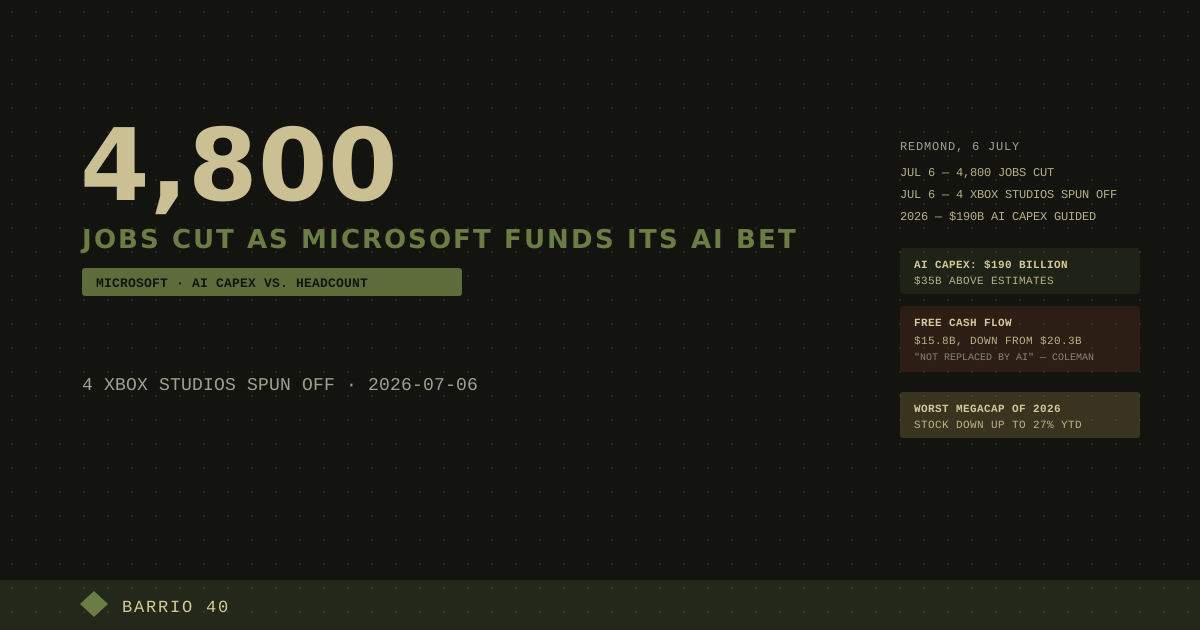
THE CUTS: 4,800 JOBS, AND TWO-THIRDS OF THEM IN ONE DIVISION
Microsoft's announcement on July 6 was framed, at the corporate level, as a routine reset: 4,800 positions eliminated, 2.1% of a workforce that spans well over 200,000 people worldwide. What the topline number obscures is how unevenly it lands. Roughly 3,200 of the 4,800 roles — close to two-thirds — are inside Xbox, which by itself amounts to about a fifth of that division's entire staff. Roughly half of the affected Xbox employees are leaving immediately; the remaining 1,600 or so will exit on a phased timeline that runs through the end of fiscal year 2027, the kind of drawn-out schedule companies use when the cuts touch product lines, studios, and contractual obligations too entangled to unwind overnight. This is not Microsoft's first 2026 round — it follows earlier reductions across the year — but it is by a wide margin the one most concentrated in a single, recognizable consumer brand, which is part of why it read differently than a line item in an earnings call.
THE XBOX UNWIND: SELLING WHAT $69 BILLION BOUGHT
The studio spin-offs are the part of Monday's announcement that will outlast the headcount number in people's memory, because they reverse — in miniature — a strategy Microsoft spent the better part of a decade and roughly $69 billion executing. Compulsion Games, Double Fine Productions, Ninja Theory, and Undead Labs will become independent companies rather than remain inside Xbox Game Studios; Arkane Studios, the French developer behind the Dishonored and Deathloop series, is still negotiating its status with its works council, a legal step required in France before a restructuring of this kind can proceed. These are not the studios behind Xbox's biggest franchises — Halo, Call of Duty, and Elder Scrolls stay put — but they are studios Microsoft spent real acquisition capital and years of integration effort absorbing, precisely the kind of asset a company keeps unless something else is pulling harder on the balance sheet. Sharma's framing to staff was explicit about what that something else looks like from the inside: gaming margins running "3-10x lower than comparable platform and publishing businesses," inside a company now allocating capital toward a very different kind of platform bet.
THE CAPEX MATH THAT MAKES THIS MORE THAN A GAMING STORY
Set against Microsoft's 2026 numbers, the Xbox retrenchment looks less like a gaming-specific problem and more like one visible edge of a company-wide reallocation. Microsoft has guided to approximately $190 billion in capital expenditure for 2026 — about $35 billion above the roughly $155 billion Wall Street had modeled, and a 61% jump year over year — almost entirely AI-infrastructure spending: data centers, custom silicon, networking, and the power contracts to run them. That spending is landing directly on the cash-flow line despite a headline-strong income statement: free cash flow fell to $15.8 billion from $20.3 billion a year earlier, even as reported net income for the quarter came in at $31.8 billion. Wall Street's read on that gap has been unforgiving. Microsoft has been 2026's worst-performing megacap tech stock, down somewhere between 19% and 27% year-to-date depending on the measurement window, including its worst June since 2000 — a decline that, by one estimate, erased somewhere in the neighborhood of $530-570 billion in market value. Azure's growth rate is decelerating at the same time AI revenue is compounding: Microsoft has guided cloud growth down to 37-38% for the coming quarter, from 39-40% in recent quarters, even as its annualized AI revenue reportedly reached $37 billion, up 123% year over year. Satya Nadella's own framing of the trade-off, offered on a recent earnings call, is about as candid as CEO language gets: "Every dollar of capex we're putting in has line of sight to a multi-decade platform shift. The next $100 billion in cloud revenue will be AI-first, and AI infrastructure is the new moat" — paired with an acknowledgment that "the focus needs to be on doing that and landing this CapEx as quickly as we can, and converting it to revenue as quickly as we can." Investors, reading a widening gap between capex and free cash flow, have been asking exactly when that conversion happens; Monday's Xbox restructuring is one visible answer.
"NOT BEING REPLACED BY AI": A CAREFULLY WORDED DENIAL
Amy Coleman's line to staff — "I also want to be direct that the roles eliminated today are not being replaced by AI" — is worth reading closely rather than taking at face value, because of what it does and doesn't rule out. It denies that AI systems are literally doing the work these 4,800 people used to do. It says nothing about whether the capital that would otherwise have funded those roles is instead funding AI infrastructure, which is the claim the numbers above actually support: a company spending a record $190 billion on AI data centers and chips, watching free cash flow shrink under that load, and simultaneously divesting studios and headcount in an adjacent, lower-margin business. Coleman's fuller comments — that AI "is changing how work gets done" and that employees need to keep building new skills — track almost exactly the language Microsoft has used in prior 2026 rounds, and it's a formulation other companies have converged on too: distinguish "AI replaced this job" (rare, and legally and reputationally risky to admit) from "AI is why we're spending differently" (nearly universal, and much harder for any single employee to dispute). Whether that's precise accounting or careful public relations is, in practice, unanswerable from outside the building — but the distinction is doing real work in how the story gets told.
THE WIDER 2026 PATTERN: A YEAR OF AI-CITED CUTS BEFORE JULY EVEN ENDS
Microsoft's announcement is the largest and most closely documented entry in a pattern that has been building all year. Layoffs.fyi's running tracker counted 267 layoff events in 2026 through July 6, affecting 185,894 workers — a pace of roughly 994 job losses a day — and found that 56% of those events, 150 companies accounting for 156,270 of the affected workers, cited AI, automation, or machine learning explicitly. Through May alone, AI was named in 87,714 announced job cuts, about 22% of all layoffs so far this year and already ahead of the full-year 2025 total. Microsoft's cuts sit alongside a list of comparable 2026 reductions: Oracle cut 21,000 positions, 13% of its staff, over the trailing twelve months; Meta cut 8,000 roles, 10% of its workforce, effective May 20; Amazon cut roughly 16,000 corporate positions in the first quarter alone — more than half of all tech-sector layoffs that quarter — even as AWS revenue kept growing 24%; Salesforce cut 4,000 roles citing AI "efficiencies"; GitLab cut about 350 positions, 14% of its staff, explicitly to redirect spending toward AI infrastructure; and Coinbase cut roughly 700 roles, also 14% of its workforce. The throughline across nearly all of them is the same one visible in Microsoft's numbers: capital that used to fund headcount in one part of the business is being redirected toward AI infrastructure and AI-adjacent priorities in another, whether or not any individual company is willing to say so as plainly as its balance sheet implies.
THE SKEPTICAL READ: HOW MUCH OF THIS IS ACTUALLY ABOUT AI
Not every observer accepts the AI-capex explanation at face value, and the skepticism deserves a place in this story rather than a footnote. Labor economists and reporters covering the 2026 layoff wave have raised the possibility of "AI-washing" — companies attaching the AI label to workforce reductions that are, in reality, driven by more familiar pressures: post-pandemic headcount overhang, margin compression in specific business lines, or simply the easier optics of blaming a technology trend rather than ordinary cost discipline. Coleman's own carefully split formulation — the roles aren't "being replaced by AI," but AI is "changing how work gets done" — is itself a data point for that argument: a company threading language precisely enough to invoke AI's shadow over a decision without claiming AI caused it directly is doing exactly what a skeptic would expect if the honest answer were more mundane than the framing suggests. The two explanations aren't mutually exclusive, either — a company can be genuinely reallocating capital toward AI infrastructure and also using "AI transformation" as convenient cover for cuts it would have made anyway. What's harder to dispute is the capital allocation itself: $190 billion is going somewhere, free cash flow is visibly absorbing the cost, and Monday's Xbox restructuring is the clearest single data point yet of a hyperscaler unwinding a non-AI bet to keep funding an AI one.
WHAT THIS SIGNALS FOR TEAMS BUILDING ON THESE MODELS
For any team building products on top of Microsoft's AI stack — Copilot, Azure AI Foundry, the MAI models this site covered out of Build in June — Monday's news is a useful data point about the parent company's priorities, independent of what it means for the 4,800 people affected. A hyperscaler willing to divest studios it spent a decade and $69 billion assembling, in order to keep a $190 billion AI infrastructure commitment on schedule, is a hyperscaler unlikely to slow that commitment for anything short of a genuine capital crisis — which is reassuring if your roadmap depends on Azure's AI capacity being there next year, and worth watching closely if you're pricing in continued Azure growth deceleration as the trade-off for it. The more uncomfortable read, for the industry more broadly, is that 2026 has now produced its clearest example of the AI capex supercycle directly displacing jobs in an adjacent, unrelated business line, with the company's own head of HR going on record specifically to manage how that displacement gets described. Whatever the honest split between "AI reallocation" and "AI-washing" turns out to be, the number of companies now reaching for that same careful language — Microsoft this week, GitLab and Salesforce before it — suggests it's becoming the standard script for a decision every capital-intensive AI bettor in the industry is being forced to make.