THE REPORT THAT SET THE AGENDA: "WE CAN NO LONGER SAY WE DID NOT KNOW"
The Independent International Scientific Panel on AI is a deliberately IPCC-shaped institution: a body of independent experts, not government representatives, tasked with synthesizing the state of AI research into an evidence-based assessment that policymakers can act on rather than relitigate from scratch. The UN General Assembly formally established it on August 26, 2025, under resolution A/RES/79/325, fulfilling a commitment member states made in the Global Digital Compact a year earlier. Its 40 members — selected for expertise, disciplinary range, and geographic and gender balance, with explicit attention to representation from developing countries — were appointed on February 12, 2026, and elected Bengio and Ressa as co-chairs at their inaugural meeting on March 3, serving in their individual expert capacity rather than as delegates of any government or company. The panel's mandate requires it to present its annual assessment at each session of the Global Dialogue on AI Governance, which is exactly why its first report landed on July 1, five days before Geneva opened rather than at some unrelated point on the calendar.
What the report actually said is harder to spin as routine caution. The panel concluded that AI carries substantial potential benefits for economies and societies, but paired that with a specific, uncomfortable finding: that current science cannot guarantee AI capabilities will keep advancing without causing catastrophic harm, whether "on its own or due to malicious users," in Bengio's own phrasing, and cited growing evidence of deceptive behavior in frontier models as part of the basis for that conclusion. Guterres' framing at the launch — "the world cannot govern what it cannot understand," and "the potential is great, but the risks are real, and the cost of waiting is rising" — was written to be quoted at Geneva, and it was. The report's non-prescriptive mandate means it stops short of recommending specific rules; its job was to make the case that inaction has a cost governments can no longer claim ignorance of, and hand that case to the diplomats meeting six days later.
TWO DAYS, PALEXPO, AND (ALMOST) EVERY GOVERNMENT ON EARTH
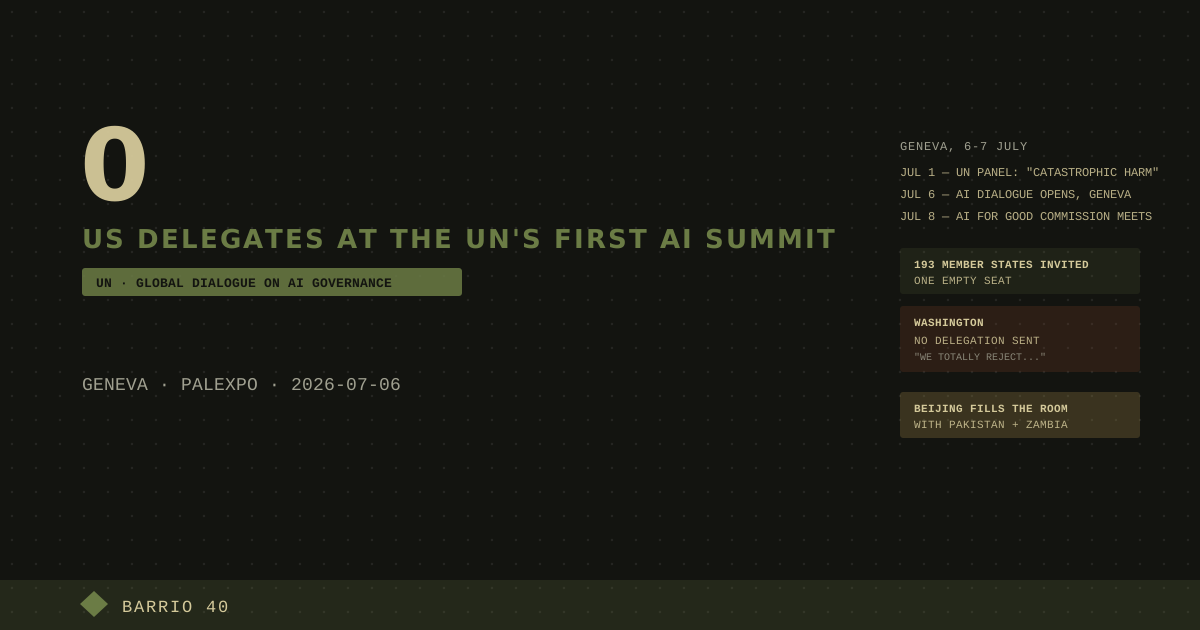
The Dialogue itself is a two-day session, July 6 and 7, co-chaired at the state level by El Salvador's Egriselda López and Estonia's Rein Tammsaar, and structured around a high-level segment plus thematic tracks covering AI's societal and economic dimensions, bridging the access and capacity-building gap between wealthy and developing nations, and building "safe, secure and trustworthy" AI through interoperable rather than fragmented national approaches. It does not stand alone: Geneva this week is simultaneously hosting the WSIS Forum 2026 (running July 6 through 10) and the ITU's AI for Good Global Summit (July 7 through 10), with the newly formed AI for Good Global Commission holding its first meeting on July 8 — a genuine convergence, by design, meant to put government delegations, standards bodies, civil society, and industry inside the same convention center for the better part of a week rather than scattering the same conversation across separate events on separate continents. The billing is the world's first UN-convened venue where all 193 member states are, in principle, invited to negotiate AI governance as equals; whether that principle held on day one is the more interesting story.
WASHINGTON, IN ITS OWN WORDS
It didn't, at least not for the country that builds most of the frontier models this site covers week to week. The US sent no delegation to the Dialogue's launch, and the position isn't new or improvised — it's the position Kratsios stated on the record at the Security Council's open debate on AI last September, when he argued that "broad overregulation incentivizes centralization, stifles innovation, and increases the danger that these tools will be used for tyranny and conquest," on top of the flatter rejection of "centralized control and global governance of AI" quoted above. What makes the absence notable rather than merely consistent is how far it is from where Washington stood a few years earlier: the US had endorsed the OECD AI Principles, helped found the Global Partnership on AI, and signed both the Bletchley Declaration and a UN General Assembly resolution on AI — a track record of engagement with exactly the kind of multilateral process it now treats as illegitimate on its face. Read against everything this site has tracked over the past two weeks — GPT-5.6 gated to roughly 20 partners at the administration's request on June 30, the unsealed Pentagon emails that blacklisted Anthropic over an autonomous-weapons redline, OpenAI's $42.6 billion equity offer to the Treasury on July 2 — the throughline holds: this White House wants maximal say over how frontier AI gets built and deployed inside the United States, and treats any shared claim on that authority, foreign or international, as the thing worth rejecting outright.
BEIJING FILLS THE ROOM
China's posture is the mirror image, and it showed up in Geneva as more than a talking point: Beijing co-convened a high-level side dialogue with Pakistan and Zambia that drew more than 150 participants, explicitly pitched around the argument that AI governance shouldn't become, in its own framing, "a game of the club of wealthy nations" — a direct appeal to the developing-world delegations that make up the bulk of the Dialogue's 193 invited seats. CSIS's read on the summit is that the forum is less a technical standards exercise than a venue where global power is being renegotiated in real time, and China's calculation is straightforward: a US that opts out of UN-anchored AI governance hands Beijing a low-cost way to cultivate exactly the soft power and Global South alignment that a decade of chip export controls has been trying to deny it. That's not a hypothetical rivalry playing out only in Geneva's conference rooms, either — it's the same contest this site covered on July 1, when Meituan open-sourced LongCat-2.0, a 1.6-trillion-parameter model trained end-to-end on domestic Chinese ASICs with no Nvidia silicon anywhere in the pipeline. The chip controls were built to slow China's frontier models; the country showing up to help write the rules for how everyone's frontier models get governed globally is a second front in the same competition, running on a completely different battlefield.
THE COMPANIES SHOW UP ANYWAY
The oddest wrinkle in Monday's proceedings is that American industry didn't follow the American government's lead. Microsoft President Brad Smith attended and pushed the argument this site has heard from Microsoft before — that closing the capacity gap between wealthy and developing nations depends on private infrastructure investment more than treaty text. Meta also sent representatives, arguing for public-private collaboration on governance while explicitly signaling alignment with the White House's AI Action Plan and encouraging other countries to adopt its approach. The result is a genuinely unusual split from the pattern this site has tracked all month, where government and industry have mostly moved in lockstep or in open conflict — Anthropic litigating against the Pentagon in court, OpenAI negotiating an equity stake directly with the Treasury Secretary. In Geneva, two of the US's largest AI companies effectively occupied the chair their own government left empty, making an American case in an American accent without any American diplomat in the room to back it with actual negotiating authority.
WHAT THIS SIGNALS FOR TEAMS BUILDING ON THESE MODELS
Nothing binding comes out of a two-day dialogue whose founding mandate is explicitly non-prescriptive, and nobody in Geneva expects a treaty by Tuesday. But the direction of travel is the part worth tracking, and it runs opposite to the story this site has spent the past two weeks on. Every lever this site has covered through late June and into July — GPT-5.6's gated release, the Fable 5 export shutdown, the Pentagon's blacklisting of Anthropic, OpenAI's equity offer — has run through Washington's judgment, because Washington has insisted on being the chokepoint. Geneva is the first sign this year that a second rulebook is being written somewhere the US has chosen not to sit: one shaped instead by the EU's existing AI Act, by China's Global South courtship, and by whatever emerges from a UN process that 193 governments were invited to help write. For any team shipping AI products into markets outside the United States, that's a second compliance surface worth watching independently of what happens in Washington — because for the first time in this site's coverage, the country building most of the frontier models isn't the one holding the pen.